
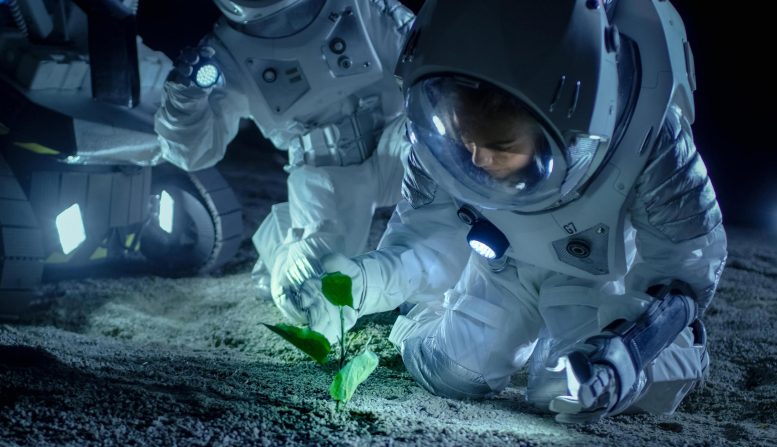
During the 54th Lunar and Planetary Science Conference, an abstract was presented by researchers from the University of Alberta proposing that rice modified genetically could grow in the Martian regolith.
The Martian, the bestselling book by Andy Weir published in 2011, revolves around the story of botanist Mark Watney who is stranded on Mars and tries to cultivate food. While Watney focused on planting potatoes, recent findings presented at the 54th Lunar and Planetary Science Conference by a team of interdisciplinary researchers from the University of Arizona indicate that rice could be a more viable option for future Martian farmers like Watney.
According to the team’s abstract, Rice Can Grow and Survive in Martian Regolith with Challenges That Could be Overcome Through Control of Stress-Related Genes, the main hindrance in cultivating food on Mars is the existence of perchlorate salts, which have been detected in the Martian soil and are known to be poisonous for plants.
The team was able to simulate Martian soil using basaltic-rich soil mined from the Mojave Desert, called the Mojave Mars Simulant, or MMS, which was developed by scientists from NASA and the Jet Propulsion Laboratory.

The teams then grew three varieties of rice, including one wild-type and two gene-edited lines with genetic mutations that better enable them to respond to stress, such as drought, sugar starvation, or salinity. These varieties were grown in the MMS, as well as a regular potted mix and a hybrid of the two. While plants were able to grow in the Martian simulant, they were not as developed as those grown in the potting soil and hybrid mix. Replacing just a quarter of the Martian simulant with potting soil resulted in improved development.
Perchlorate Thresholds and Growth Viability
The team also experimented with the amount of perchlorate in the soil, finding that 3 grams per kilogram was the threshold beyond which nothing would grow, while mutant strains could still root in 1 gram per kilogram.
Their findings suggest that there might be a way forward for genetically modified rice to find purchase in Martian soil.
The next steps will include experimenting with a newer Martian soil simulant called the Mars Global Simulant, as well as other rice strains that have increased tolerance for higher salt concentrations. An important part of the research will be determining to what degree perchlorate may be leeching into the plant from the soil. Farther down the road, the researchers would like to introduce rice into a closed habitat chamber and place it in a Mars simulation chamber that replicates the temperature and atmosphere of the planet.
Whether humans ever colonize Mars, the team’s research could have applications here on Earth. Second author on the abstract, Abhilash Ramachandran, a post-doctoral fellow at the Arkansas Center for Space and Planetary Sciences, noted that he spoke with an Australian researcher from an area where the soil had high salinity, and saw their work as a potential way to grow food there. He added, “We could use Earth as a terrestrial analog before the seeds ever get sent to Mars.”
First author on the abstract, Peter James Gann, a doctoral student in cell and molecular biology, said that the project began when he met Ramachandran for coffee in the student union. “He was new here at the university, and we shared the things we were doing in our respective laboratories. Since he works on planetary science, and I specialize in cell and molecular biology, we decided to try out plants.”
They were joined by co-authors Yheni Dwiningsih, a post-doctoral associate in plant sciences; Dominic Dharwadker, an undergraduate student in the Honors College; and Vibha Srivastava, a professor in the Department of Crop, Soil, and Environmental Sciences who has a joint appointment with the U of A System Division of Agriculture.
Gann, for one, is pleased with how his initial conversation with Ramachandran has turned out. “Relevant and interesting research can emanate from talking to strangers over a cup of coffee or a glass of beer,” he said, before adding: “Ain’t that cool?”
Meeting: 54th Lunar and Planetary Science Conference: Rice Can Grow and Survive in Martian Regolith with Challenges That Could be Overcome Through Control of Stress-Related Genes
Never miss a breakthrough: Join the SciTechDaily newsletter.
Follow us on Google and Google News.