
Close Menu
    Facebook X (Twitter) Instagram
    SciTechDaily
    • Biology
    • Chemistry
    • Earth
    • Health
    • Physics
    • Science
    • Space
    • Technology
    Facebook X (Twitter) Pinterest YouTube RSS
    SciTechDaily
    Home»Science»A “Greener” Way To Clean Wastewater Treatment Filters With Reusable Nanoparticle Catalysts
    Science

    A “Greener” Way To Clean Wastewater Treatment Filters With Reusable Nanoparticle Catalysts

    By American Chemical SocietyMarch 2, 2022No Comments3 Mins Read
    Facebook Twitter Pinterest Telegram LinkedIn WhatsApp Email Reddit
    Share
    Facebook Twitter LinkedIn Pinterest Telegram Email Reddit
    Greener Way To Clean Wastewater Treatment Filters
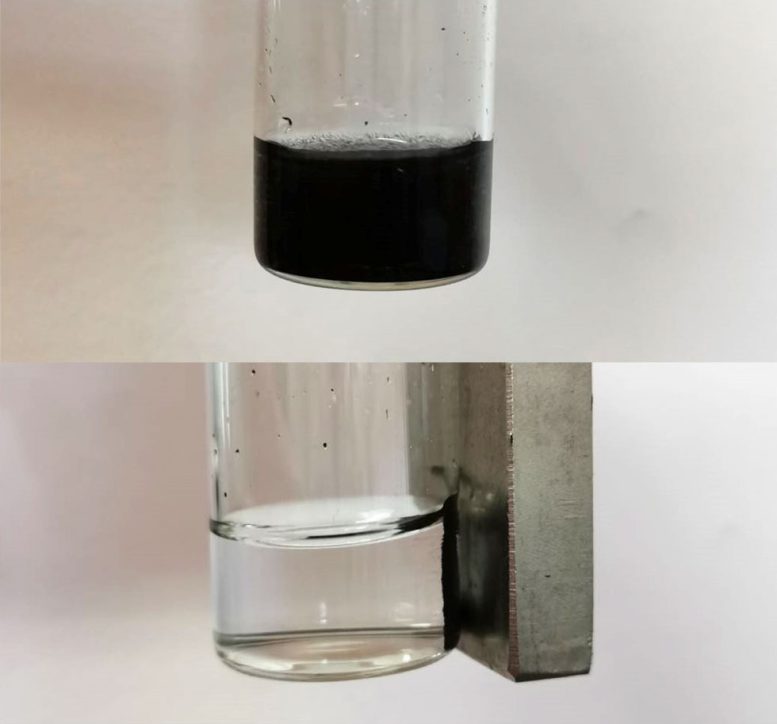
    Nanoparticles (top image) efficiently break down pollutants and are magnetic, making them easily recoverable for reuse (bottom image). Credit: Adapted from ACS Applied Materials & Interfaces 2022, DOI: 10.1021/acsami.1c23466

    Researchers have developed a green and cost-effective cleaning system for wastewater filters using glucose oxidase and iron oxide nanoparticles.

    Membrane filters don’t require much energy to purify water, making them popular for wastewater treatment. To keep these materials in tip-top condition, they’re commonly cleaned with large amounts of strong chemicals, but some of these agents destroy the membranes in the process. Now, researchers reporting in ACS Applied Materials & Interfaces have developed reusable nanoparticle catalysts that incorporate glucose to help efficiently break down contaminants inside these filters without damaging them.

    Typically, dirty wastewater filters are unclogged with strong acids, bases, or oxidants. Chlorine-containing oxidants such as bleach can break down the most stubborn organic debris. But they also damage polyamide membranes, which are in most commercial nanofiltration systems, and they produce toxic byproducts. A milder alternative to bleach is hydrogen peroxide, but it decomposes contaminants slowly.

    Previously, scientists have combined hydrogen peroxide with iron oxide to form hydroxyl radicals that improve hydrogen peroxide’s efficiency in a process known as the Fenton reaction. Yet in order for the Fenton reaction to clean filters, extra hydrogen peroxide and acid are needed, increasing financial and environmental costs. One way to avoid these additional chemicals is to use the enzyme glucose oxidase, which simultaneously forms hydrogen peroxide and gluconic acid from glucose and oxygen. So, Jianquan Luo and colleagues wanted to combine glucose oxidase and iron oxide nanoparticles into a system that catalyzes the Fenton-based breakdown of contaminants, creating an efficient and delicate cleaning system for membrane filters.

    Superior Contaminant Removal with Glucose Oxidase and Iron Oxide

    First, the researchers compared the removal of organic contaminants from polyamide filters by the glucose oxidase enzyme and iron oxide nanoparticles to other cleaning methods, including the traditional Fenton reaction. They found this approach was superior at breaking down the common contaminants bisphenol A and methylene blue, while also preserving more of the membrane structure.

    Encouraged by their initial results, the team combined glucose oxidase and iron oxide into a single nanoparticle, connecting them with an amino bridge. Finally, they tested the new nanoparticle’s ability to clean methylene blue-soaked nanofiltration membranes, which they fouled and cleaned for three cycles. After each cleaning cycle, the nanoparticles were retrieved with a magnet and reused with fresh glucose to activate the catalyst.

    The nanoparticles were highly effective at cleaning the membranes, returning them to 94% of their initial water filtration capacity. Because the nanoparticles don’t require strong chemicals and are easily recoverable, the researchers say their new system is a “greener” and more cost-effective approach for cleaning nanofiltration membranes.

    Reference: “Chemoenzymatic Cascade Reaction for Green Cleaning of Polyamide Nanofiltration Membrane” by Jinxuan Zhang, Huiru Zhang, Yinhua Wan and Jianquan Luo, 2 March 2022, ACS Applied Materials & Interfaces.
    DOI: 10.1021/acsami.1c23466

    The authors acknowledge funding from the Beijing Natural Science Foundation and the National Natural Science Foundation of China.

    Never miss a breakthrough: Join the SciTechDaily newsletter.
    Follow us on Google and Google News.

    American Chemical Society Catalysts Materials Science Nanoparticles Wastewater
    Share. Facebook Twitter Pinterest LinkedIn Email Reddit

    Related Articles

    Engineers Develop New Lightweight Metal from Carbide Nanoparticles

    New Graphene Based Catalyst Shows Promise for Clean, Inexpensive Hydrogen Production

    Solid Nanoparticles Keep Their Internal Structure While Deforming Like a Liquid

    New Observations Reveal the Inner Workings of Lithium-Ion Batteries

    Superlattice Study Reveals Gear-Like Molecular-Scale Machines

    Argonne Researchers Develop New Technique for Creating Nanoalloys

    Researchers Use TEM to Record 3D Dynamic Imaging of Soft Materials

    PGClear Uses a Palladium-Gold Catalyst to Break Down Hazardous Compounds

    Researchers Uncover Why Lithium Iron Phosphate Works So Well

    Leave A Reply Cancel Reply

    • Facebook
    • Twitter
    • Pinterest
    • YouTube

    Don't Miss a Discovery

    Subscribe for the Latest in Science & Tech!

    Trending News

    Why Popular Diabetes Drugs Like Ozempic Don’t Work for Everyone: The “Genetic Glitch”

    Scientists Stunned After Finding Plant Thought Extinct for 60 Years

    Scientists Discover Tiny New Spider That Hunts Prey 6x Its Size

    Natural Component From Licorice Shows Promise for Treating Inflammatory Bowel Disease

    Scientists Warn: Popular Sweetener Linked to Dangerous Metabolic Effects

    Monster Storms on Jupiter Unleash Lightning Beyond Anything on Earth

    Scientists Create “Liquid Gears” That Spin Without Touching

    The Simple Habit That Could Help Prevent Cancer

    Follow SciTechDaily
    • Facebook
    • Twitter
    • YouTube
    • Pinterest
    • Newsletter
    • RSS
    SciTech News
    • Biology News
    • Chemistry News
    • Earth News
    • Health News
    • Physics News
    • Science News
    • Space News
    • Technology News
    Recent Posts
    • Common Food Preservative Linked to Rising Suicide Deaths Among Young People
    • Seeing the Invisible: Scientists Develop New Way To Track Particles in 3D
    • The Atomic Gap That Could Cost the Semiconductor Industry Billions
    • Earth’s Secret Advantage: Why Most Alien Worlds May Be Too Dry for Life
    • Ancient Bacteria Turned a DNA System Into a Cell Skeleton
    Copyright © 1998 - 2026 SciTechDaily. All Rights Reserved.
    • Science News
    • About
    • Contact
    • Editorial Board
    • Privacy Policy
    • Terms of Use

    Type above and press Enter to search. Press Esc to cancel.