
Close Menu
    Facebook X (Twitter) Instagram
    SciTechDaily
    • Biology
    • Chemistry
    • Earth
    • Health
    • Physics
    • Science
    • Space
    • Technology
    Facebook X (Twitter) Pinterest YouTube RSS
    SciTechDaily
    Home»Technology»US Ignition Facility Will Spend Less Time on Energy Research
    Technology

    US Ignition Facility Will Spend Less Time on Energy Research

    By SciTechDailyNovember 7, 2012No Comments3 Mins Read
    Facebook Twitter Pinterest Telegram LinkedIn WhatsApp Email Reddit
    Share
    Facebook Twitter LinkedIn Pinterest Telegram Email Reddit
    Laser lab shifts focus
    The NIF’s lasers blast a tiny pellet containing isotopes of hydrogen to trigger fusion reactions. Credit: Lawrence Livermore National Laboratory,

    The world’s most powerful laser ignition facility is set to emphasize its nuclear weapons research after unsuccessfully campaigning to demonstrate the principles of a fusion power plant.

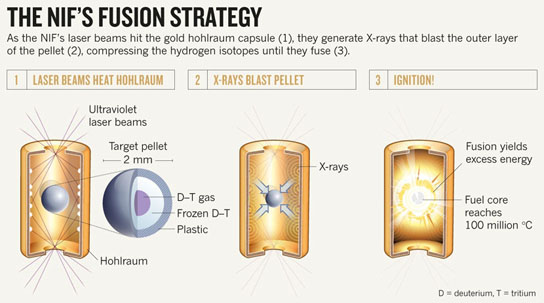
    At the US National Ignition Facility (NIF), scientists and engineers have been working on how to focus the 192 laser beams on a gold lined “hohlraum” capsule, just a few millimeters long, containing a pellet of hydrogen isotopes. As 500 terawatts of laser power hits the capsule, it generates X-rays that blast into the pellet, causing the atoms of deuterium and tritium inside to fuse. This process converts a tiny amount of their mass into a burst of energy.

    The goal was to develop a power plant that would implode nearly 1,000 pellets a minute, but unexpected technical problems left the NIF short of this campaign.
    nif_laser_graphic

    Federal officials and the US Congress are preparing to set a new direction for the $3.5-billion facility at the Lawrence Livermore National Laboratory in California. Ignition research will be cut down from 80% to 50%, and the National Nuclear Security Administration (NNSA) will determine what to do the rest of the time. The NNSA is planning on running experiments that mimic the conditions inside nuclear weapons, which will generate data to validate the computer codes used to check that the USA’s warheads remain viable. This is apparently essential work, given the voluntary moratorium on underground nuclear testing which began in 1992.

    A fair amount of work is needed to get ignition to work successfully and produce significant amounts of power. One shot of the laser delivers 1.85 megajoules of energy. Based on the data obtained from the imploding pellets, researchers think that they are still far away from reaching the necessary conditions for ignition. Too much of the laser light is scattering back out of the capsule. Another problem is that the pellet is being squeezed asymmetrically, which lowers the pressure at its center. This asymmetry also causes the isotopes to mix unevenly, lowering the temperature.

    Congress is disappointed in the NIF’s apparent lack of progress. The NIF is still decades away from using laser fusion to produce electricity. This was oversold to Congress, which believed that it was funding an energy project.

    Livermore will still control the operation’s day-to-day running, but the NNSA headquartered in Washington DC will set priorities as the facility expands its work.

    Never miss a breakthrough: Join the SciTechDaily newsletter.
    Follow us on Google and Google News.

    Fusion Energy High Energy Research Lawrence Livermore National Laboratory NIF Nuclear
    Share. Facebook Twitter Pinterest LinkedIn Email Reddit

    Related Articles

    Fusion Breakthrough: At the Brink of Fusion Ignition at National Ignition Facility

    Compact Fusion Power Plant Concept Uses State-of-the-Art Physics To Improve Energy Production

    New Method Developed for 3D Printing Living Microbes To Enhance Biomaterials

    Bessel Beams: Laser Beam Shaping To Improve Metal 3D Printing

    Harnessing the Power of the Sun on Earth: Major Advance in Stellarator Performance for Fusion Energy

    Viability of Large-Scale Hydrogen Storage in Geologic Formations

    Keeping an Eye on the Fusion Magnet Technology of the Future

    DOE Pushes for Aggressive U.S. Investment in Fusion Energy

    US National Ignition Facility Rethinks Its Strategy for Laser Fusion

    Leave A Reply Cancel Reply

    • Facebook
    • Twitter
    • Pinterest
    • YouTube

    Don't Miss a Discovery

    Subscribe for the Latest in Science & Tech!

    Trending News

    This Copper Drug Clears Alzheimer’s Brain Toxins and Boosts Memory

    Adults Over 65 Lost Massive Amounts of Weight With Ozempic

    How Flocking Birds “Defy” One of Physics’ Most Fundamental Laws

    Physicists Create a New Kind of Schrödinger’s Cat State From Exotic Quantum Building Blocks

    Your Diet Could Be Missing the Key Ingredient for Heart Protection

    Researchers Warn Widely Prescribed Blood Pressure Drugs Could Be Harming Diabetic Kidneys

    James Webb Spots Something Strange Between Day and Night on an Alien Planet

    How Ancient People Moved a 6-Ton Stone 700 Kilometers to Stonehenge

    Follow SciTechDaily
    • Facebook
    • Twitter
    • YouTube
    • Pinterest
    • Newsletter
    • RSS
    SciTech News
    • Biology News
    • Chemistry News
    • Earth News
    • Health News
    • Physics News
    • Science News
    • Space News
    • Technology News
    Recent Posts
    • Scientists Uncover Cause of Inflammatory Bowel Disease Solving Decades-Old Mystery
    • The Surprising Reason Swimming Could Be Better for Your Heart Than Running
    • Could Vitamin C Be the Secret to Keeping Your Brain Younger?
    • The Surprising Fix for Robot Traffic Jams
    • Near Absolute Zero, This Transistor Starts Acting Like a Brain Cell
    Copyright © 1998 - 2026 SciTechDaily. All Rights Reserved.
    • Science News
    • About
    • Contact
    • Editorial Board
    • Privacy Policy
    • Terms of Use

    Type above and press Enter to search. Press Esc to cancel.