
Close Menu
    Facebook X (Twitter) Instagram
    SciTechDaily
    • Biology
    • Chemistry
    • Earth
    • Health
    • Physics
    • Science
    • Space
    • Technology
    Facebook X (Twitter) Pinterest YouTube RSS
    SciTechDaily
    Home»Technology»US National Ignition Facility Rethinks Its Strategy for Laser Fusion
    Technology

    US National Ignition Facility Rethinks Its Strategy for Laser Fusion

    By SciTechDailyDecember 14, 2012No Comments2 Mins Read
    Facebook Twitter Pinterest Telegram LinkedIn WhatsApp Email Reddit
    Share
    Facebook Twitter LinkedIn Pinterest Telegram Email Reddit
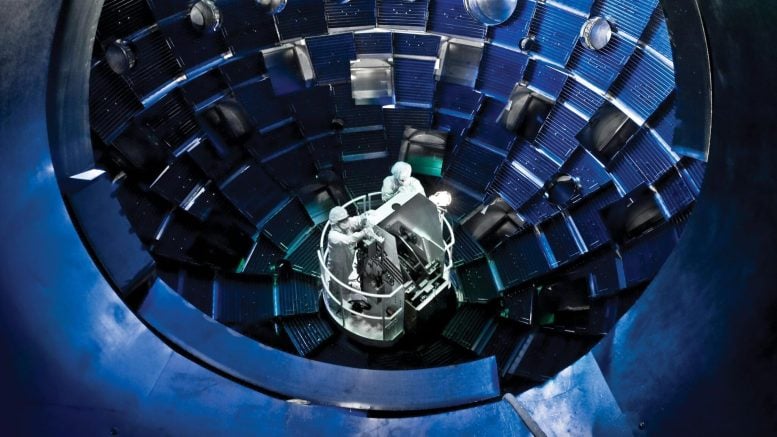
    National Ignition Facility Target Chamber
    Inside the National Ignition Facility’s 10-meter-diameter target chamber. Credit: Lawrence Livermore National Laboratory

    The failure of the US National Ignition Facility’s six-year campaign to demonstrate fusion in the lab has the government deciding on a more methodical path for harnessing the most powerful laser ever built.

    The government’s new plan [PDF] was revealed to Nature, and it calls for a slower, more deliberate approach to achieve ignition, the point at which more energy is produced by a fusion reaction than is consumed. Many physicists agree that this would be an important proof of concept for achieving controlled fusion.

    The National Ignition Facility at the Lawrence Livermore National Laboratory in California will be set on a new course, exploring several alternative ways of achieving ignition. It sets a three-year deadline for finding out whether ignition is possible at all. The last deadline was aimed to demonstrate actual fusion.

    The $3.5-billion NIF uses lasers to crush 2-millimeter pellets of hydrogen fuel to the point of fusion. Instead of irradiating the fuel directly, the lasers shine into a cylindrical capsule, whose walls will emit X-rays that squeeze the fuel pellet until it explodes.
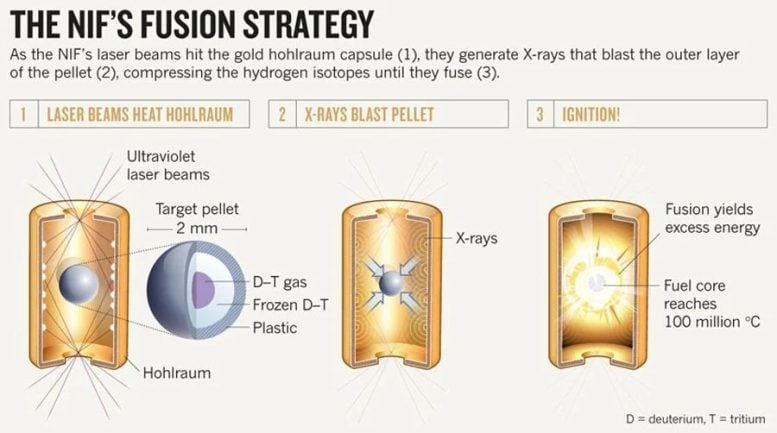
    NIF Fusion Strategy Infographic


    This indirect approach mimics the ignition system in a thermonuclear weapon, which uses radiation from a fission stage to squeeze hydrogen isotopes in the fusion stage, creating a much more powerful explosion.

    This latest plan was drafted by the US National Nuclear Security Administration (NNSA), which oversees the lab. The researchers will conduct reduced-power tests to refine their computer models over the next three years to determine why ignition has been so elusive.

    Another approach consists of using lasers to ignite the hydrogen fuel inside the pellet directly, and using a machine called the Z-pinch to squeeze the fuel inside a magnetic field. By 2015, the NNSA hopes to be able to say whether ignition can be achieved using the NIF or Z-pinch.

    Never miss a breakthrough: Join the SciTechDaily newsletter.
    Follow us on Google and Google News.

    Fusion Fusion Energy Lawrence Livermore National Laboratory
    Share. Facebook Twitter Pinterest LinkedIn Email Reddit

    Related Articles

    Fusion’s New Hero: The Liquid Metal That Beats the Heat

    Caltech Engineers Have Developed an Unusually Tough New Material

    Carbon Nanotubes Could Revolutionize Everything From Batteries and Water Purifiers to Auto Parts and Sporting Goods

    MIT Contributes to Success of Historic Fusion Ignition Experiment

    Nuclear Fusion Energy Breakthrough: Ignition Confirmed in Record 1.3 Megajoule Shot

    Bessel Beams: Laser Beam Shaping To Improve Metal 3D Printing

    DOE Pushes for Aggressive U.S. Investment in Fusion Energy

    US Ignition Facility Will Spend Less Time on Energy Research

    A Big Step Forward for Nuclear Fusion Power

    Leave A Reply Cancel Reply

    • Facebook
    • Twitter
    • Pinterest
    • YouTube

    Don't Miss a Discovery

    Subscribe for the Latest in Science & Tech!

    Trending News

    Scientists Say This Natural Hormone Reverses Obesity by Targeting the Brain

    35-Million-Year-Old Mystery: Strange Arachnid Discovered Preserved in Amber

    Is AI Really Just a Tool? It Could Be Altering How You See Reality

    JWST Reveals a “Forbidden” Planet With a Baffling Composition

    The Protein “Sabotaging” Aging Muscle Recovery Could Be Key to Surviving Aging

    This Diet–Gut Interaction Could Transform Fat Into a Calorie-Burning Machine

    Scientists Discover Hidden Virus Linked to Colorectal Cancer

    Scientists Discover 132-Million-Year-Old Dinosaur Tracks on South Africa’s Coast

    Follow SciTechDaily
    • Facebook
    • Twitter
    • YouTube
    • Pinterest
    • Newsletter
    • RSS
    SciTech News
    • Biology News
    • Chemistry News
    • Earth News
    • Health News
    • Physics News
    • Science News
    • Space News
    • Technology News
    Recent Posts
    • 500 Million Years Ago, Life Changed Forever: Scientists Reveal the DNA Changes That Helped Animals Move Onto Land
    • Surprise RNA Discovery Challenges Long-Held Beliefs About How Genes Work
    • Your IQ at 23 Could Predict Your Wealth at 27, Study Finds
    • 320 Light-Years Away, a Planet Confirms a Fundamental Cosmic Assumption
    • Astronomers Solve Decades-Long Mystery About Saturn’s Spin – “Something Strange Was Happening”
    Copyright © 1998 - 2026 SciTechDaily. All Rights Reserved.
    • Science News
    • About
    • Contact
    • Editorial Board
    • Privacy Policy
    • Terms of Use

    Type above and press Enter to search. Press Esc to cancel.