
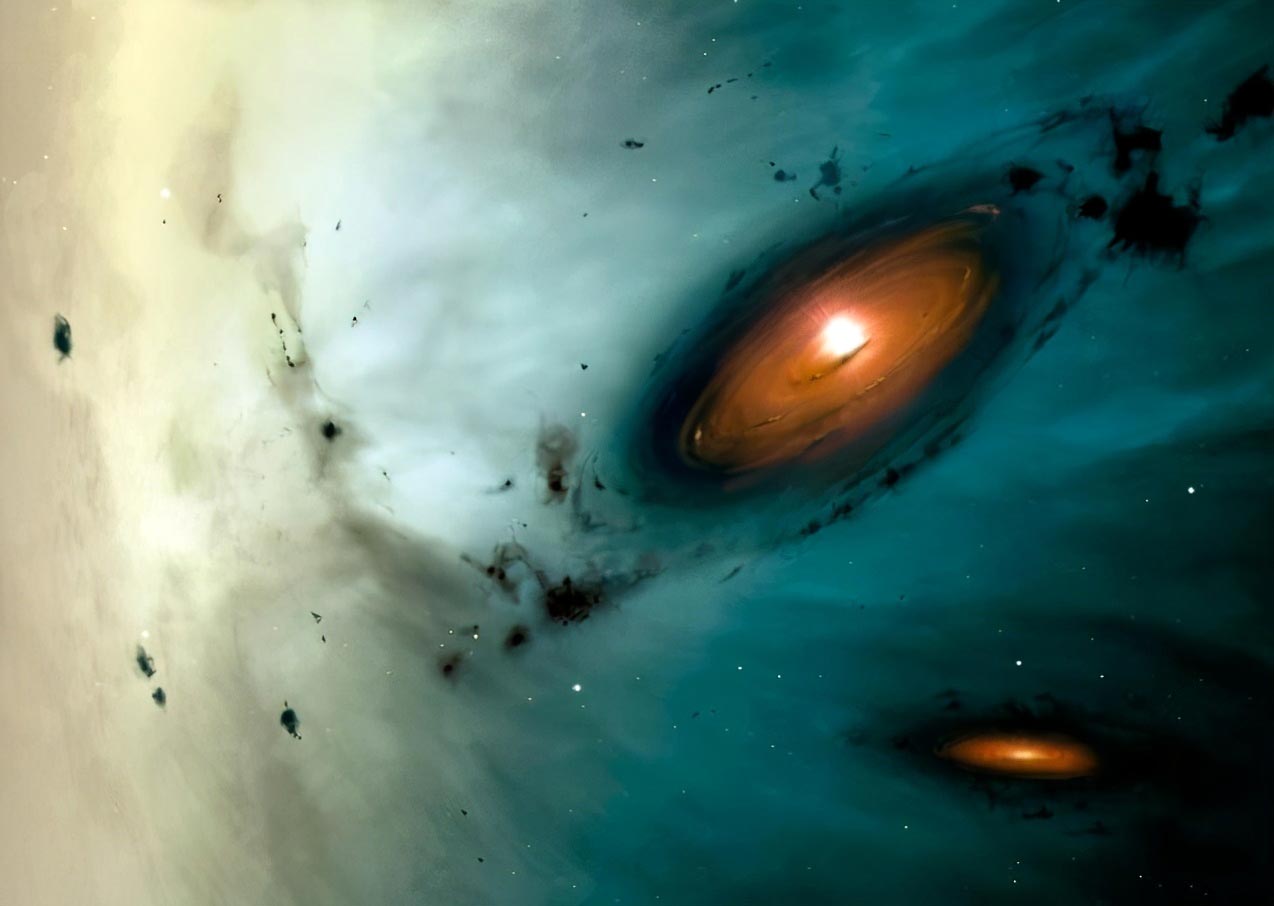
By amassing in high-density regions, dust grains avoid drifting toward the star they are orbiting.
A key step in the formation of new planets may have been uncovered by a new theoretical model of a protoplanetary disk developed by a RIKEN astrophysicist and two collaborators that explains how dust in the disk overcomes a tendency to drift toward the star.
Planets are birthed from a swirling disk of dust and gas that surrounds a young star, but it is unclear how dust grains can grow into larger objects before they spiral inward toward the star.
In the classical theory of planet formation, minuscule dust particles collide and stick together to form centimeter-sized grains. These grains gradually build up to form kilometer-sized planetesimals, the first major step in producing a new planet.
But the dust grains feel a drag from the gas in the protoplanetary disk. This slows the dust grains down, so that they fall toward the star. The speed at which they fall increases as the dust grains grow larger.
Previous studies have suggested that this effect should prevent the grains from forming objects larger than a meter, which poses a major conundrum for astronomers. “Various mechanisms have been proposed to explain the formation of planetesimals, but they are still under debate,” notes Ryosuke Tominaga of the RIKEN Star and Planet Formation Laboratory.
New Theoretical Model
Tominaga and two colleagues have now proposed a model that suggests a possible solution to this problem—small variations in the distribution of dust in the protoplanetary disk are quickly amplified into regions of high and low dust density.
In areas having slightly higher densities, dust coagulates more efficiently, and it forms larger clumps that drift toward the star more quickly. When these clumps meet smaller dust particles, they form regions of even higher dust density, accelerating grain growth. Meanwhile, the regions vacated by the large clumps end up with relatively low densities.
Formation of High and Low Dust Density Bands
The team found that this positive feedback creates multiple bands of high and low dust density in the protoplanetary disk. These bands can arise in a matter of 10,000 years or so, a remarkably short time for such astronomical processes. These high-density areas are ideal sites for further aggregation, allowing planetesimals to form before the dust grains are pulled into the star.
“Unlike previous theories, this coagulation mechanism works even when there is far more gas than dust in the protoplanetary disk,” says Tominaga.
The team is now working on more-detailed models that include the formation and evolution of the disk itself, along with the eventual formation of planetesimals.
Reference: “Coagulation Instability in Protoplanetary Disks: A Novel Mechanism Connecting Collisional Growth and Hydrodynamical Clumping of Dust Particles” by Ryosuke T. Tominaga, Shu-ichiro Inutsuka and Hiroshi Kobayashi, 8 December 2021, The Astrophysical Journal.
DOI: 10.3847/1538-4357/ac173a
Never miss a breakthrough: Join the SciTechDaily newsletter.
Follow us on Google and Google News.
1 Comment
Interesting.
1. Link with Temperatures High, Medium and Low on the Kelvin Scale and Matter-Energy Einsteinian equation. Both Ways. Matter to Energy andEnergy to Matter.
2. Link further with Bhors uUcertaity Principe applicable to Electrons AND Positrons.
3. Is it possible that Matter has consciousness?
4. Dust particles appear to have freedom of choice on whether to become pasrt of the Sun to become part of the Natural Fuson Reactor (The Sun) or a Planetary Body like the Eight Known Planets in our solar system! Accordingly they aggregate to become Planets (Sattelites of the Sun (Aum), and Moons ( Sattelites of the Planets}!
4. Reminds me of the Beattles Song, “We all live ina Yellow Submarine, Yellow Submarine…..”. Powered by a Nuclear Fusion Reactor.
Views expressed are personal and not binding on anyone.