
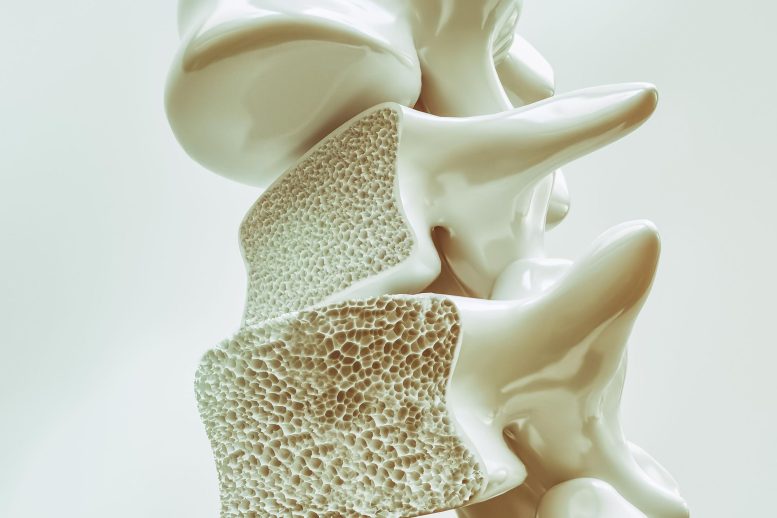
Researchers at UCLA found that anti-Mullerian hormone (AMH) levels can predict menopause-related bone loss in women aged 42 and older.
Physicians may be able to determine if menopause-related bone loss is already in progress or about to begin by measuring the level of a hormone that declines as women approach their final menstrual period, new UCLA research finds.
The findings could help physicians determine when, and how, to treat bone loss in women as they age before that bone loss causes significant health issues, according to the study. Specifically, the study found that for women 42 and older who are not yet postmenopausal, levels of anti-Mullerian hormone, or AMH, can be used to determine if they are experiencing, or about to experience, bone loss related to their transition into menopause.
The findings will be published today (April 4, 2022) in the peer-reviewed Journal of Bone and Mineral Research.
“To be able to intervene and reduce the rate and amount of bone loss, we need to know if this loss is imminent or already ongoing,” said the study’s lead author, Dr. Arun Karlamangla, a professor of medicine in the division of geriatrics at the David Geffen School of Medicine at UCLA. “We do not reliably know before it actually happens when a woman’s last menstrual period will be, so we cannot tell whether it is time to do something about bone loss.”
Bone loss typically begins about a year before a woman’s last menstrual period, Karlamangla said.
The Connection Between AMH and Bone Loss
Women experience significant bone loss during the menopause transition, a roughly three-year window that brackets the final menstrual period and is accompanied by other symptoms such as irregular menstrual cycles, hot flashes, and mood and sleep disorders. Levels of the AMH decline as a woman’s final menstrual period draws closer.
The researchers examined data from the Study of Women’s Health Across the Nation, or SWAN, a multi-site, multi-ethnic study examining the changes women undergo during the transition to menopause.
They found that 17% of premenopausal women age 42 or older will have lost a significant fraction of their peak bone mass within two to three years of the date a physician makes the prediction. But among those with less than 50 picograms of AMH per milliliter of blood, nearly double the percentage, 33%, will have lost a significant fraction of peak bone mass in the same timeframe. (A picogram is one-trillionth of a gram.)
In addition, 42% of women in early perimenopause — meaning that they have irregular menstrual bleeding but with no more than a three-month gap between periods — will have lost a significant fraction of peak bone mass within two to three years. But among women in early perimenopause with AMH levels below 25 pg/mL, 65% will have lost a significant percentage of peak bone mass in that time.
The study has some limitations, the researchers note. The findings cannot be applied to women who are already taking osteoporosis medications, have undergone a hysterectomy prior to their final period, or have used exogenous sex hormones during the transition to menopause; and the study did not include Hispanic women, nor did it include women who became menopausal before age 42.
“These findings make feasible the designing and testing of midlife interventions to prevent or delay osteoporosis in women,” the study’s authors write.
Reference: “Anti-mullerian hormone as predictor of future and ongoing bone loss during the menopause transition” by Arun S Karlamangla, Albert Shieh, Gail A Greendale, Elaine W Yu, Sherri‐Ann M Burnett‐Bowie, Patrick M Sluss, Deborah Martin, Anthony Morrison and Joel S Finkelstein, 4 April 2022, Journal of Bone and Mineral Research.
DOI: 10.1002/jbmr.4525
The Study of Women’s Health Across the Nation is supported by the National Institutes of Health through the National Institute on Aging, the National Institute of Nursing Research and the NIH Office of Research on Women’s Health.
The study’s co-authors are Dr. Albert Shieh and Dr. Gail Greendale of UCLA; Dr. Elaine Yu, Dr. Sherri-Ann Burnett-Bowie, Dr. Patrick Sluss and Dr. Joel Finkelstein of Harvard University; Deborah Martin of the University of Pittsburgh; and Anthony Morrison of Motive Biosciences.
Never miss a breakthrough: Join the SciTechDaily newsletter.
Follow us on Google and Google News.