
Close Menu
    Facebook X (Twitter) Instagram
    SciTechDaily
    • Biology
    • Chemistry
    • Earth
    • Health
    • Physics
    • Science
    • Space
    • Technology
    Facebook X (Twitter) Pinterest YouTube RSS
    SciTechDaily
    Home»Space»Massive Stars Play a Crucial Role in Shaping Their Surroundings: How Do the Simulation Models Stack Up?
    Space

    Massive Stars Play a Crucial Role in Shaping Their Surroundings: How Do the Simulation Models Stack Up?

    By OzGravMay 21, 2022No Comments3 Mins Read
    Facebook Twitter Pinterest Telegram LinkedIn WhatsApp Email Reddit
    Share
    Facebook Twitter LinkedIn Pinterest Telegram Email Reddit
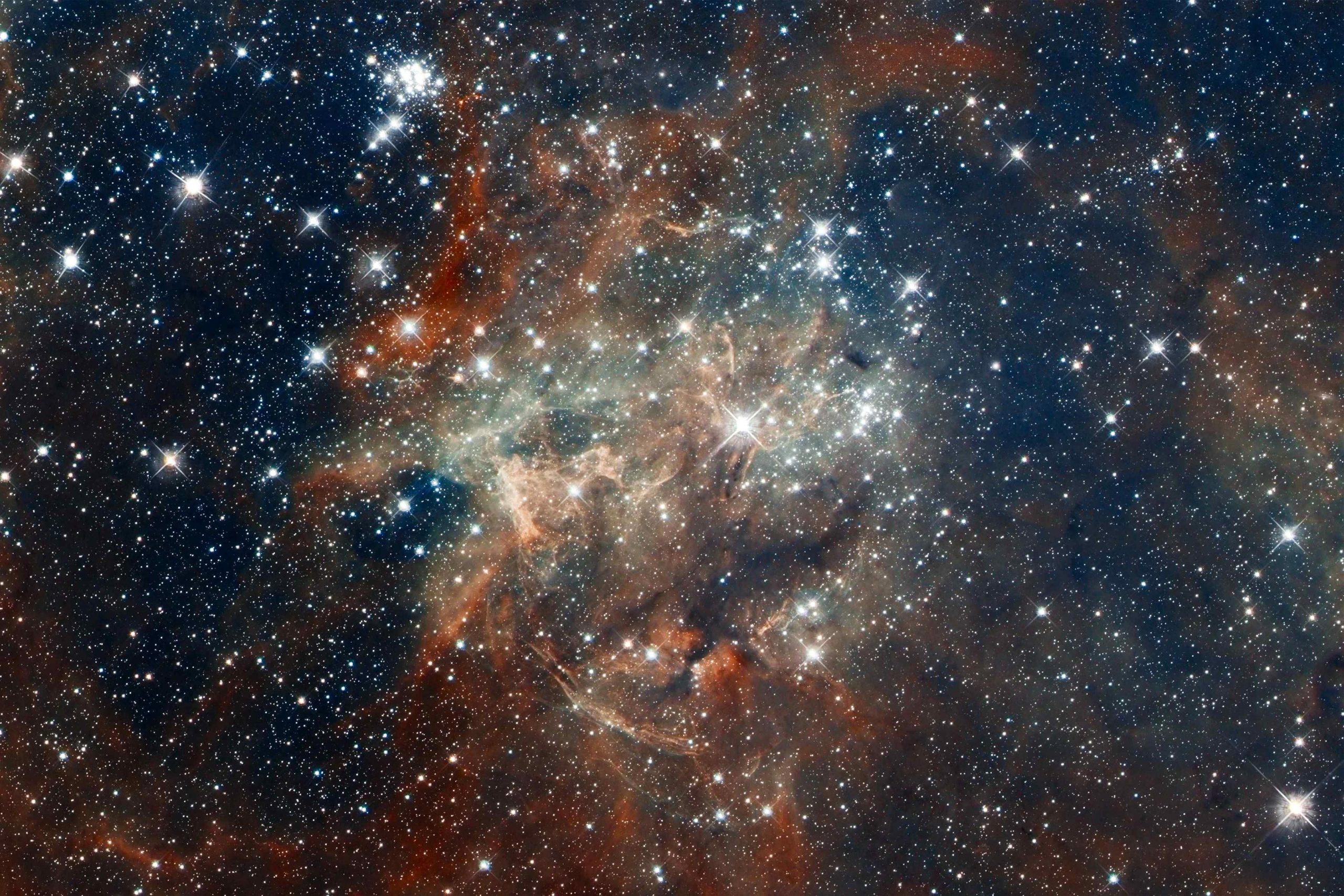
    30 Doradus Nebula LMC
    Figure 1: The 30 Doradus nebula, also known as the Tarantula Nebula, in the Large Magellanic Cloud (LMC) is home to many massive stars. Credit: NASA/ESA

    Massive stars play a vital role in galaxies, but one-dimensional models produce varying predictions, affecting black hole and galaxy evolution simulations.

    Less than one percent of stars in a galaxy are formed with masses exceeding ten solar masses. Despite their rarity, massive stars are believed to play a crucial role in shaping their surroundings, ultimately determining the evolution of the star cluster or galaxy in which they are located.

    Simulations of massive stars are used in many fields of astrophysics, from predicting gravitational-wave event rates to studying star formation and star cluster evolution. However, their rarity and short lives, along with their more extreme properties, mean that the evolution of massive stars is riddled with many uncertainties. These uncertainties are compounded by the fact that accurate modeling of stellar lives in three dimensions is prohibitively expensive in terms of computing resources.

    Limitations of One-Dimensional (1D) Stellar Evolution Codes

    Therefore, stellar evolution is modeled using one-dimensional (1D) codes, with only radius or mass as the spatial coordinate. Three-dimensional (3D) processes such as rotation and mixing are approximated using 1D analogs, which generally give good results for most stars.

    However, in the envelopes of massive stars (and in low-mass stars at the late stages of evolution), the use of these 1D analogs can lead to numerical challenges for stellar evolution codes. The time steps of the computation become very small (of the order of days) and 1D codes struggle to compute the further evolution of the star.
    Black Hole Masses Pair Instability Chart
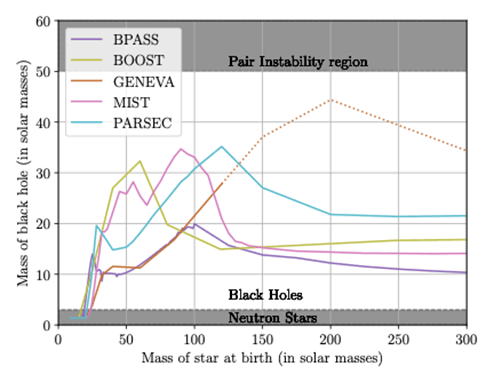
    Figure 2: Black hole masses predicted by different massive stellar models can vary by about 20 solar masses. Credit: OzGrav

    While researchers are trying to find the solution using multidimensional models, 1D stellar evolution codes adopt different pragmatic methods to push the evolution of stars beyond these numerical challenges. These methods, along with other uncertain parameters in the evolution of massive stars, can significantly alter the predictions of massive stellar models. To get an idea of how different their predictions can be, we examined models of massive stars from five different datasets, each computed using a different 1D code.

    We found that certain aspects of these predictions were extremely sensitive to the modeling assumptions employed by different codes. For example, in Figure 2, the different sets of massive star models show a variation of about 20 solar masses in their predictions of the mass of the black hole formed.

    We also found huge differences in the radial evolution of these stellar models and thus the ionizing radiation produced by them. These differences can directly affect binary evolution and the simulations of stellar environments, such as galaxies.

    Never miss a breakthrough: Join the SciTechDaily newsletter.
    Follow us on Google and Google News.

    Astrophysics Gravitational Waves OzGrav Stars
    Share. Facebook Twitter Pinterest LinkedIn Email Reddit

    Related Articles

    Misbehaving Pulsars: Unexpected Changes in the Most Predictable of Stars

    Elusive Continuous Gravitational Waves — Long-Lasting Ripples in Space-Time — In X-ray Star Systems

    Earth-Shaking Science at Cryogenic Temperatures: Next Generation Vibration Sensors

    Dancing Stars and Black Holes in a Cosmic Cloud of Gas: Investigating the “Common Envelope Phase”

    Massive, Never-Before-Seen Star System Puzzles Scientists

    Supercomputer Simulations of Core-Collapse Supernovae Reveal Complicated Physics of Exploding Massive Stars

    New Possible Explanation of Strange Black Hole Merger Revealed

    Future Gravitational Wave Detectors to Detect Millions of Black Holes & the Evolution of the Universe

    Radio and Gravitational Wave Signatures of Double Neutron Stars – Accurate Clocks to Test Einstein’s Theory of General Relativity

    Leave A Reply Cancel Reply

    • Facebook
    • Twitter
    • Pinterest
    • YouTube

    Don't Miss a Discovery

    Subscribe for the Latest in Science & Tech!

    Trending News

    This Experimental Drug Repaired the Gut and Reversed Severe Fatty Liver Disease

    Physicists Just Turned a Black Hole Energy Theory Into Reality

    Stanford Scientists Solve a 252-Million-Year-Old Mass Extinction Mystery

    The Ancient Survival Mechanism Making Weight Loss So Difficult

    Just 3,000 Steps a Day May Help Protect the Brain From Alzheimer’s

    “Weird Clams” Reveal a New Invasion Along the U.S. Northeast Coast

    Archaeologists Decapitated Tutankhamun and Glued His Body Back Together

    New Black Hole Theory Solves a 50-Year-Old Problem

    Follow SciTechDaily
    • Facebook
    • Twitter
    • YouTube
    • Pinterest
    • Newsletter
    • RSS
    SciTech News
    • Biology News
    • Chemistry News
    • Earth News
    • Health News
    • Physics News
    • Science News
    • Space News
    • Technology News
    Recent Posts
    • Quantum Computer Stores Data in Vibrations Like Notes on a Guitar
    • Astronomers Discover Two Super Puff Planets Lighter Than Cotton Candy
    • One Asteroid Collision May Have Rocked Earth, Mars, and the Moon
    • Scientists Restore the Sense of Touch With Electrical Brain Stimulation
    • New Study Reveals Herpesvirus Infection May Accelerate Alzheimer’s Disease
    Copyright © 1998 - 2026 SciTechDaily. All Rights Reserved.
    • Science News
    • About
    • Contact
    • Editorial Board
    • Privacy Policy
    • Terms of Use

    Type above and press Enter to search. Press Esc to cancel.