
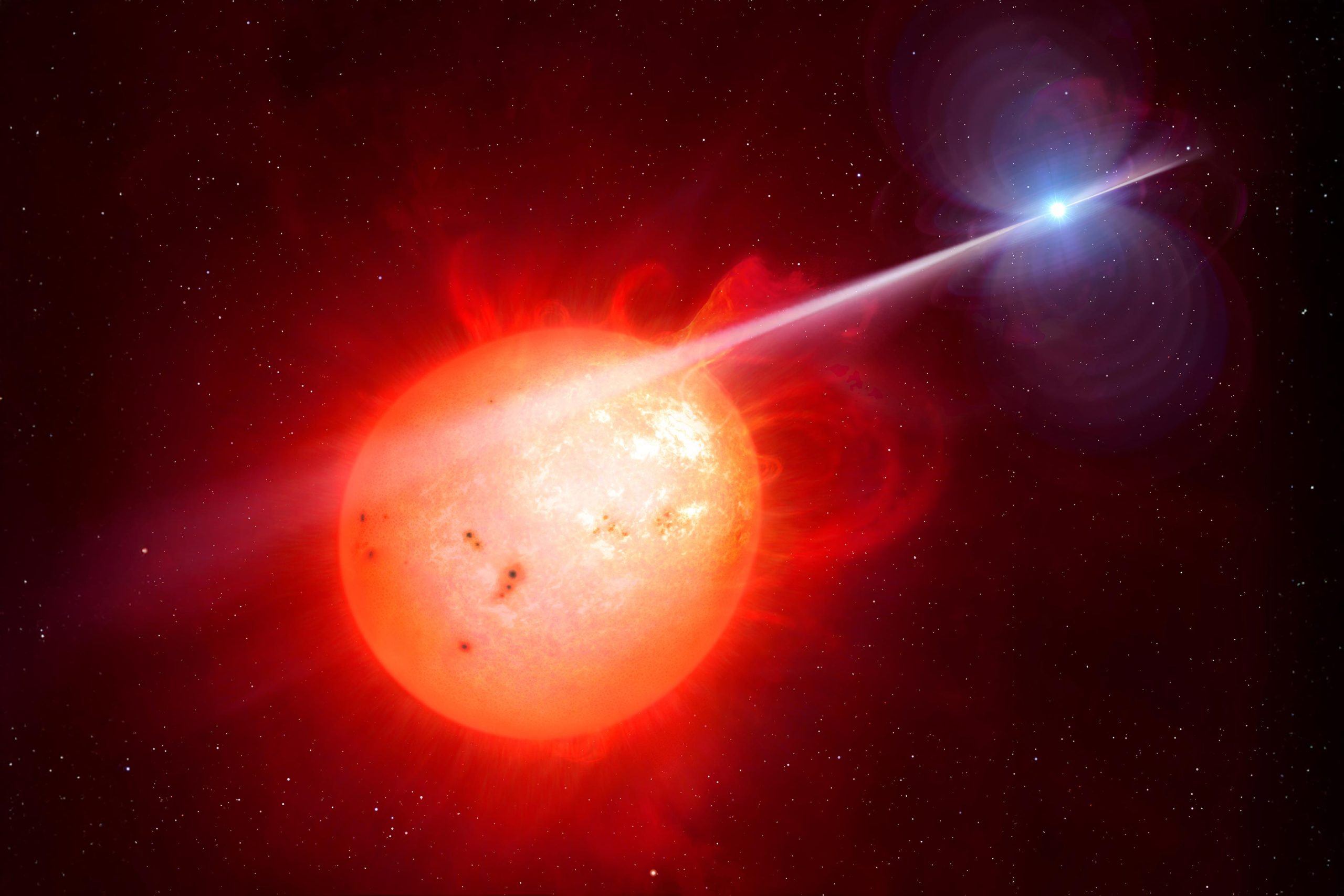
Gravitational waves are ripples in space-time that come in many forms. So far, short-duration gravitational wave signals have been observed from colliding black holes and colliding neutron stars, but scientists expect to find other kinds of gravitational waves. Recently published research led by the ARC Centre of Excellence for Gravitational Wave Discovery (OzGrav) studied continuous waves: long-lasting gravitational waves, in this particular case, waves from neutron stars — old dead stars — in specific star systems called low-mass X-ray binaries. Gravitational-wave detectors LIGO (Laser Interferometer Gravitational-wave Observatory) and Virgo provide excellent data to search for continuous waves as their signals are likely to be present in the detector data all the time (compared to gravitational waves from colliding black holes, which last only a second or so).
Neutron stars, which are typically about one and half times the mass of our Sun, are very compact at only 20km across. Some neutron stars are alone, while others are in “binary systems” — the neutron star and a companion star orbit around each other. The OzGrav team focused on looking for continuous waves from spinning neutron stars in “low mass X-ray binaries” (LMXBs). Low mass describes the neutron star’s companion which typically has a lower mass than our Sun; they are called X-ray binaries because scientists have observed X-rays from them using X-ray telescopes.
In the study, the team searched for continuous waves from spinning neutron stars by directly targeting five LMXBs, which is a first for these five LMXBs. All the targeted LMXBs have X-ray observations which indicate how fast the neutron star is spinning: its rotation frequency. This is extremely useful information when searching for continuous waves as it’s expected that the frequency of the continuous wave is related to the rotation frequency of the neutron star. This allowed the team to search for each LMXB within a specific frequency range.
Lead author and OzGrav researcher from the University of Melbourne Hannah Middleton says: “We used a search method, developed by researchers at the University of Melbourne, which was previously used to search for another LMXB called Scorpius X-1. Scorpius X-1 is a promising continuous wave source, because its X-rays are very bright, but the X-ray observations were unable to measure Scorpius X-1’s rotation frequency. This means that a wide range of frequencies need to be looked at. By taking advantage of the X-ray measurements of rotation frequency for our five LMXBs, we can reduce the computational cost of the search, sometimes by as much as 99 percent.”
But knowing the rotation frequency is not quite enough: the continuous wave frequency may not equate to the rotation frequency, so the team searched for small frequency ranges around the measured values.
“The continuous-wave frequency might even be slowly changing over time, so we need to be able to track it over many months of data,” adds Middleton. “The search uses a technique called a hidden Markov model which is widely used in applications from speech recognition to communication technologies. The resulting search can keep track of a signal even if the frequency changes unpredictably during an observation.”
So, what did the scientists find? After analyzing data from the second observing run (over 200 days between November 2016 to August 2017), unfortunately, they did not find strong evidence for continuous wave signals from these five LMXBs. But the search continues! LIGO and Virgo’s third observation run (from April 2019 to March 2020) has just completed, so the OzGrav scientists have plenty of data analysis and star searching to sink their teeth into.
Never miss a breakthrough: Join the SciTechDaily newsletter.
Follow us on Google and Google News.