
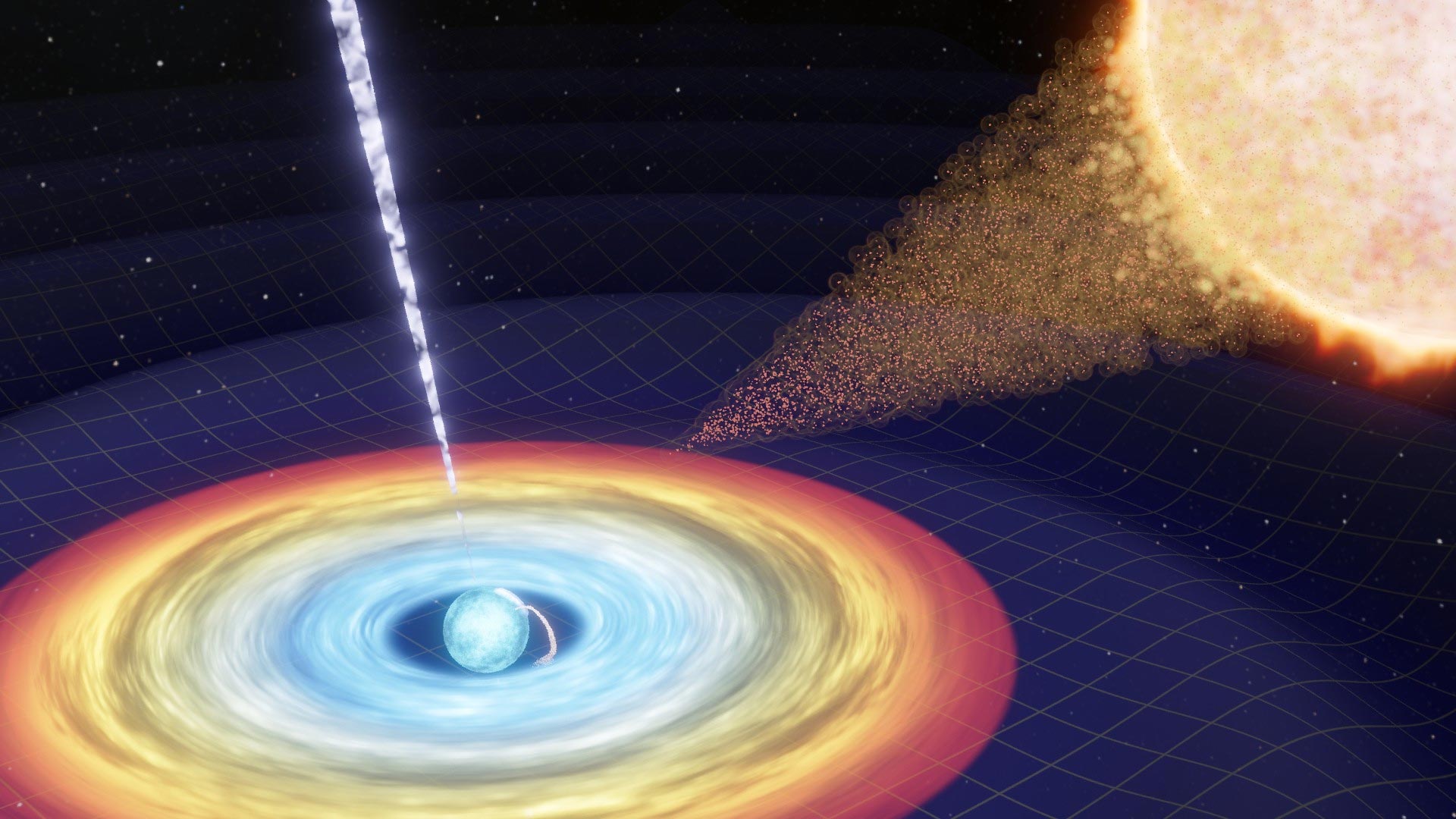
The search for a constant gravitational wave “hum” from spinning neutron stars may reveal unprecedented insights into the densest matter in the universe.
Scientists refine the search for enigmatic continuous gravitational waves.
The hunt for the never before heard “hum” of gravitational waves caused by mysterious neutron stars has just got a lot easier, thanks to an international team of researchers.
Gravitational waves have only been detected from black holes and neutron stars colliding, major cosmic events that cause huge bursts that ripple through space and time.
The research team, involving scientists from the LIGO Scientific Collaboration (LSC), Virgo Collaboration and the Centre for Gravitational Astrophysics (CGA) at The Australian National University (ANU), are now turning their eagle eye to spinning neutron stars to detect the waves.
Listening for the Faint Hum
Unlike the massive bursts caused by black holes or neutron stars colliding, the researchers say single spinning neutron stars have a bulge or “mountain” only a few millimeters high, which may produce a steady constant stream or “hum” of gravitational waves.
The researchers are using their methods that detected gravitational waves for the first time in 2015 to capture this steady soundtrack of the stars over the thunderous noise of massive black holes and dense neutron stars colliding.
They say it’s like trying to capture the squeak of a mouse in the middle of a stampeding herd of elephants.
If successful, it would be the first detection of a gravitational wave event that didn’t involve the collision of massive objects like black holes or neutron stars.
ANU Distinguished Professor, Susan Scott from the ANU Research School of Physics, said the collision of dense neutron stars sent a “burst” of gravitational waves rippling through the Universe.
“Neutron stars are mystery objects,” Professor Scott, also a Chief Investigator with the ARC Centre of Excellence for Gravitational Wave Discovery (OzGrav), said.
“We don’t really understand what they are made up of, or how many types of them exist. But what we do know is that when they collide, they send incredible bursts of gravitational waves across the Universe.
“In contrast, the gentle hum of a spinning neutron star is very faint and almost impossible to detect.”
Three new papers have just been published by the LSC and Virgo collaborations detailing the most sensitive searches to date for the faint hum of gravitational waves from spinning neutron stars.
Their work offers a “map to the potential El Dorado of gravitational waves.”
Targeting Young Supernova Remnants
“One of our searches targets young supernova remnants. These neutron stars, recently born, are more deformed, and should emit a stronger stream of gravitational waves,” Dr. Lilli Sun, from CGA and an Associate Investigator with OzGrav, said.
As these searches become more and more sensitive they are providing more detail than ever of the possible shape and make-up of neutron stars.
“If we can manage to detect this hum, we’ll be able to look deep into the heart of a neutron star and unlock its secrets,” Dr. Karl Wette, a postdoctoral researcher with OzGrav and the CGA, said.
Professor Scott, who is also the leader of the General Relativity Theory and Data Analysis Group at ANU, added: “Neutron stars represent the densest form of matter in the Universe before a black hole will form.”
“Searching for their gravitational waves allows us to probe nuclear matter states that simply can’t be produced in laboratories on Earth.”
For more on this research, see Spinning Neutron Stars Reveal New Insights Into Elusive Continuous Gravitational Waves.
Never miss a breakthrough: Join the SciTechDaily newsletter.
Follow us on Google and Google News.
2 Comments
… when Albert try to explain how one object is on top of another object, there was some space time thing pushing, etc… there was a woman that is from Germany that is university professor and it is not okay with its explanation…
… well if you have two bars on top of each other and then those bars will not melt into one bar, but one bar will repel other one with the space time thing, but if you melt them then by miracle the space time goes by, by, and the bars melt together…
… an exception that need some clarification…
It would be easier and more practical to begin by detecting earth/ moon gravitational waves then working outward.