

Close Menu
    Facebook X (Twitter) Instagram
    SciTechDaily
    • Biology
    • Chemistry
    • Earth
    • Health
    • Physics
    • Science
    • Space
    • Technology
    Facebook X (Twitter) Pinterest YouTube RSS
    SciTechDaily
    Home»Technology»Quantum Digits Unlock More Computational Power With Fewer Quantum Particles
    Technology

    Quantum Digits Unlock More Computational Power With Fewer Quantum Particles

    By University of InnsbruckJuly 22, 2022No Comments3 Mins Read
    Facebook Twitter Pinterest Telegram LinkedIn WhatsApp Email Reddit
    Share
    Facebook Twitter LinkedIn Pinterest Telegram Email Reddit
    Innsbruck Quantum Computer
    The Innsbruck quantum computer stores information in individual trapped calcium atoms, each of which has eight states, of which the scientists have used up to seven for computing. Credit: Uni Innsbruck/Harald Ritsch

    Quantum Computer Works With More Than Zero and One

    As we all learn from early on, digital computers work with zeros and ones, also known as binary information. This approach has worked well. In fact, it has been so successful that computers now power everything from coffee machines to self-driving cars and it is difficult to imagine a life without them.

    “Working with more than zeros and ones is very natural, not only for the quantum computer but also for its applications, allowing us to unlock the true potential of quantum systems.” Martin Ringbauer

    Building on this incredible success, today’s quantum computers are also developed with binary information processing in mind. “The building blocks of quantum computers, however, are more than just zeros and ones,” explains Martin Ringbauer, an experimental physicist from Innsbruck, Austria. “Restricting them to binary systems prevents these devices from living up to their true potential.”

    A team of scientists has now succeeded in developing a quantum computer that can perform arbitrary calculations with so-called quantum digits (qudits), thereby unlocking additional computational power with fewer quantum particles. This group is led by Thomas Monz at the Department of Experimental Physics at the University of Innsbruck.

    Quantum Systems Are Different

    Storing information in zeros and ones is not the most efficient way of doing calculations, but it is the simplest way. Simple typically also means reliable and robust to errors, which is why binary information has become the unchallenged standard for classical computers.
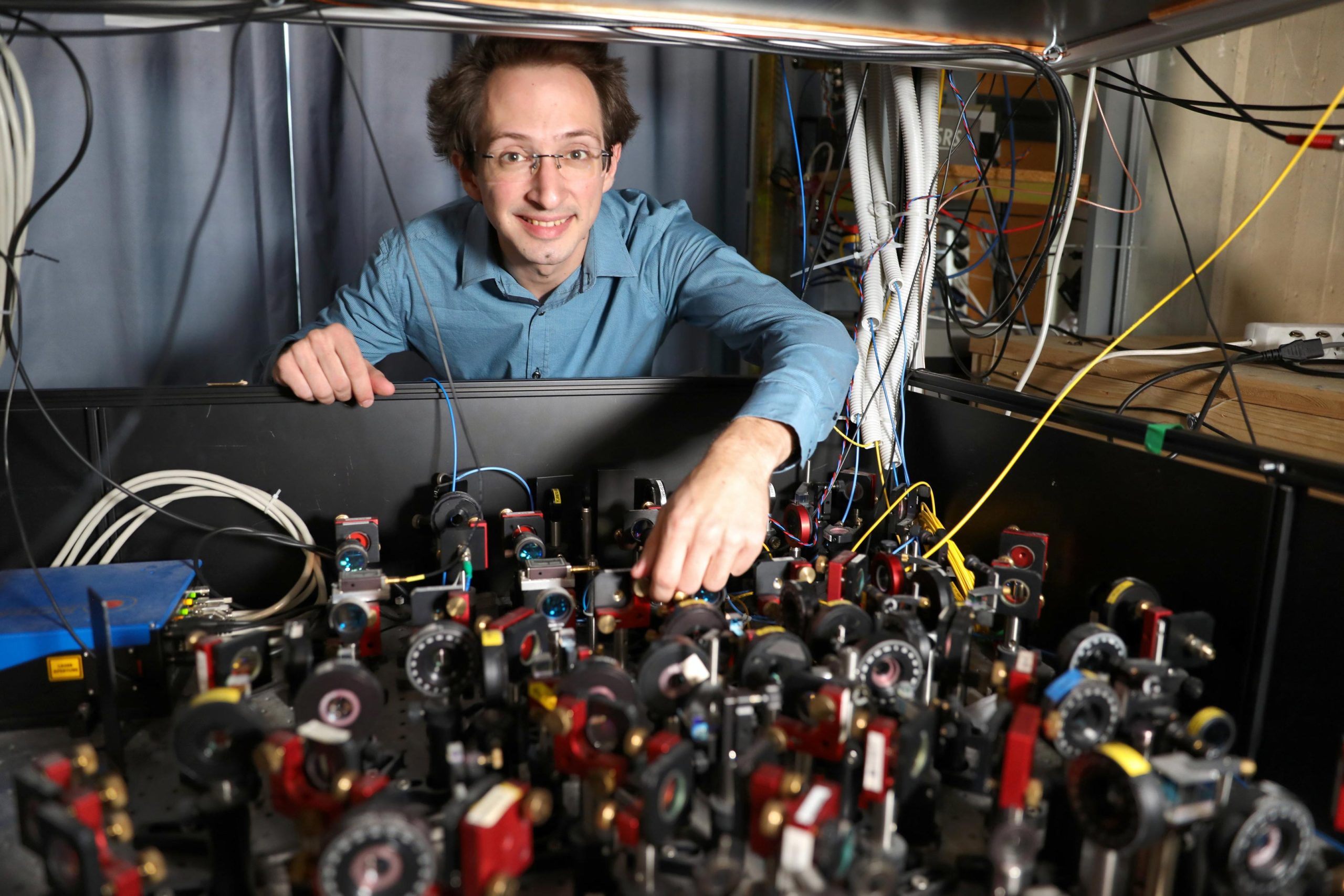
    Martin Ringbauer
    Quantum physicist Martin Ringbauer in his lab. Credit: Uni Innsbruck

    However, the situation is quite different in the quantum world. For example, in the Innsbruck quantum computer, information is stored in individually trapped Calcium atoms. Each of these atoms naturally has eight different states, of which only two are usually used to store information. Indeed, almost all existing quantum computers have access to more quantum states than they actually use for computation.

    A Natural Approach for Hardware and Software

    The physicists from Innsbruck now designed a quantum computer that can make use of the full potential of these atoms, by computing with qudits. Contrary to the classical case, using more states does not make the computer less reliable in this instance. “Quantum systems naturally have more than just two states and we showed that we can control them all equally well,” says Thomas Monz.

    On the flip side, many of the tasks that need quantum computers, such as problems in physics, chemistry, or material science, are also naturally expressed in the qudit language. Rewriting them for qubits can often make them too complicated for today’s quantum computers. “Working with more than zeros and ones is very natural, not only for the quantum computer but also for its applications, allowing us to unlock the true potential of quantum systems,” explains Martin Ringbauer.

    Reference: “A universal qudit quantum processor with trapped ions” by Martin Ringbauer, Michael Meth, Lukas Postler, Roman Stricker, Rainer Blatt, Philipp Schindler and Thomas Monz, 21 July 2022, Nature Physics.
    DOI: 10.1038/s41567-022-01658-0

    Funding: Horizon 2020 Framework Program, Austrian Science Fund

    Never miss a breakthrough: Join the SciTechDaily newsletter.
    Follow us on Google and Google News.

    Popular Quantum Computing University of Innsbruck
    Share. Facebook Twitter Pinterest LinkedIn Email Reddit

    Related Articles

    A New, Faster Type of Quantum Computer

    Fundamental Breakthrough: Error-Free Quantum Computing Gets Real

    New Superconducting Material Discovered That Could Power Quantum Computers of the Future

    New Tunable Optical Chips Can Be Used As Building-Blocks for Next Generation Quantum Computers

    Scientists Pave the Way for Quantum Computing by Coupling Magnetization to Superconductivity

    A New Model of a Quantum Computer

    Engineers Show Feasibility of Organic Topological Insulators

    Yale Physicists Observe Quantum Information While Preserving Its Integrity

    Electronic Read-Out of the Quantum State of an Atom

    Leave A Reply Cancel Reply

    • Facebook
    • Twitter
    • Pinterest
    • YouTube

    Don't Miss a Discovery

    Subscribe for the Latest in Science & Tech!

    Trending News

    Scientists May Have Found the Key to Jupiter and Saturn’s Moon Mystery

    Scientists Uncover Brain Changes That Link Pain to Depression

    Saunas May Do More Than Raise Body Temperature – They Activate Your Immune System

    Exercise in a Pill? Metformin Shows Surprising Effects in Cancer Patients

    Hidden Oceans of Magma Could Be Protecting Alien Life

    New Study Challenges Alzheimer’s Theories: It’s Not Just About Plaques

    Artificial Sweeteners May Harm Future Generations, Study Suggests

    Splashdown! NASA Artemis II Returns From Record-Breaking Moon Mission

    Follow SciTechDaily
    • Facebook
    • Twitter
    • YouTube
    • Pinterest
    • Newsletter
    • RSS
    SciTech News
    • Biology News
    • Chemistry News
    • Earth News
    • Health News
    • Physics News
    • Science News
    • Space News
    • Technology News
    Recent Posts
    • Physicists Discover a Strange New Kind of One-Dimensional Particle
    • Scientists Discover Unexpected Climate Benefit Hidden in Forest Soils
    • The Grand Canyon’s “Swiss Cheese” Rocks Hold a Critical Secret
    • Scientists Discover 430,000-Year-Old Wooden Tools, Rewriting Human History
    • Scientists Make Breakthrough on 40-Year-Old 2D Physics Puzzle
    Copyright © 1998 - 2026 SciTechDaily. All Rights Reserved.
    • Science News
    • About
    • Contact
    • Editorial Board
    • Privacy Policy
    • Terms of Use

    Type above and press Enter to search. Press Esc to cancel.