

Close Menu
    Facebook X (Twitter) Instagram
    SciTechDaily
    • Biology
    • Chemistry
    • Earth
    • Health
    • Physics
    • Science
    • Space
    • Technology
    Facebook X (Twitter) Pinterest YouTube RSS
    SciTechDaily
    Home»Science»Scientists Discover 430,000-Year-Old Wooden Tools, Rewriting Human History
    Science

    Scientists Discover 430,000-Year-Old Wooden Tools, Rewriting Human History

    By University of TübingenApril 15, 20263 Comments5 Mins Read
    Facebook Twitter Pinterest Telegram LinkedIn WhatsApp Email Reddit
    Share
    Facebook Twitter LinkedIn Pinterest Telegram Email Reddit
    Artist’s Reconstruction of a Marathousa 1 Paleolithic Woman
    An artist’s reconstruction of a Marathousa 1 paleolithic woman producing a digging stick from a small alder tree trunk with a small stone tool. This kind of wood was used for the Marathousa 1 digging stick. Use-wear analysis of stone tools at Marathousa 1 shows evidence of woodworking. Credit: Original art by G. Prieto, copyright K. Harvati.

    An international research team from Germany, the UK, and Greece has found evidence that wooden tools were used in Greece 430,000 years ago.

    An international collaboration involving researchers from the Universities of Tübingen and Reading and the Senckenberg Nature Research Society has identified what are now considered the earliest known hand-held wooden tools used by humans.

    The study, led by Professor Katerina Harvati from the Senckenberg Center for Human Evolution and Palaeoenvironment at the University of Tübingen and Dr. Annemieke Milks at the University of Reading, focuses on discoveries made at the Marathousa 1 site in the central Peloponnese region of Greece. The findings date back approximately 430,000 years.
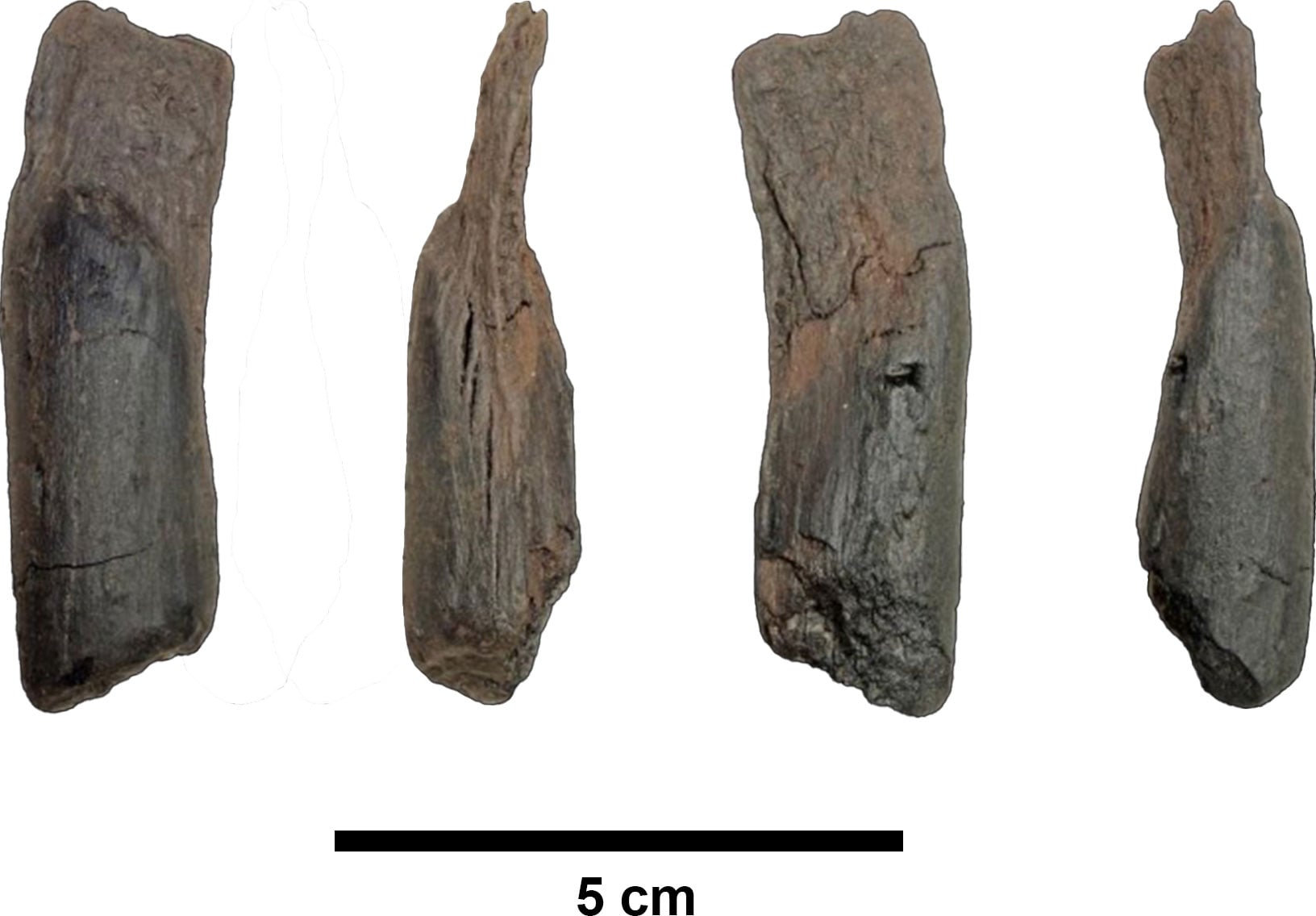
    Prehistoric Wooden Tool From Marathousa Site
    A small wooden tool, which is a new wood tool type used by humans, documented here for the first time from the Marathousa 1 site in Greece, which dates back 430,000 years. Currently, the function of the tool is not known. Credit: Photograph by N. Thompson, copyright K. Harvati.

    Discovery pushes back tool timeline

    Reported in the journal PNAS, the discoveries include two wooden objects shaped and used by early humans. One is made from alder wood, while the other comes from willow or poplar. These items are now recognized as the oldest hand-held wooden tools ever identified, extending the known timeline of this type of technology by at least 40,000 years.

    Additional evidence from the site, including stone tools and the remains of an elephant and other animals, suggests the location once served as a lakeside butchering area. Early humans occupied the site around 430,000 years ago during the Middle Pleistocene – the period from around 774,000 to 129,000 years ago.

    “The Middle Pleistocene was a critical phase in human evolution, during which more complex behaviors developed. The earliest reliable evidence of the targeted technological use of plants also dates from this period,” says Professor Katerina Harva-ti, a paleoanthropologist and expert in human evolution, who leads the long-term research program at Marathousa 1.

    Microscopic analysis reveals human craftsmanship

    Finds of shaped stone and bone tools had already demonstrated the range of activities carried out by the people who lived at the site, prompting the research team to examine preserved wooden fragments in greater detail.

    “Unlike stones, wooden objects need special conditions to survive over long periods of time,” says Dr Annemieke Milks, a leading expert in early wooden tools. “We examined all the wooden remains closely, looking at their surfaces under microscopes. We found marks from chopping and carving on two objects – clear signs that early humans had shaped them.”

    Prehistoric Wooden Digging Stick From Marathousa
    Digging or multifunctional stick used by humans from the Marathousa 1 site in Greece which dates back 430,000 years. Credit: Photograph by D. Michailidis, copyright K. Harvati.

    Through this analysis, the team confirmed that two wooden pieces had been modified and used by humans. One fragment, taken from an alder trunk, shows both shaping marks and signs of wear, suggesting it may have been used for digging near the lake or for stripping bark.

    A second, much smaller fragment made from willow or poplar also displays signs of working and possible use. In contrast, a third piece of alder wood featuring a grooved pattern was determined to have been marked by a large carnivore, possibly a bear, rather than by human activity.

    Evidence challenges global record of tools

    “The oldest wooden tools come from places such as the United Kingdom, Zambia, Germany, and China and include weapons, digging sticks, and tool handles. However, they are all more recent than our finds from Marathousa 1m,” Annemieke Milks says. There is only one older piece of evidence of wood used by humans, from the Kalambo Falls site in Zambia, dating to around 476,000 years ago. Yet that wood was used not as a tool but as structural material.

    “We have discovered the oldest wooden tools known to date, as well as the first evidence of this kind from southeastern Europe,” Harvati says. “This shows once again how exceptionally good the conditions at the Marathousa 1 site are for preservation. And the fact that large carnivores left their mark near the butchered elephant alongside human activity indicates fierce competition between the two.”

    Reference: “Evidence for the earliest hominin use of wooden handheld tools found at Marathousa 1 (Greece)” by Annemieke Milks, Maria Ntinou, Stylianos Koutalis, Dimitrios Michailidis, George E. Konidaris, Domenico Giusti, Nicholas Thompson, Georgia Tsartsidou, Eleni Panagopoulou, Vangelis Tourloukis, Panagiotis Karkanas and Katerina Harvati, 26 January 2026, Proceedings of the National Academy of Sciences.
    DOI: 10.1073/pnas.2515479123

    Research on the Marathousa 1 finds is funded by the European Research Council and the German Science Foundation.

    Never miss a breakthrough: Join the SciTechDaily newsletter.
    Follow us on Google and Google News.

    Anthropology Archaeology History Paleoanthropology Paleontology Popular
    Share. Facebook Twitter Pinterest LinkedIn Email Reddit

    Related Articles

    When Good Governments Go Bad: History Shows That Societies Collapse When Leaders Undermine Social Contracts

    Defining Moment in Human Evolution: Turbulent Era Sparked Leap in Human Behavior, Technology 320,000 Years Ago

    World’s Largest DNA Analysis of Viking Skeletons Yields Unexpected Results About Who They Really Were

    Vast Stone Monuments Discovered in Saudi Arabia Were Constructed in 7,000 Years Ago

    DNA of Bones Found in Cave Reveals Major Cultural Transition in Europe Took Place Earlier Than Thought

    Earliest Interbreeding Between Ancient Human Populations Discovered – Evolutionary Puzzle Solved

    Mystery Surrounding Dinosaur Footprints on a Cave Ceiling Finally Solved

    How Ancient Poop Debunked Myth of Native American Lost Civilization

    New Evidence Shows Humans Mastered Fire Earlier Than Thought

    3 Comments

    1. kamir bouchareb st on April 15, 2026 1:36 pm

      nice

      Reply
    2. BigA on April 15, 2026 8:34 pm

      Hahaha 😆

      Reply
    3. Mat on April 19, 2026 3:41 pm

      Stick is used to put in slice in carcass to hold it open to then cut further into the animal being butchered.

      Reply
    Leave A Reply Cancel Reply

    • Facebook
    • Twitter
    • Pinterest
    • YouTube

    Don't Miss a Discovery

    Subscribe for the Latest in Science & Tech!

    Trending News

    Largest-Ever Study Finds Medicinal Cannabis Ineffective for Anxiety, Depression, PTSD

    250-Million-Year-Old Egg Solves One of Evolution’s Biggest Mysteries

    Living With Roommates Might Be Changing Your Gut Microbiome Without You Knowing

    Century-Old Cleaning Chemical Linked to 500% Increased Risk of Parkinson’s Disease

    What if Your Memories Never Happened? Physicists Take a New Look at the Boltzmann Brain Paradox

    One of the Universe’s Largest Stars May Be Getting Ready To Explode

    Scientists Discover Enzyme That Could Supercharge Ozempic-Like Weight Loss Drugs

    Popular Sweetener Linked to DNA Damage – “It’s Something You Should Not Be Eating”

    Follow SciTechDaily
    • Facebook
    • Twitter
    • YouTube
    • Pinterest
    • Newsletter
    • RSS
    SciTech News
    • Biology News
    • Chemistry News
    • Earth News
    • Health News
    • Physics News
    • Science News
    • Space News
    • Technology News
    Recent Posts
    • Scientists Say This Overlooked Organ Could Hold the Key to Longer Life
    • Want Less Stress? Landmark Study Points to a Simple Habit
    • Scientists Reveal Eating Fruits and Vegetables May Increase Your Risk of Lung Cancer
    • AI Reveals Explosive Growth of Floating Algae Across the World’s Oceans
    • 5.5 Million Bees Discovered Living Beneath a New York Cemetery
    Copyright © 1998 - 2026 SciTechDaily. All Rights Reserved.
    • Science News
    • About
    • Contact
    • Editorial Board
    • Privacy Policy
    • Terms of Use

    Type above and press Enter to search. Press Esc to cancel.