

Responsive material changes its behavior based on earlier conditions.
Inspired by living systems, a new material has been developed that changes its electrical behavior based on previous experience, effectively giving it a basic form of adaptive memory. Such adaptive materials could play a vital role in the next generation of medical and environmental sensors, as well as in soft robots or active surfaces. The breakthrough was achieved by researchers at Aalto University in Finland.
Responsive materials have become common in a range of applications, from glasses that darken in sunlight to drug delivery systems. However, existing materials always react in the same way each time. Their response to a change doesn’t depend on their history, nor do they adapt based on their past.
This is fundamentally different from living systems, which dynamically adapt their behavior based on previous conditions. “One of the next big challenges in material science is to develop truly smart materials inspired by living organisms. We wanted to develop a material that would adjust its behavior based on its history,” says Bo Peng, an Academy Research Fellow at Aalto University who was one of the senior authors of this study.
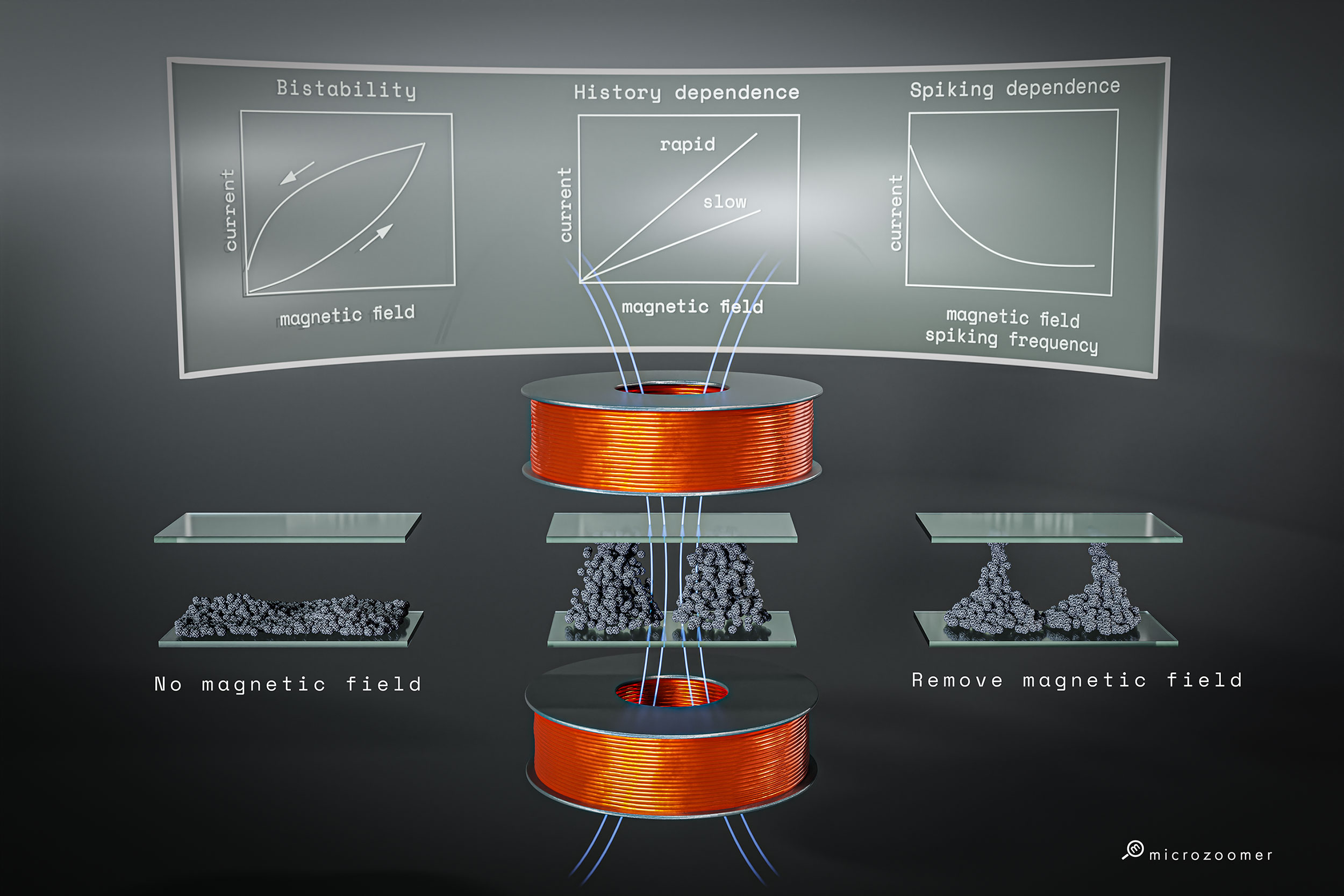
The researchers synthesized micrometer-sized magnetic beads which were then stimulated by a magnetic field. When the magnet was on, the beads stacked up to form pillars. The strength of the magnetic field affects the shape of the pillars, which in turn affects how well they conduct electricity.
“With this system, we coupled the magnetic field stimulus and the electrical response. Interestingly, we found that the electrical conductivity depends on whether we varied the magnetic field rapidly or slowly. That means that the electrical response depends on the history of the magnetic field. The electrical behavior was also different if the magnetic field was increasing or decreasing. The response showed bistability, which is an elementary form of memory. The material behaves as though it has a memory of the magnetic field,” explains Peng.
Basic Learning
The system’s memory also allows it to behave in a way that resembles rudimentary learning. Although learning in living organisms is enormously complex, its most basic element in animals is a change in the response of connections between neurons, known as synapses. Depending on how frequently they are stimulated, synapses in a neuron will become harder or easier to activate. This change, known as short-term synaptic plasticity, makes the connection between a pair of neurons stronger or weaker depending on their recent history.
The researchers were able to accomplish something similar with their magnetic beads, even though the mechanism is totally differently. When they exposed the beads to a quickly pulsing magnetic field, the material became better at conducting electricity, whereas slower pulsing made it conduct poorly.
“This is reminiscent of short term-synaptic plasticity,” says Aalto’s Distinguished Professor Olli Ikkala. “Our material functions a bit like a synapse. What we’ve demonstrated paves the way for the next generation of life-inspired materials, which will draw on biological process of adaptation, memory, and learning.”
“In the future, there could be even more materials that are algorithmically inspired by life-like properties, though they won’t involve the full complexity of biological systems. Such materials will be central to the next generation of soft robots and for medical and environmental monitoring,” adds Ikkala.
Reference: “Magnetic field–driven particle assembly and jamming for bistable memory and response plasticity” by Xianhu Liu, Hongwei Tan, Carlo Rigoni, Teemu Hartikainen, Nazish Asghar, Sebastiaan van Dijken, Jaakko V. I. Timonen, Bo Peng and Olli Ikkala, 11 November 2022, Science Advances.
DOI: 10.1126/sciadv.adc9394
Never miss a breakthrough: Join the SciTechDaily newsletter.
Follow us on Google and Google News.