

Researchers at Aalto University have uncovered the thermal energy loss in qubits through a simple experimental setup, shedding light on superconducting qubit coherence loss in quantum computers.
The study, involving physicists and an international team, focuses on superconducting Josephson junctions, crucial for high-performance quantum computing, and provides insights into thermal dissipation and its impact on qubit efficiency.
Measuring Superconducting Qubit Coherence Loss
Physicists from Aalto University in Finland, alongside an international team of collaborators, have theoretically and experimentally shown that superconducting qubit coherence loss can be directly measured as thermal dissipation in the electrical circuit holding the qubit.
At the heart of the most advanced quantum computers and ultrasensitive detectors are superconducting Josephson junctions, the basic elements of qubits – or quantum bits. As the name suggests, these qubits and their circuitry are very efficient conductors of electricity.
Understanding Thermal Dissipation in Qubits
“Despite the fast progress of making high-quality qubits, there has remained an important unresolved question: how and where does thermal dissipation occur?” says Bayan Karimi, a postdoctoral researcher in the Pico research group at Aalto University and the first author of the study.
“We have developed for a long time the methods for measuring this loss based on our group’s expertise in quantum thermodynamics,” adds Jukka Pekola, the Aalto University professor who heads the Pico research group.
As physicists continue to push for ever more efficient qubits in the race to hone the technology surrounding quantum devices, these new data allow researchers to better understand how their qubits decay. In terms of quantum computing, qubits with longer coherence times allow for more operations, leading to more complex calculations unachievable in classical computing environments.
Tracing Energy Loss to Thermal Radiation
The transmission of supercurrents is made possible by the Josephson effect, where two closely spaced superconducting materials can support a current with no applied voltage. As a result of the study, previously unattributed energy loss can be traced to thermal radiation originating at the qubits and propagating down the leads.
Think of a campfire warming someone at the beach – the ambient air stays cold, but the person still feels the warmth radiating from the fire. Karimi says this same type of radiation leads to dissipation in the qubit.
This loss has been noted before by physicists who have conducted experiments on large arrays of hundreds of Josephson junctions placed in circuit. Like a game of telephone, one of these junctions would seem to destabilize the rest further down the line.
A Simple Experimental Setup Yields Big Results
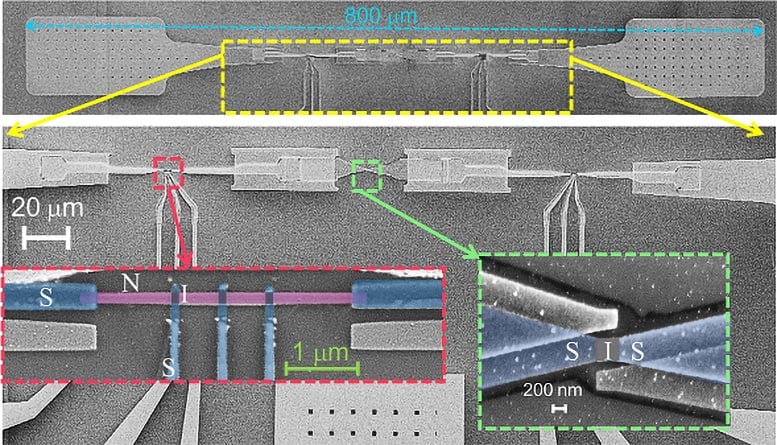
Originally formulating their experiments with these many junctions in an array, Karimi, Pekola, and the team started tracing their way backward to more and more simple experiments. Their final experimental setup: observing the effects of tweaking the voltage at a single Josephson junction. By placing an ultrasensitive thermal absorber next to this junction, they were able to passively measure the very weak radiation emitted from this junction at each phase transition in a broad range of frequencies up to 100 gigahertz.
The theoretical work of the group was accomplished in partnership with colleagues from the University of Madrid. The research was published on August 22nd in Nature Nanotechnology.
Reference: “Bolometric detection of Josephson radiation” by Bayan Karimi, Gorm Ole Steffensen, Andrew P. Higginbotham, Charles M. Marcus, Alfredo Levy Yeyati and Jukka P. Pekola, 22 August 2024, Nature Nanotechnology.
DOI: 10.1038/s41565-024-01770-7
The work was done in collaboration with the InstituteQ Chair of Excellence professor Charles Marcus of the University of Washington, in the USA, and Niels Bohr Institute in Copenhagen, Denmark. The fabrication of the devices used in the experiments utilized the cleanrooms of OtaNano, Finland’s national research infrastructure for micro- and nanotechnologies. The work was also made possible by the Research Council of Finland via the Quantum Technology Finland (QTF) Centre of Excellence and THEPOW consortium.
Never miss a breakthrough: Join the SciTechDaily newsletter.
Follow us on Google and Google News.
2 Comments
The AI bubble is bursting soon and the investment money needs a new bubble. Quantum computing looks like the next one. Now if they could just patch up those glitches enough to get the hype train going…
Just kidding. Quantum computing is just like fusion – always ten years away.
From what I have read the Qubit loses a robustness when transmitted , could the Qubit at its most robust point be transitioned into a Photon light beam that is flavored to correspond to its meaning then transmitted to be gathered for information correlation . As far as the construction of a superconductor for room temperature most examples are thick solids at very low sub temperatures, I have read recently that they have found that electrons in a solid are dark electrons I see this as how the difference of electron charges very in solid materials of thickness, with that difference in mind could a superconductor for room temperature be realised when the material is only one Atom in thickness then layered in a fashion to create a thicker more useful size.