
Close Menu
    Facebook X (Twitter) Instagram
    SciTechDaily
    • Biology
    • Chemistry
    • Earth
    • Health
    • Physics
    • Science
    • Space
    • Technology
    Facebook X (Twitter) Pinterest YouTube RSS
    SciTechDaily
    Home»Technology»Tiny Titans of Tech: How Moiré Excitons Are Advancing Quantum Computing
    Technology

    Tiny Titans of Tech: How Moiré Excitons Are Advancing Quantum Computing

    By Kyoto UniversityAugust 3, 2024No Comments2 Mins Read
    Facebook Twitter Pinterest Telegram LinkedIn WhatsApp Email Reddit
    Share
    Facebook Twitter LinkedIn Pinterest Telegram Email Reddit
    Moiré Excitons
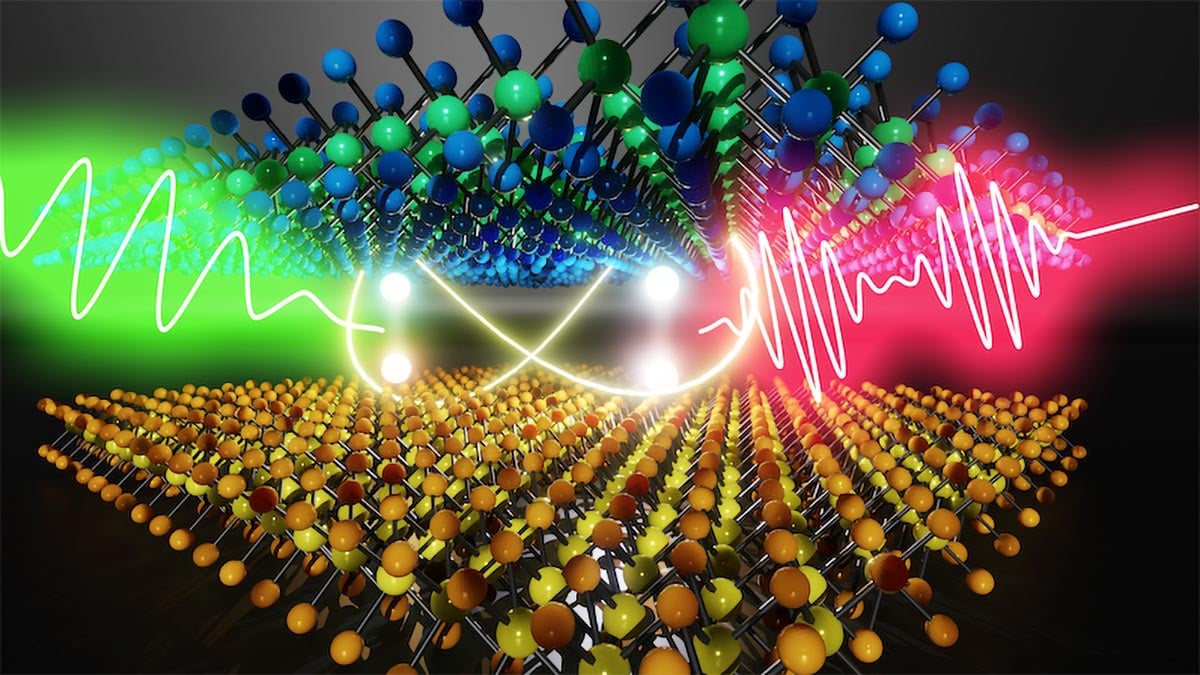
    An artist’s rendering of moiré excitons in a nano-semiconductor. Credit: KyotoU/Matsuda Lab

    Researchers at Kyoto University have developed a groundbreaking method to measure the quantum coherence time of moiré excitons, potentially improving qubits for quantum computing.

    By using advanced microfabrication and etching techniques combined with Michelson interferometry, they observed enhanced stability in quantum coherence at extremely low temperatures, significantly outperforming traditional excitons in semiconductors.

    Quantum technology is quantifiable in qubits, which are the most basic unit of data in quantum computers. The operation of qubits is affected by the quantum coherence time required to maintain a quantum wave state.

    Scientists have hypothesized that moiré excitons — electron-hole pairs confined in moiré interference fringes that overlap with slightly offset patterns — may function as qubits in next-generation nano-semiconductors.

    However, due to diffraction limits, it has not been possible to focus light enough in measurements, causing optical interference from many moiré excitons.

    Breakthrough in Quantum Coherence Measurement

    To solve this, Kyoto University researchers have developed a new method of reducing these moiré excitons to measure the quantum coherence time and realize quantum functionality. The team has observed changing photoluminescence signals of moiré excitons following the fabrication process.

    “We combined electron beam microfabrication techniques with reactive ion etching. By utilizing Michelson interferometry on the emission signal from a single moiré exciton, we could directly measure its quantum coherence time,” Kazunari Matsuda of KyotoU’s Institute Advanced Energy explains.

    Implications for Quantum Computing

    The results show that the quantum coherence of a single moiré exciton remains steady at -269°C for more than 12 picoseconds, ten times longer than that of an exciton in the parent material, a two-dimensional semiconductor. The confined moiré excitons in interference fringes prevent loss of quantum coherence.

    “We plan to establish a foothold for the next phase of experiments for advancing quantum computing and other quantum technologies in the next generation of nano-semiconductors,” adds Matsuda.

    Reference: “Quantum coherence and interference of a single moiré exciton in nano-fabricated twisted monolayer semiconductor heterobilayers” by Haonan Wang, Heejun Kim, Duanfei Dong, Keisuke Shinokita, Kenji Watanabe, Takashi Taniguchi and Kazunari Matsuda, 8 June 2024, Nature Communications.
    DOI: 10.1038/s41467-024-48623-4

    Never miss a breakthrough: Join the SciTechDaily newsletter.
    Follow us on Google and Google News.

    2D Materials Kyoto University Nanotechnology Quantum Computing Quantum Information Science Qubits
    Share. Facebook Twitter Pinterest LinkedIn Email Reddit

    Related Articles

    How Silicon Ring Resonators Are Rewriting the Rules of Quantum Computing

    Chaining Atoms Together Using Nuclear Spins Yields Quantum Storage

    Shrinking Superconducting Qubits for Quantum Computing With Atom-Thin Materials

    Atomically-Thin, Twisted Graphene Has Unique Properties That Could Advance Quantum Computing

    MIT Turns “Magic” Superconducting Material Into Versatile Electronic Devices

    Scientists Create Quietest Semiconductor Quantum Bits Ever – 10 Times Lower Noise Than Previous Record

    Silicon Qubits Could Be the Key to a Quantum Revolution

    USC Study Validates Large-Scale Quantum Chip

    New Spin Technique Moves Quantum Computers a Step Closer

    Leave A Reply Cancel Reply

    • Facebook
    • Twitter
    • Pinterest
    • YouTube

    Don't Miss a Discovery

    Subscribe for the Latest in Science & Tech!

    Trending News

    New Pill Lowers Stubborn Blood Pressure and Protects the Kidneys

    Humans May Have Hidden Regenerative Powers, New Study Suggests

    Scientists Just Solved the Mystery of Why Crabs Walk Sideways

    Doctors Are Surprised by What This Vaccine Is Doing to the Heart

    This Popular Supplement May Boost Your Brain, Not Just Your Muscles

    Scientists Say This Simple Supplement May Actually Reverse Heart Disease

    Warming Oceans Could Trigger a Dangerous Methane Surge

    This Simple Movement Could Be Secretly Cleaning Your Brain

    Follow SciTechDaily
    • Facebook
    • Twitter
    • YouTube
    • Pinterest
    • Newsletter
    • RSS
    SciTech News
    • Biology News
    • Chemistry News
    • Earth News
    • Health News
    • Physics News
    • Science News
    • Space News
    • Technology News
    Recent Posts
    • Hidden Heart Risk Found in 1 in 5 People, Study Warns
    • Scientists Say This Daily Walking Habit May Be the Secret to Keeping Weight Off After Dieting
    • New Therapy Rewires the Brain To Restore Joy in Depression Patients
    • Researchers Discover Efficient New Way To Split Hydrogen From Water for Energy
    • This Korean Skincare Ingredient Could Help Fight Deadly Superbugs
    Copyright © 1998 - 2026 SciTechDaily. All Rights Reserved.
    • Science News
    • About
    • Contact
    • Editorial Board
    • Privacy Policy
    • Terms of Use

    Type above and press Enter to search. Press Esc to cancel.