
Close Menu
    Facebook X (Twitter) Instagram
    SciTechDaily
    • Biology
    • Chemistry
    • Earth
    • Health
    • Physics
    • Science
    • Space
    • Technology
    Facebook X (Twitter) Pinterest YouTube RSS
    SciTechDaily
    Home»Technology»Experiment With Turnstiles of Single Electrons Lights Way Towards New Power Standard
    Technology

    Experiment With Turnstiles of Single Electrons Lights Way Towards New Power Standard

    By Aalto UniversityFebruary 12, 20222 Comments4 Mins Read
    Facebook Twitter Pinterest Telegram LinkedIn WhatsApp Email Reddit
    Share
    Facebook Twitter LinkedIn Pinterest Telegram Email Reddit
    Atoms Electrons Concept
    Researchers at Aalto University have developed a device that converts frequency to power, providing a reliable new way to link the watt to constants of Nature.

    Researchers at Aalto University propose method of transducing frequency to power.

    The world’s most commonly used system of measurement, the International System of Units (SI), was redefined in 2019. Since then, units have needed to be defined in terms of the constants of Nature – that is, Nature’s rules that are fixed and of no uncertainty, such as the speed of light – and not in terms of arbitrary references.

    This has meant that new research for relating the many units of the system to the constants through experimental realizations has been called for.

    “The redefinition has caused a need for new realizations,” says Professor Jukka Pekola.

    Linking the Watt to Natural Constants

    Researchers at Aalto University have now found a promising new way to link the watt (the unit of power) to the constants of Nature. They believe their method could show the way towards a new power standard, that is, a new way to produce an apriori known amount of power against which other power sources and detectors can be compared.

    The researchers have developed a device that converts frequency to power. Frequency is a quantity that can be set with low uncertainty, and therefore it provides a solid basis for a new standard.
    Measured Power at Different Device Working Points
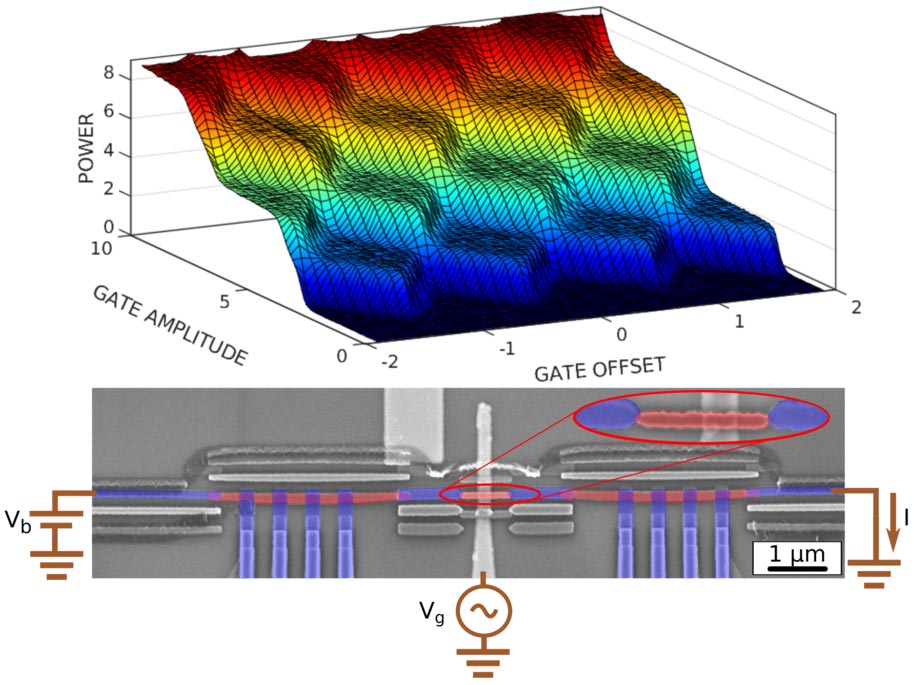
    Measured power at different device working points (top). Its values are even integer multiples of Δf, hence the plateau structure of this figure. The device (bottom) is constituted by a small metallic island, source and drain leads and a gate electrode. Credit: Aalto University

    “Frequency can be defined very, very precisely. If you can make the other quantities depend on frequency in a known way, then you have a very accurate standard,” Pekola says.

    Furthermore, the researchers have discovered that such dependence obeys a simple law with accuracy and robustness.

    “These characteristics increase the chances of using this method as a standard,” says Marco Marín Suárez, a doctoral candidate.

    “Basically, this is a potential new way of realizing a watt, or energy flux, just by setting previously known quantities,” describes Marín Suárez.

    Potential New Realization of the Watt

    In the experiment, power is produced with a single-electron transistor in its turnstile operation. This device was previously proved by Pekola to work as a potential standard for the ampere, the unit of electrical current. It is constituted by a small metallic island, source and drain leads and a gate electrode, and it can address very small powers.

    The way from a proposal to an actual accepted new standard is long. Aalto researchers hope that their work will next attract the attention of metrologists who would take it further with more precise measurements.

    “This first experiment was not on the level of metrology yet. We could demonstrate that this principle works, though, and we have also shown where the main errors come from. It remains to be seen if this comes to be adopted by the metrology community,” Pekola sums up.

    The researchers seek now to push their proposal forward by characterizing how well the frequency to power conversion law adjusts to their method. This will increase the accuracy at which small powers can be calibrated.

    Reference: “An electron turnstile for frequency-to-power conversion” by Marco Marín-Suárez, Joonas T. Peltonen, Dmitry S. Golubev and Jukka P. Pekola, 20 January 2022, Nature Nanotechnology.
    DOI: 10.1038/s41565-021-01053-5

    The experiments were conducted at the OtaNano national research infrastructure. Professor Pekola’s group is part of the QTF Centre of Excellence and InstituteQ, the Finnish quantum institute.

    Never miss a breakthrough: Join the SciTechDaily newsletter.
    Follow us on Google and Google News.

    Aalto University Electrons Nanotechnology
    Share. Facebook Twitter Pinterest LinkedIn Email Reddit

    Related Articles

    Not Graphene: New Type of Atomically Thin Carbon Material Discovered

    Unlocking the Next Generation of Computer Technology: New Nanoscale Device for Spintronics

    Scientists Use Bacteria As Micro-3D Printers to Create Highly Customized Structures

    Black Silicon Photodetector Breaks the 100% Efficiency Limit, Shocking Scientists

    New Detector Breakthrough Is Potential Game-Changer for Quantum Computing

    Pavlov’s Soft Robot: Liquid Crystal Polymer Learns to Move and Grab Objects

    Ultra-Clean Carbon Nanotube Transistors With Superior Semiconducting Properties

    Mapping the Pathways of Electrical Charge From Molecule to Molecule

    “Designer Electrons” Have Tunable Properties

    2 Comments

    1. Walt on February 13, 2022 10:33 am

      Might this not also affect our understanding of time?

      Reply
    2. BibhutibhusanPatel on February 14, 2022 2:27 am

      Electon is always rational to power emitted as has quantum radiation
      ,so related to a nature’s constant.Hence the device has no new theory in work.

      Reply
    Leave A Reply Cancel Reply

    • Facebook
    • Twitter
    • Pinterest
    • YouTube

    Don't Miss a Discovery

    Subscribe for the Latest in Science & Tech!

    Trending News

    Popular Supplement Ingredient Linked to Shorter Lifespan in Men

    Scientists May Have Found a Way To Repair Nerve Damage in Multiple Sclerosis

    “Totally Unexpected” – Scientists Discover Pancreatic Cancer’s Fatal Addiction

    A Strange Quantum Effect May Explain One of Biology’s Greatest Mysteries

    James Webb Telescope Reveals the Universe’s Hidden Cosmic Web in Stunning Detail

    Scientists Identify Simple Supplement That Greatly Reduces Alzheimer’s Damage

    You May Have a Dangerous Type of Cholesterol Even if Your Tests Look Normal

    Your Blood Pressure Reading Could Be Wrong Because of One Simple Mistake

    Follow SciTechDaily
    • Facebook
    • Twitter
    • YouTube
    • Pinterest
    • Newsletter
    • RSS
    SciTech News
    • Biology News
    • Chemistry News
    • Earth News
    • Health News
    • Physics News
    • Science News
    • Space News
    • Technology News
    Recent Posts
    • Cancer Mystery Solved: Scientists Discover How Melanoma Becomes “Immortal”
    • Scientists Uncover Cancer-Fighting Power of Popular Fatty Liver Drug
    • Beyond Pain Relief: Scientists Discover a Protein That Could Stop Osteoarthritis in Its Tracks
    • NASA’s New AI Processor Is 500x Faster Than Current Space Computers
    • Scientists Find Evidence Earth Is Drifting Through the Ashes of an Exploded Star
    Copyright © 1998 - 2026 SciTechDaily. All Rights Reserved.
    • Science News
    • About
    • Contact
    • Editorial Board
    • Privacy Policy
    • Terms of Use

    Type above and press Enter to search. Press Esc to cancel.