
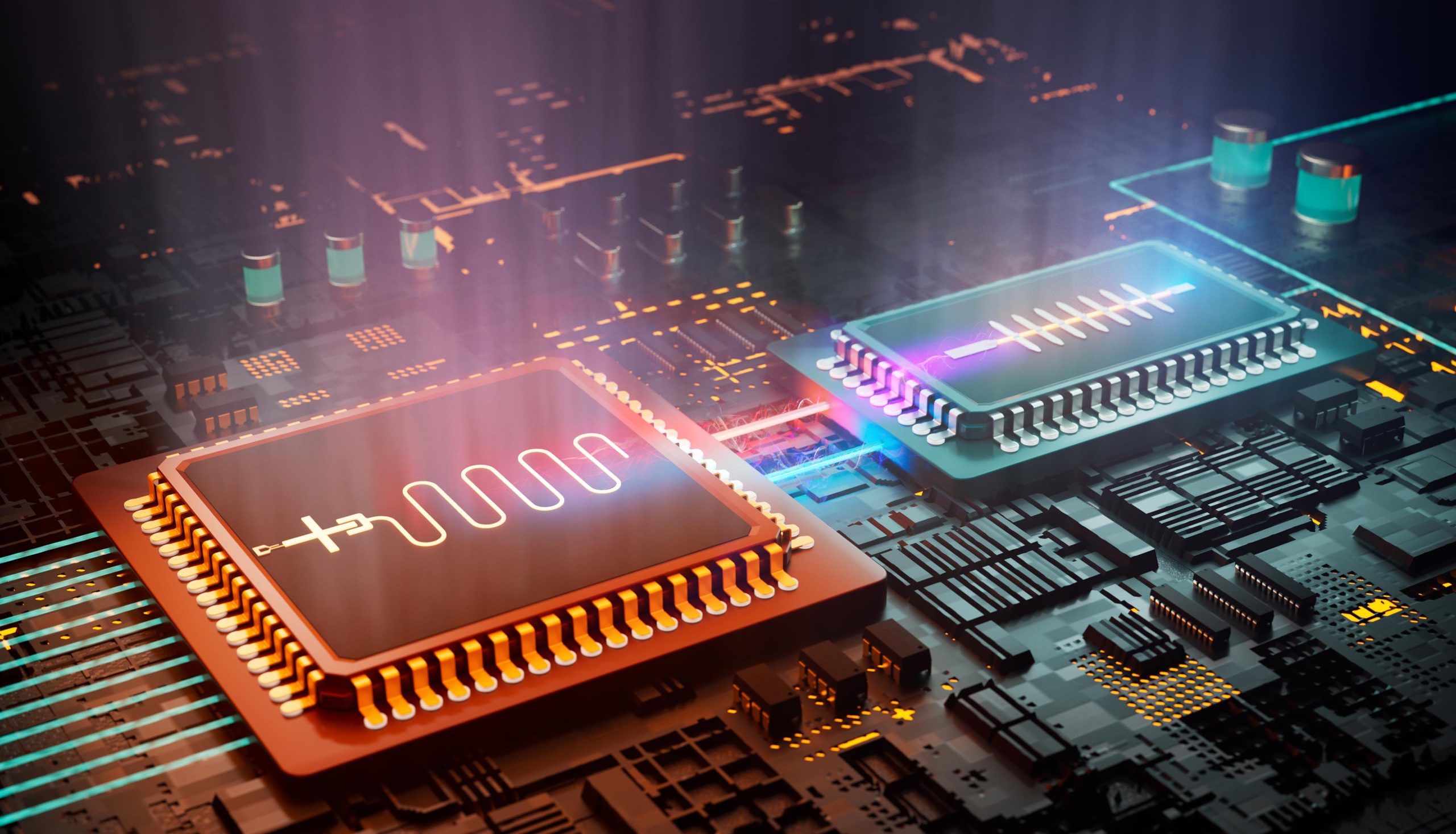
Aalto University researchers are the first in the world to measure qubits with ultrasensitive thermal detectors—thus evading the Heisenberg uncertainty principle.
Chasing ever-higher qubit counts in near-term quantum computers constantly demands new feats of engineering.
Among the troublesome hurdles of this scaling-up race is refining how qubits are measured. Devices called parametric amplifiers are traditionally used to do these measurements. But as the name suggests, the device amplifies weak signals picked up from the qubits to conduct the readout, which causes unwanted noise and can lead to decoherence of the qubits if not protected by additional large components. More importantly, the bulky size of the amplification chain becomes technically challenging to work around as qubit counts increase in size-limited refrigerators.
Bolometer-Based Qubit Measurement
Cue the Aalto University research group Quantum Computing and Devices (QCD). They have a hefty track record of showing how thermal bolometers can be used as ultrasensitive detectors, and they just demonstrated in an April 10 Nature Electronics paper that bolometer measurements can be accurate enough for single-shot qubit readout.
Overcoming the Heisenberg Uncertainty Principle
To the chagrin of many physicists, the Heisenberg uncertainty principle determines that one cannot simultaneously know a signal’s position and momentum, or voltage and current, with accuracy. So it goes with qubit measurements conducted with parametric voltage-current amplifiers. But bolometric energy-sensing is a fundamentally different kind of measurement—serving as a means of evading Heisenberg’s infamous rule. Since a bolometer measures power, or photon number, it is not bound to add quantum noise stemming from the Heisenberg uncertainty principle in the way that parametric amplifiers are.
The Advantage of Nanobolometers
Unlike amplifiers, bolometers very subtly sense microwave photons emitted from the qubit via a minimally invasive detection interface. This form factor is roughly 100 times smaller than its amplifier counterpart, making it extremely attractive as a measurement device.
Quantum Measurement Evolution and Prospects
“When thinking of a quantum-supreme future, it is easy to imagine high qubit counts in the thousands or even millions could be commonplace. A careful evaluation of the footprint of each component is absolutely necessary for this massive scale-up. We have shown in the Nature Electronics paper that our nanobolometers could seriously be considered as an alternative to conventional amplifiers,” says Aalto University Professor Mikko Möttönen, who heads the QCD research group.
“In our very first experiments, we found these bolometers accurate enough for single-shot readout, free of added quantum noise, and they consume 10,000 times less power than the typical amplifiers—all in a tiny bolometer, the temperature-sensitive part of which can fit inside of a single bacterium,” Möttönen explains.
Single-shot fidelity is an important metric physicists use to determine how accurately a device can detect a qubit’s state in just one measurement as opposed to an average of multiple measurements. In the case of the QCD group’s experiments, they were able to obtain a single-shot fidelity of 61.8% with a readout duration of roughly 14 microseconds. When correcting for the qubit’s energy relaxation time, the fidelity jumps up to 92.7%.
Future Enhancements for Bolometric Readout
“With minor modifications, we could expect to see bolometers approaching the desired 99.9% single-shot fidelity in 200 nanoseconds. For example, we can swap the bolometer material from metal to graphene, which has a lower heat capacity and can detect very small changes in its energy quickly. And by removing other unnecessary components between the bolometer and the chip itself, we can not only make even greater improvements on the readout fidelity, but we can achieve a smaller and simpler measurement device that makes scaling-up to higher qubit counts more feasible,” says András Gunyhó, the first author on the paper and a doctoral researcher in the QCD group.
Prior to demonstrating the high single-shot readout fidelity of bolometers in their most recent paper, the QCD research group first showed that bolometers can be used for ultrasensitive, real-time microwave measurements in 2019. They then published in 2020 a paper in Nature showing how bolometers made of graphene can shorten readout times to well below a microsecond.
Reference: “Single-shot readout of a superconducting qubit using a thermal detector” by András M. Gunyhó, Suman Kundu, Jian Ma, Wei Liu, Sakari Niemelä, Giacomo Catto, Vasilii Vadimov, Visa Vesterinen, Priyank Singh, Qiming Chen and Mikko Möttönen, 10 April 2024, Nature Electronics.
DOI: 10.1038/s41928-024-01147-7
The work was carried out in the Research Council of Finland Centre of Excellence for Quantum Technology (QTF) using OtaNano research infrastructure in collaboration with VTT Technical Research Centre of Finland and IQM Quantum Computers. It was primarily funded by the European Research Council Advanced Grant ConceptQ and the Future Makers Program of the Jane and Aatos Erkko Foundation and the Technology Industries of Finland Centennial Foundation.
Never miss a breakthrough: Join the SciTechDaily newsletter.
Follow us on Google and Google News.