
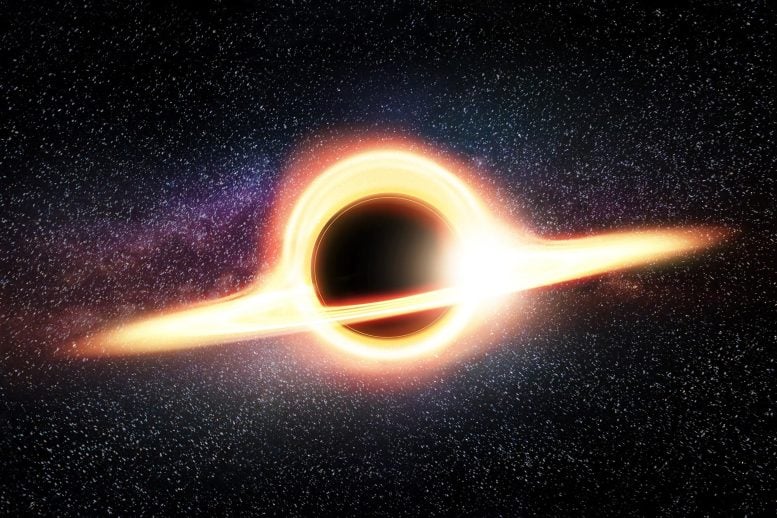
Astronomers discovered a black hole in the RAD12 galaxy that uniquely ejects a jet at its neighboring galaxy, RAD12-B. This phenomenon sheds light on how supermassive black holes affect star formation in elliptical galaxies.
A team of astronomers has found a unique black hole that is shooting a fiery jet at another galaxy with the aid of citizen scientists. The black hole is housed in the RAD12 galaxy, which is around a billion light-years from Earth. The research was recently published in the Monthly Notices of the Royal Astronomical Society (Letters).
Galaxies are classified into two types depending on their morphology: spirals and ellipticals. Spirals have a lot of cold gas and dust and optically-blue looking spiral arms. An average of one Sun-like star forms per year in spiral galaxies. Elliptical galaxies, on the other hand, are yellow in color and lack distinctive characteristics like spiral arms.
It is still a mystery to astronomers why the elliptical galaxies we see today haven’t been producing new stars for billions of years. Star creation is very rare in elliptical galaxies. There is evidence that “monster” or supermassive black holes are at fault. These “monster” black holes release enormous electron jets traveling at extremely high speeds at other galaxies, depleting the cold gas and dust needed for future star formation.

The unique nature of RAD12 had been observed in 2013 using optical data from the Sloan Digitised Sky Survey (SDSS) and radio data from the Very Large Array (FIRST survey). However, follow-up observation with the Giant Meterwave Radio Telescope (GMRT) in India was required to confirm its truly exotic nature: The black hole in RAD12 appears to be ejecting the jet only towards a neighboring galaxy, named RAD12-B. In all cases, jets are ejected in pairs, moving in opposite directions at relativistic speeds. Why only one jet is seen coming from RAD12 remains a puzzle to astronomers.
Exotic Structure
A conical stem of young plasma is seen being ejected from the center and reaches far beyond the visible stars of RAD12. The GMRT observations revealed that the fainter and older plasma extends far beyond the central conical stem and flares out like the cap of a mushroom (seen in red in the tricolor image). The whole structure is 440 thousand light-years long, which is much larger than the host galaxy itself.
RAD12 is unlike anything known so far; this is the first time a jet has been observed to collide with a large galaxy like RAD12-B. Astronomers are now one step closer to understanding the impact of such interactions on elliptical galaxies, which may leave them with little cold gas for future star formation.
Research lead Dr. Ananda Hota says, “We are excited to have spotted a rare system that helps us understand radio jet feedback of supermassive black holes on star formation of galaxies during mergers. Observations with the GMRT and data from various other telescopes such as the MeerKAT radio telescope strongly suggest that the radio jet in RAD12 is colliding with the companion galaxy. An equally important aspect of this research is the demonstration of public participation in making discoveries through the RAD@home Citizen Science research collaboratory.”
Reference: “RAD@home citizen science discovery of an active galactic nucleus spewing a large unipolar radio bubble on to its merging companion galaxy” by Ananda Hota, Pratik Dabhade, Sravani Vaddi, Chiranjib Konar, Sabyasachi Pal, Mamta Gulati, C S Stalin, Ck Avinash, Avinash Kumar, Megha Rajoria and Arundhati Purohit, 12 October 2022, Monthly Notices of the Royal Astronomical Society.
DOI: 10.1093/mnrasl/slac116
Never miss a breakthrough: Join the SciTechDaily newsletter.
Follow us on Google and Google News.