
A restarted black hole in J1007+3540 reveals how episodic jet activity and cluster pressure sculpt giant radio galaxies.
Astronomers have captured one of the clearest views yet of a black hole returning to life, in a vast radio galaxy where activity stretches nearly one million light-years across space. The phenomenon has been compared to a “cosmic volcano,” as enormous jets once again erupt from the galaxy’s core.
The discovery came when researchers detected renewed jet emission from the supermassive black hole at the center of J1007+3540. After nearly 100 million years of inactivity, the black hole has restarted, launching powerful streams of magnetized plasma into its surroundings.
Radio observations show the galaxy caught in a turbulent confrontation between the newly reactivated jets and the intense pressure of the massive galaxy cluster that surrounds it. The interaction is far from smooth, with the jets visibly bent, compressed, and disrupted by the dense environment.
The findings were published in the Monthly Notices of the Royal Astronomical Society. The images were obtained using two highly sensitive radio interferometers: the Low Frequency Array (LOFAR) in the Netherlands and India’s upgraded Giant Metrewave Radio Telescope (uGMRT).
A black hole turns on again
Most large galaxies contain a supermassive black hole, but only a minority produce extended radio jets that can span hundreds of thousands of light-years. According to the international team behind the study, J1007+3540 stands out because it provides clear evidence of repeated outbursts. Its central engine has switched on, shut down, and reignited over cosmic timescales.
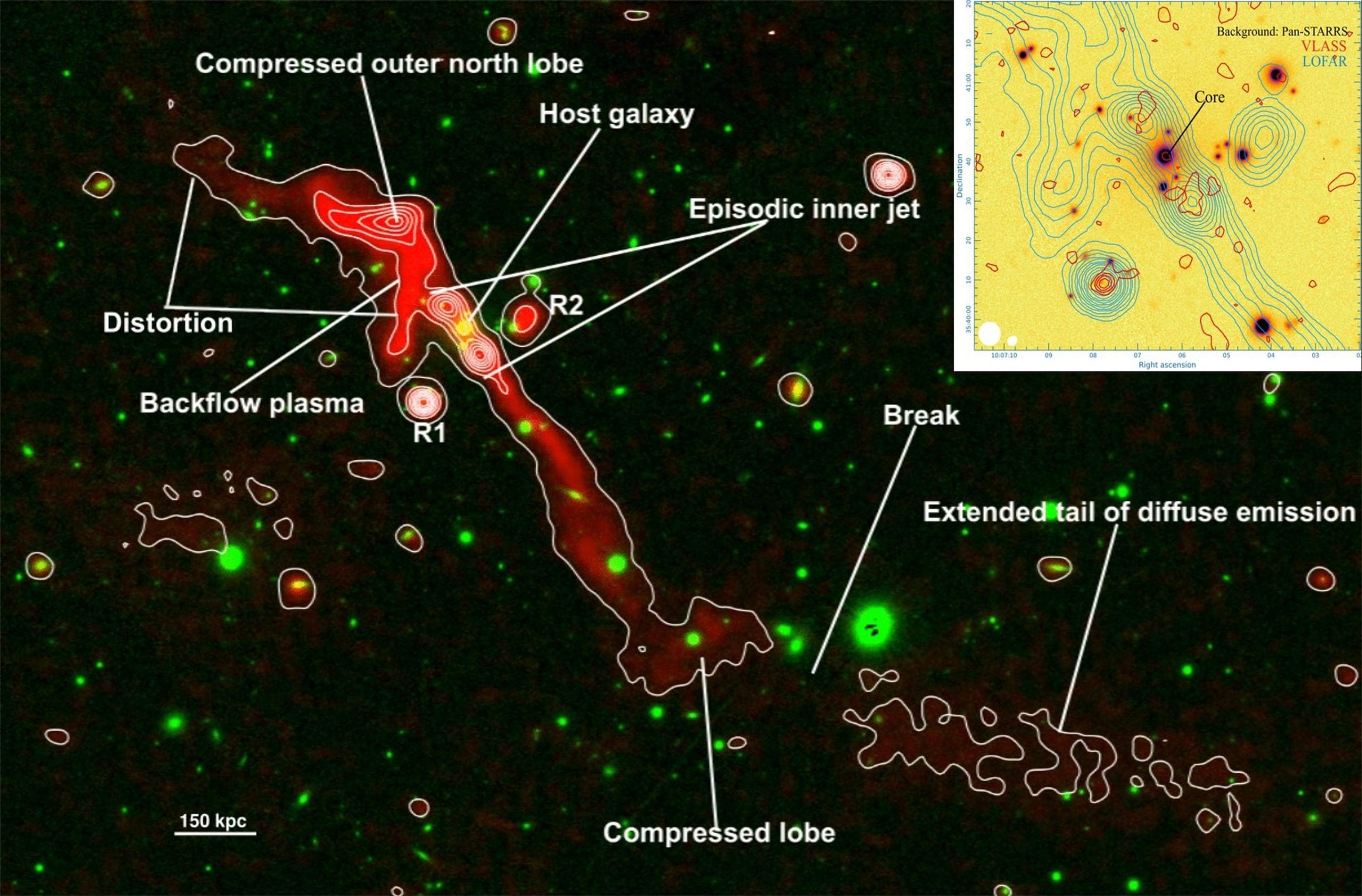
The new radio data reveal a bright, compact inner jet that marks the black hole’s recent reawakening, said lead researcher Shobha Kumari of Midnapore City College in India. Surrounding it is a broader cocoon of older, dimmer plasma, remnants from earlier eruptions. This aging material has been distorted and compressed by the extreme conditions inside the galaxy cluster, preserving a layered record of past and present activity.
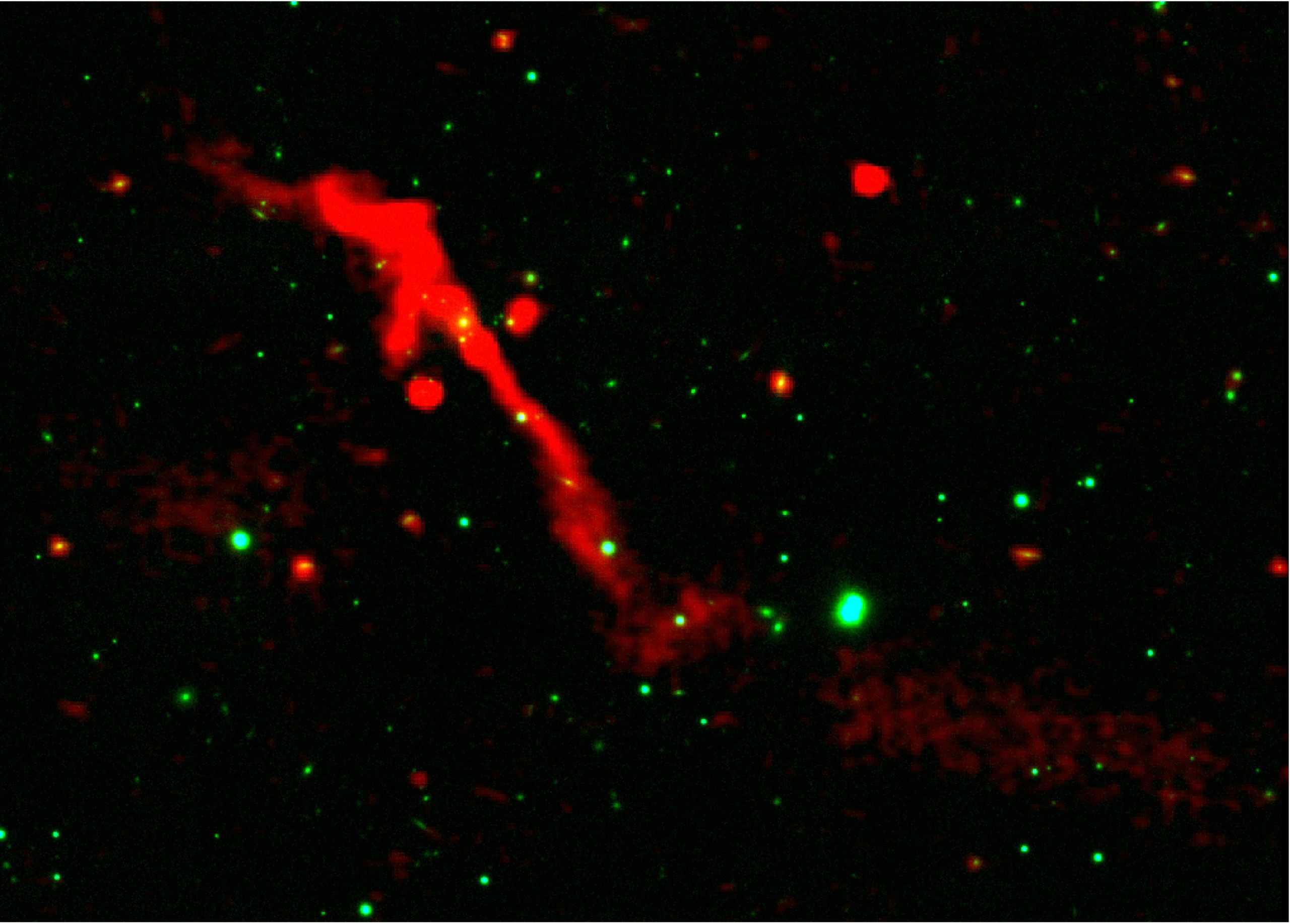
“It’s like watching a cosmic volcano erupt again after ages of calm—except this one is big enough to carve out structures stretching nearly a million light-years across space”, Kumari added.
“This dramatic layering of young jets inside older, exhausted lobes is the signature of an episodic AGN – a galaxy whose central engine keeps turning on and off over cosmic timescales.”
The research was carried out by Kumari and co-authors Dr. Sabyasachi Pal, of Midnapore City College, Dr. Surajit Paul, associate professor at the Manipal Centre for Natural Sciences in India, and Dr. Marek Jamrozy, of Jagiellonian University in Poland.
Cluster pressure reshapes the jets
“J1007+3540 is one of the clearest and most spectacular examples of episodic AGN with jet-cluster interaction, where the surrounding hot gas bends, compresses, and distorts the jets,” Dr. Pal said.
J1007+3540 lives inside a massive galaxy cluster filled with extremely hot gas. This environment creates enormous external pressure – far higher than what most radio galaxies experience. As the revived jets push outward, they are bent, squeezed, and distorted by the interaction with the dense medium.
The LOFAR image reveals that the northern lobe is compressed and dramatically distorted, the authors say, showing a curved backflow signature of plasma that seems to be shoved sideways by the surrounding gas.
The uGMRT image also shows that this compressed region has an ultra-steep radio spectrum, meaning the particles there are extremely old and have lost much of their energy – another sign of the cluster’s harsh influence.
The long, faint tail of diffuse emission stretching to the southwest tells an equally dramatic story, the researchers say. It shows that magnetized plasma is being dragged in a large extension through the cluster environment, leaving behind a wispy trail millions of years old. This, they add, suggests the galaxy is not just producing jets, it is also being shaped and sculpted by the powerful environment around it.
Episodic activity reveals galaxy evolution
Systems such as J1007+3540 are extremely valuable to astronomers. They reveal how black holes turn on and off, how jets evolve over millions of years, and how cluster environments can reshape the entire morphological structure of a radio galaxy.
The combination of restarted activity, giant scale, and strong environmental pressure makes J1007+3540 a useful example of galaxy evolution in action. The authors say it shows that the growth of galaxies is not peaceful or gradual but rather a battle between the explosive power of black holes and the crushing pressure of the environments they live in.
By studying this galaxy, astronomers are gaining rare insight into:
- How frequently black holes transition between active and inactive phases
- How aging radio plasma interacts with hot gas in galaxy clusters
- How repeated eruptions reshape a galaxy’s environment over cosmic time
The research team now plans to use more sensitive, high-resolution observations to zoom even deeper into the core of J1007+3540 and track how the restarted jets propagate through this turbulent environment.
Understanding systems like J1007+3540 helps scientists piece together how galaxies grow, shut down, and awaken again, and how huge cosmic environments can shape, bend, distort, and even suffocate the jets that try to escape from their central engine.
Reference: “Probing AGN duty cycle and cluster-driven morphology in a giant episodic radio galaxy” by Shobha Kumari, Sabyasachi Pal, Surajit Paul and Marek Jamrozy, 15 January 2026, Monthly Notices of the Royal Astronomical Society.
DOI: 10.1093/mnras/staf2038
SK gratefully acknowledges the Department of Science & Technology, Government of India, for financial support, vide reference no. DST/WISE-PhD/PM/2023/3 (G) under the ‘WISE Fellowship for Ph.D.’ program to carry out this work.
Never miss a breakthrough: Join the SciTechDaily newsletter.
Follow us on Google and Google News.
1 Comment
The black hole was always “active and alive” it was just that the matter and space around it started interacting to it’s local massive gravitational pull again. All mass migrates toward a higher gravitational attraction. Eventually gravity wins.