

Close Menu
    Facebook X (Twitter) Instagram
    SciTechDaily
    • Biology
    • Chemistry
    • Earth
    • Health
    • Physics
    • Science
    • Space
    • Technology
    Facebook X (Twitter) Pinterest YouTube RSS
    SciTechDaily
    Home»Space»Star Formation in the Universe Has Decreased Drastically
    Space

    Star Formation in the Universe Has Decreased Drastically

    By Royal Astronomical SocietyNovember 7, 20121 Comment5 Mins Read
    Facebook Twitter Pinterest Telegram LinkedIn WhatsApp Email Reddit
    Share
    Facebook Twitter LinkedIn Pinterest Telegram Email Reddit
    how the Universe is thought to have evolved from the Big Bang
    This schematic diagram shows how the Universe is thought to have evolved from the Big Bang to the present day. Data from the UKIRT, VLT, and Subaru observatories allowed the astronomers to take four precise and comparable snapshots of the Universe when it was, 2, 4, 6, and 9 billion years old, each containing hundreds of star-forming galaxies. By comparing the different snapshots, astronomers were able to accurately track what has changed over the last 11 billion years. Credit: Chandra / NASA / NOAO / KIPAC

    In a new study, an international team of scientists established that the rate of star formation in the Universe is now only 1/30th of what it was at its peak and that this decline will continue.

    While parts of the world experience economic hardship, a team of Portuguese, UK, Japanese, Italian and Dutch astronomers has found an even bigger slump happening on a cosmic scale. In the largest ever study of its kind, the international team of astronomers has established that the rate of formation of new stars in the Universe is now only 1/30th of its peak and that this decline is only set to continue. The team, led by David Sobral of the University of Leiden in the Netherlands, publish their results in the journal Monthly Notices of the Royal Astronomical Society.

    The accepted model for the evolution of the Universe suggests that stars began to form about 13.4 billion years ago, or around three hundred million years after the Big Bang. Many of these first stars are thought to have been monsters by today’s standards, and were probably hundreds of times more massive than our Sun. Such beasts aged very quickly, exhausted their fuel, and exploded as supernovae within a million years or so. Lower mass stars in contrast have much longer lives and last for billions of years.
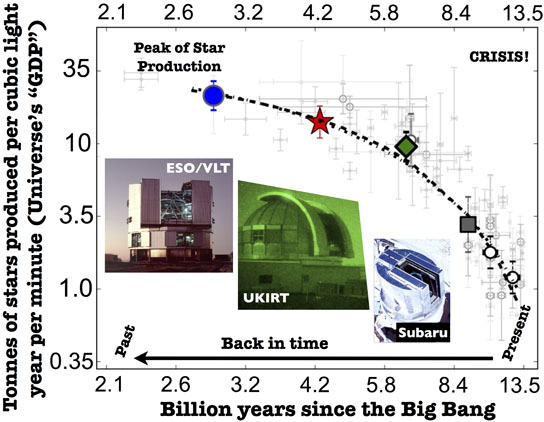
    changing 'GDP' of the Universe over time
    This diagram indicates the changing ‘GDP’ of the Universe over time. The new results indicate that, measured by mass, the production rate of stars has dropped by 97% since its peak 11 billion years ago. Credit: D. Sobral

    Much of the dust and gas from stellar explosions was (and is still) recycled to form newer and newer generations of stars. Our Sun, for example, is thought to be a third generation star, and has a very typical mass by today’s standards. But regardless of their mass and properties, stars are key ingredients of galaxies like our own Milky Way. Unveiling the history of star formation across cosmic time is fundamental to understanding how galaxies form and evolve.

    In the new study, scientists used the UK Infrared Telescope (UKIRT), the Very Large Telescope (VLT) and the Subaru telescope to carry out the most complete survey ever made of star-forming galaxies at different distances, with around ten times the data of any previous effort. With the range of distances, the time taken for the light to reach us means that we see identically selected galaxies at different periods in the history of the universe, so we can really understand how conditions change over time.

    By looking at the light from clouds of gas and dust in these galaxies where stars are forming, the team is able to assess the rate at which stars are being born. They find that the production of stars in the universe as a whole has been continuously declining over the last 11 billion years, being 30 times lower today than at its likely peak, 11 billion years ago.
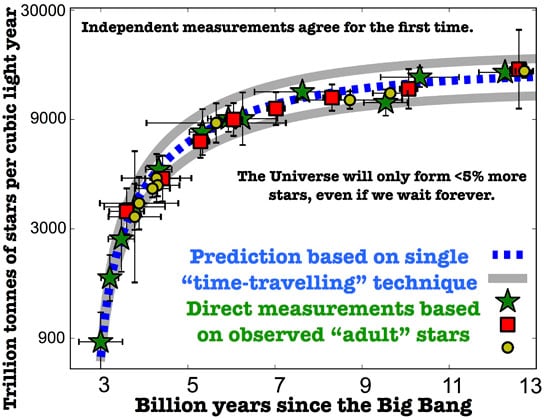
    how the total mass of stars in the Universe should have changed over the last 11 billion years
    This diagram shows how the total mass of stars in the Universe should have changed over the last 11 billion years based on the new observations (lines) and how it actually did (symbols; different measurements by other teams). This provides an excellent agreement between both and strengthens the prediction of the new results that no more than a further 5% of stars will come into existence, even if we wait forever. Credit: D. Sobral

    Dr. Sobral comments: “You might say that the universe has been suffering from a long, serious “crisis”: cosmic GDP output is now only 3% of what it used to be at the peak in star production!”

    ‘If the measured decline continues, then no more than 5% more stars will form over the remaining history of the cosmos, even if we wait forever. The research suggests that we live in a universe dominated by old stars. Half of these were born in the ‘boom’ that took place between 11 and 9 billion years ago and it took more than five times as long to produce the rest. “The future may seem rather dark, but we’re actually quite lucky to be living in a healthy, star-forming galaxy which is going to be a strong contributor to the new stars that will form.

    ‘Moreover, while these measurements provide a sharp picture of the decline of star-formation in the Universe, they also provide ideal samples to unveil an even more fundamental mystery which is yet to be solved: why?”

    Reference: “A large Hα survey at z = 2.23, 1.47, 0.84 and 0.40: the 11 Gyr evolution of star-forming galaxies from HiZELS” by David Sobral, Ian Smail, Philip N. Best, James E. Geach, Yuichi Matsuda, John P. Stott, Michele Cirasuolo and Jaron Kurk, 7 November 2012, Monthly Notices of the Royal Astronomical Society.
    DOI: 10.1093/mnras/sts096

    Never miss a breakthrough: Join the SciTechDaily newsletter.
    Follow us on Google and Google News.

    Astrophysics Galaxy Evolution National Radio Astronomy Observatory Popular Royal Astronomical Society Stars
    Share. Facebook Twitter Pinterest LinkedIn Email Reddit

    Related Articles

    Astronomers Solve the 1936 Mystery of FU Orionis’ Dramatic Outburst

    New Types of Stars – “Old Smokers” and Erupting Protostars – Discovered in the Milky Way

    Astronomers May Have Discovered the Youngest Planet Ever Detected in Our Galaxy

    Young Chaotic Star System Reveals Secrets of Planet Formation

    Stirred-Up Planet Factory Captured by the Revolutionary ALMA Telescope

    Unprecedented Astronomy: Atmosphere of the Red Supergiant Star Antares Revealed by Radio Telescopes

    Cosmic Order Emerging From Chaos: Galactic Fountains and Carousels Unveiled

    Two Massive Stars with Magnetic Fields Discovered in Binary System Epsilon Lupi

    VLA Reveals Unexpected “Storm” in Teacup Galaxy

    1 Comment

    1. noel a. glemao on May 11, 2021 5:35 pm

      exodus 33:16for wherein shall it be known here that i and thy people have found grace in thy sight?is it not in that thou goest withus?so shall be seperated i thy people;from all the people that are upon the face of the earth:those firstborn over twenty will be die:noel a. glemao#philippines ,palihan,orani,bataan

      Reply
    Leave A Reply Cancel Reply

    • Facebook
    • Twitter
    • Pinterest
    • YouTube

    Don't Miss a Discovery

    Subscribe for the Latest in Science & Tech!

    Trending News

    Why Popular Diabetes Drugs Like Ozempic Don’t Work for Everyone: The “Genetic Glitch”

    Scientists Stunned After Finding Plant Thought Extinct for 60 Years

    Scientists Discover Tiny New Spider That Hunts Prey 6x Its Size

    Natural Component From Licorice Shows Promise for Treating Inflammatory Bowel Disease

    Scientists Warn: Popular Sweetener Linked to Dangerous Metabolic Effects

    Monster Storms on Jupiter Unleash Lightning Beyond Anything on Earth

    Scientists Create “Liquid Gears” That Spin Without Touching

    The Simple Habit That Could Help Prevent Cancer

    Follow SciTechDaily
    • Facebook
    • Twitter
    • YouTube
    • Pinterest
    • Newsletter
    • RSS
    SciTech News
    • Biology News
    • Chemistry News
    • Earth News
    • Health News
    • Physics News
    • Science News
    • Space News
    • Technology News
    Recent Posts
    • Scientists Uncover How Serotonin May Trigger Tinnitus
    • Common Food Compound Shows Surprising Power Against Superbugs
    • Ancient DNA Study Reveals Human Evolution Is Happening Faster Than We Thought
    • 5 Simple Ways To Remember More and Forget Less
    • This Common Habit Could Signal Serious Health Problems in Later Life
    Copyright © 1998 - 2026 SciTechDaily. All Rights Reserved.
    • Science News
    • About
    • Contact
    • Editorial Board
    • Privacy Policy
    • Terms of Use

    Type above and press Enter to search. Press Esc to cancel.