
Close Menu
    Facebook X (Twitter) Instagram
    SciTechDaily
    • Biology
    • Chemistry
    • Earth
    • Health
    • Physics
    • Science
    • Space
    • Technology
    Facebook X (Twitter) Pinterest YouTube RSS
    SciTechDaily
    Home»Space»Black Hole Fires Cosmic Bullets of Ionized Gases
    Space

    Black Hole Fires Cosmic Bullets of Ionized Gases

    By SciTechDailyJanuary 11, 20121 Comment2 Mins Read
    Facebook Twitter Pinterest Telegram LinkedIn WhatsApp Email Reddit
    Share
    Facebook Twitter LinkedIn Pinterest Telegram Email Reddit
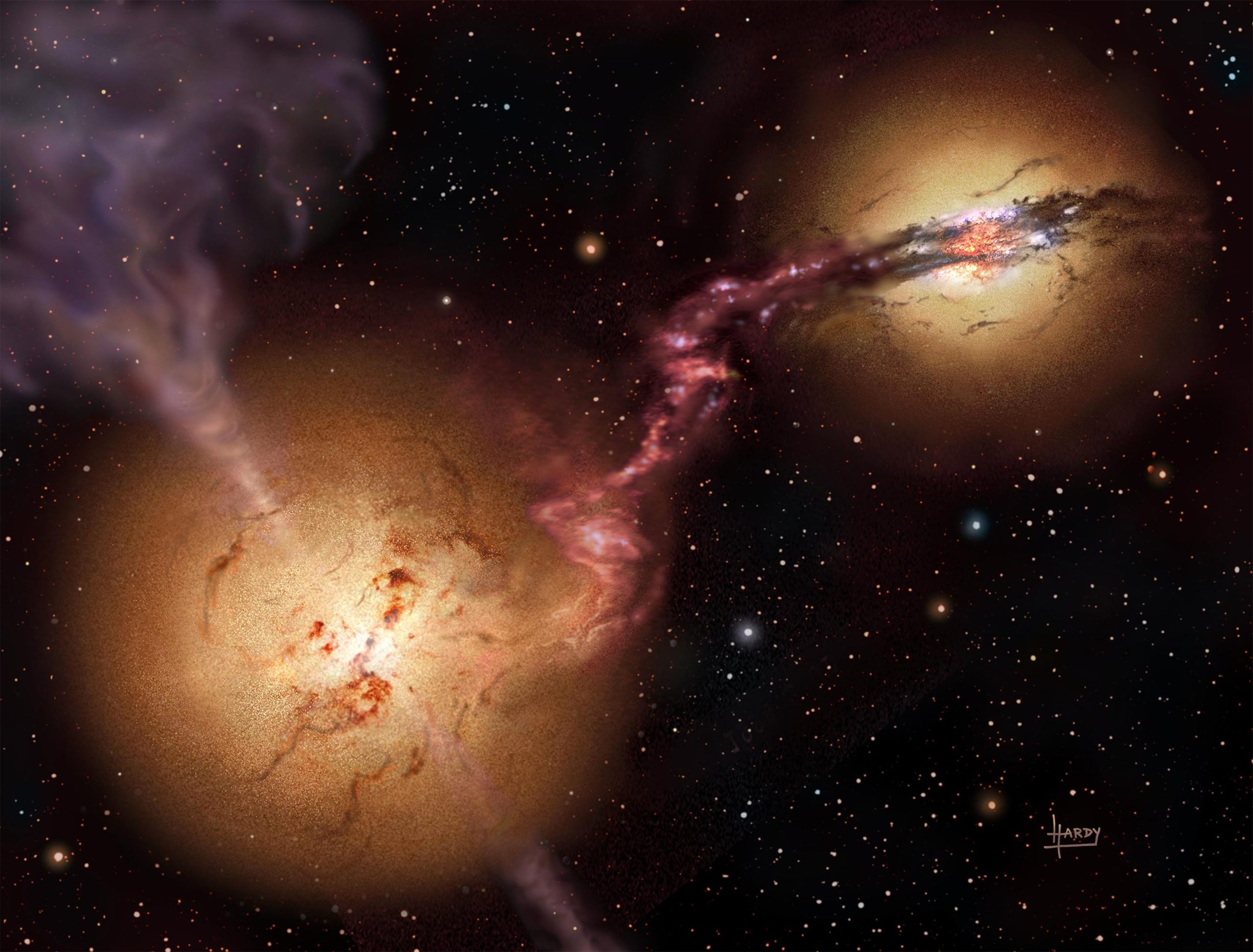
    4C60.07 System of Colliding Galaxies
    Artist’s conception of the 4C60.07 system of colliding galaxies. Credit: David A. Hardy/UK ATC

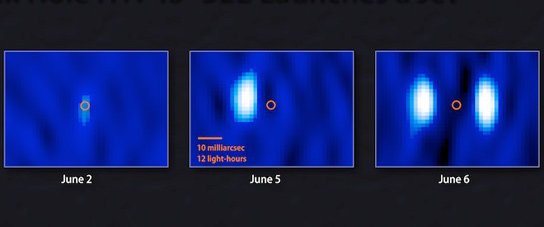
    Using the Very Large Baseline Array, astronomers have managed to capture an image of a black hole firing two gigantic pockets of ionized gas at almost a quarter the speed of light. The resulting cosmic explosion produces as much energy in an hour as our sun emits in five years.

    The Very Large Baseline Array is a set of 10 radio telescopes that spans 5,000 miles from Mauna Kea in Hawaii to St. Croix in the U.S. Virgin Islands. It provides astronomers with the sharpest vision of any telescope on Earth or in space. The black hole in question has been designated H1742-322 and it is situated near the center of our galaxy, approximately 28,000 light years from Earth in the constellation Scorpius.
    actual-cosmic-bullet

    Gregory Sivakoff from the University of Alberta states that if our eyes were as sharp as the VLBA, we would be able to see a person on the moon. The findings were presented on January 10th of this year at a meeting of the American Astronomical Society.

    A Sol-like star orbits H1743 and the black hole will periodically siphon matter from its companion. The gas and dust are incorporated into a large disk, which slowly spirals around the black hole’s event horizon. Researchers haven’t discovered yet how the process works exactly, but the disk constantly emits large jets of plasma, which spew out in opposite directions. Occasionally, these jets recede and are followed by an enormous bullet-like burst of gases.

    Sivakoff and his team detected a lump of material, which they hypothesized as being a blob of ionized gas, spiraling its way into the black hole’s center. These blobs are known as quasi-periodic oscillations, which disappeared before the jets waned. A few days later, the team detected the ejection of gases.

    Never miss a breakthrough: Join the SciTechDaily newsletter.
    Follow us on Google and Google News.

    Astrophysics Black Hole Plasma Popular Very Long Baseline Array
    Share. Facebook Twitter Pinterest LinkedIn Email Reddit

    Related Articles

    Very Long Baseline Array Discovers Orbital Motion in Pair of Supermassive Black Holes

    Hubble and VLA View Elliptical Galaxy Hercules A

    Scientists Discover the Most Powerful Quasar Outflow Ever

    NASA Satellite Discovers a New Black Hole in the Milky Way

    Cloud of Hydrogen and Helium Plunging Toward the Galactic Center

    Data Reveals Swift J1644+57’s QPO Cycle

    Intermediate-Mass Black Hole Candidates Discovered at the Center of the Milky Way

    Gamma-Ray Beams Suggest Milky Way’s Central Black Hole Had Active Past

    Scientists Convene to Take a Picture of the Supermassive Black Hole at the Center of the Milky Way

    1 Comment

    1. james lynch on September 26, 2013 12:19 pm

      Dear Sirs, I belelieve that the age of the galaxy is many/many times older than the one currently held 14 billion. I also beleive that black holes have a limit as to how much energy/mass they can sustain and after they reach a certain size we have a BIG BANG in a local area of space RELATIVELY speaking.

      Reply
    Leave A Reply Cancel Reply

    • Facebook
    • Twitter
    • Pinterest
    • YouTube

    Don't Miss a Discovery

    Subscribe for the Latest in Science & Tech!

    Trending News

    Scientists Say Love Follows Mathematical Patterns

    “Zombie Cells” Reveal a Hidden Weakness That Could Help Fight Aging

    Alien Signals May Be Hiding in a Radio Band SETI Has Barely Explored

    Earth’s Hidden Thermostat Has Regulated Climate for 60 Million Years

    This 518-Million-Year-Old Creature Reveals How Spiders Got Their Bite

    Scientists Built a Programmable Chip That Can Slow Light on Command

    The Backyard “Silly Sprinkler” That Cracked One of Physics’ Biggest Puzzles

    This Common Sleep Habit Could Be Making You Gain Weight

    Follow SciTechDaily
    • Facebook
    • Twitter
    • YouTube
    • Pinterest
    • Newsletter
    • RSS
    SciTech News
    • Biology News
    • Chemistry News
    • Earth News
    • Health News
    • Physics News
    • Science News
    • Space News
    • Technology News
    Recent Posts
    • Earth’s First Complex Organisms May Hold Clues to Life Beyond Our Planet
    • Dark Matter’s Secret Force Could Reshape Our Understanding of the Universe
    • This Star Is Racing Around the Milky Way’s Black Hole at 8% the Speed of Light
    • Where on Earth Was This Fossil 200 Million Years Ago?
    • A 25,000-Year-Old Ritual Tradition Was Hidden Beneath This Cave Floor
    Copyright © 1998 - 2026 SciTechDaily. All Rights Reserved.
    • Science News
    • About
    • Contact
    • Editorial Board
    • Privacy Policy
    • Terms of Use

    Type above and press Enter to search. Press Esc to cancel.