
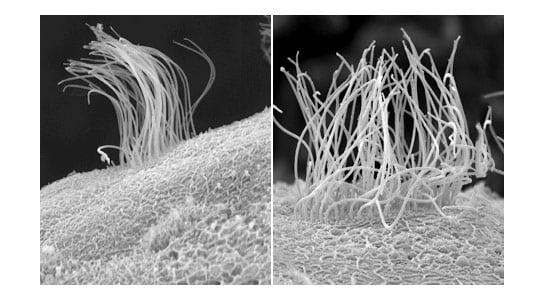
In a newly published study, Yale researchers detail a genetic mutation associated with congenital heart disease that disrupts a key signaling mechanism and leads to a form of heart defect associated with misalignment of major organs.
The search for the cause of devastating birth defects has led Yale School of Medicine researchers to a key insight into the biology of embryonic development.
A genetic mutation associated with congenital heart disease disrupts a key signaling mechanism and leads to a form of heart defect associated with misalignment of major organs, the Yale team reports in the November 13 online edition of the journal Nature. The results in frogs build upon earlier research conducted at Yale that shows that the correct left-right orientation of organs in developing embryos depends upon the proper functioning of cilia — or tiny hair-like structures on cells.
“As a critical care physician, I care for infants that have birth defects, such as holes in the heart, and it is frustrating not to know the cause of these pathologies,” said Mustafa Khokha, associate professor of pediatrics and of genetics and senior author of the paper. “Now we have gained insight into the basic biology of the condition thanks to observations of these tiny patients.”
In developed countries, birth defects are now the leading cause of infant mortality. Some heart defects, such as holes in the heart or “blue baby” syndrome are caused by improper orientation of organs in the body. In previous work along with others, Martina Brueckner of Yale revealed tiny hair-like structures on cells called cilia could be the cause. Her lab showed cilia come in two “flavors”: motile cilia and immotile cilia. Motile cilia act as subcellular paddles on fetal cells to drive fluid flow leftward. Immotile cilia sense this leftward fluid flow, which is crucial for the proper left-right orientation of organs in the developing embryo. However, the mechanism that determines whether cilia will be motile or immotile was unknown.
Previously, Brueckner and team conducted a genomic analysis of patients with heart defects and discovered a deletion in the gene galnt11 in a single child. The new study shows Galnt11 regulates Notch, a crucial signaling pathway instrumental in embryonic development. Coordination between Galnt11 and Notch determines if cilia are to be of the motile or immotile variety. Alterations in the balance of these two cilia types cause birth defects.
“It is crucial to understand the causes of these birth defects if we are to create tests that can diagnose them and provide important genetic counseling and prognosis,” Khokha said.
“But now with the new human genomics tools, we are finding the genetic causes that eluded us for so long and in the process are learning a lot about how we are put together,” Khokha said.
Other Yale authors are Marko Boskovski, Shiaulou Yuan, and Svetlana Makova.
The study was supported by grants from the National Institutes of Health (TL 1 RR024137, 5T32HD00709436, R01HL093280, NIH DE018825, and DE018824), and the Danish National Research Foundation.
Reference: “The heterotaxy gene GALNT11 glycosylates Notch to orchestrate cilia type and laterality” by Marko T. Boskovski, Shiaulou Yuan, Nis Borbye Pedersen, Christoffer Knak Goth, Svetlana Makova, Henrik Clausen, Martina Brueckner and Mustafa K. Khokha, 13 November 2013, Nature.
DOI: 10.1038/nature12723
Never miss a breakthrough: Join the SciTechDaily newsletter.
Follow us on Google and Google News.
1 Comment
This article proves that single mutation in a gene in the embryo need not necessarily result in a single defect, but linked in a major pathway in signalling other organ formation also. We know pretty well that single mRNA can give rise to multiple proteins by adjusting such as its ACTGCG..for example to read from the letter C as CTGCG.. leaving A in its transcription and thus can be responsible for the formation multiple proteins and enzymes. That is why in human genome project out of 100000 genes found in the DNA only 11000 or so are executable genes and that too doing multi-functions and formation of organs and enzymes. Hence mutations can be multiple that could give rise to one cancer, like that of breast cancer, with BRCA1 and BRCA2 or single one that can make multiple transformations in the organs. The complexity of mutations can be studied well to conquer birth defects and cancers. Thank You.