

To gain a more comprehensive understanding of the effects of human activities on the complex and interrelated ecological system, researchers are examining a footprint measurement that begins with the sun.
On this planet, which is home to 8 billion individuals, human activity is pushing the ecological boundaries to their limits. Scientists are working to calculate the impact of our actions on these scarce resources. Some are tracking the amount of carbon dioxide they produce, while others are monitoring water usage, both direct and indirect, or examining the extent of land needed to sustain our dietary habits.
According to Chris Lant, a geographer from the Quinney College of Natural Resources, these “footprints” provide a rough estimate of the influence that individuals and organizations have on the planet, but they are limited. Most footprints only capture a fraction of the picture. In response, Lant and his team of researchers have published new findings that aim to improve the accuracy of measuring the entire system.
Simply calculating a disembodied footprint for a single aspect of an intertwined system offers an imperfect picture of the cost of any one product, Lant said.
Unraveling the Complexity of Food-Energy-Water Systems
Consider a taco you might have had for lunch today — determining the carbon footprint for the quarter-cup of shredded cheddar jack and three ounces of ground beef could account for methane produced by the meat- and milk-producing animals, and for the fuel consumed by the semi-truck on the trip from Texas or Idaho.
But it wouldn’t account for the water consumed to feed the animal or indicate if the food had been produced on fragile sagebrush steppe or on resilient grasslands, or account for the energy cost of lightbulbs, heating, and dishwater at the restaurant where you bought it, or for the landfill where the wrapper ends up.
The human food-energy-water system is wickedly interconnected, but most of the links in the network are neither global nor local — the action lies in everyday trade between counties and states that rely on each other’s ecosystems, Lant said.
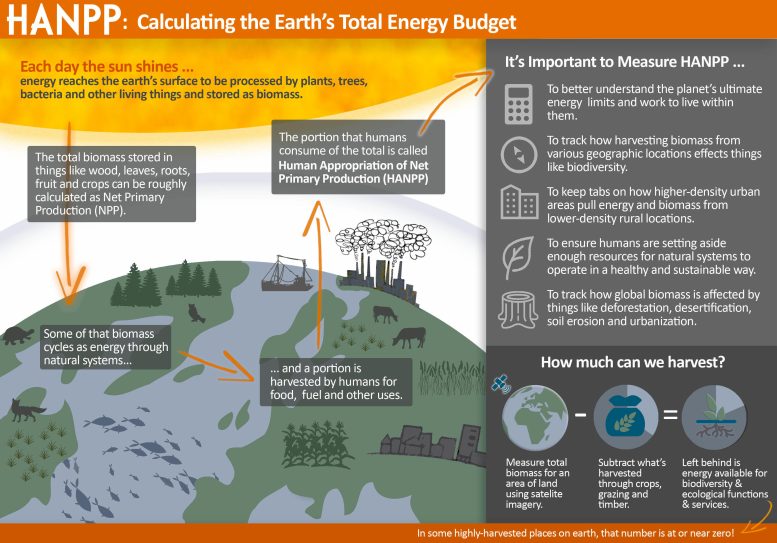
To capture a better picture of human impacts in this system, you need a measurement that starts at the source — the sun. An emerging metric called ‘Human Appropriation of Net Primary Production’ (HANNP), has promise to be a more holistic way to accurately estimate the impacts of human actions on the earth’s systems, according to Lant and coauthors.
The calculation starts with a tally of the total biomass that a piece of land can produce in a defined amount of time, called Net Primary Production (NPP). Through satellite imagery, researchers can quantify the amount of plant matter produced through photosynthesis, which offers a birds-eye estimate for the total plant (and eventually animal) growth that a piece of land contributes to the world. Tall forests or wetlands have high NPP. Nebraska grasslands or crop fields have medium NPP, while the arid red rock landscapes of southern Utah have low NPP.
Human Claim on Plant Biomass
Humans already claim a good portion of the total plant biomass produced by the sun. The HANPP metric compares the total biomass to what humans have appropriated for their own use — the corn, soybeans, alfalfa, wood, onions, cotton, grazed plants, apples, coffee, rice, paper products, peanut butter, sugar, quinoa and more that humans claim from the system for food, livestock feed, fiber, and biofuel. (In the U.S., the lowest of these four categories is direct food at 16 percent).
People tend to be pretty good at keeping records of crop production and agricultural yield—so although figuring HANPP is data intensive, it is more than just a theoretical calculation. It also has major advantages over other ecological footprints.
“HANPP is measured relative to ecological capacity, not just land area,” Lant said. “So it’s easy to see that a square mile of Gobi desert is not equivalent to a square mile of the Brazilian rainforest. Also, nearly all of the water we consume and nutrients we apply are used to grow things that we harvest. HANPP accounts for many of the connections in the system, especially between consuming cities and production of goods on rural lands.”
Connecting Urban and Rural Ecological Dependencies
Cities are dependent on rural areas for everything from blueberries to biofuels. That connection isn’t always obvious in ecological footprint metrics. Rural land is, in effect, exporting water, nutrients, and energy to keep cities running, Lant said. HANPP illustrates the strength of that connection through the line of production and consumption — supply chains — and documents how cities displace ecological footprints to land outside their boundaries.
The metric also allows researchers to see how much of total NPP humans are leaving behind for natural systems to function, such as for supporting biodiversity, Lant said. In some very intensively harvested places, that number can be close to zero.
“Photosynthesis on the planet produces 55-60 billion tonnes of carbon each year … that’s a total that’s hard to fathom, but when human use climbs toward half of this total, nature starts to disappear,” Lant said.
The new research pushes the HANPP metric forward and refines it, Lant said. The team has determined how to calculate HANPP down to the 30-meter level, tracking trends about how biomass is produced and what it is used for, he said.
Reference: “Product-Specific human appropriation of net primary production in US counties” by Suman Paudel, Kaeli Mueller, Gustavo Ovando-Montejo, Richard Rushforth, Lauren Tango and Christopher Lant, 16 April 2023, Ecological Indicators.
DOI: 10.1016/j.ecolind.2023.110241
Never miss a breakthrough: Join the SciTechDaily newsletter.
Follow us on Google and Google News.