
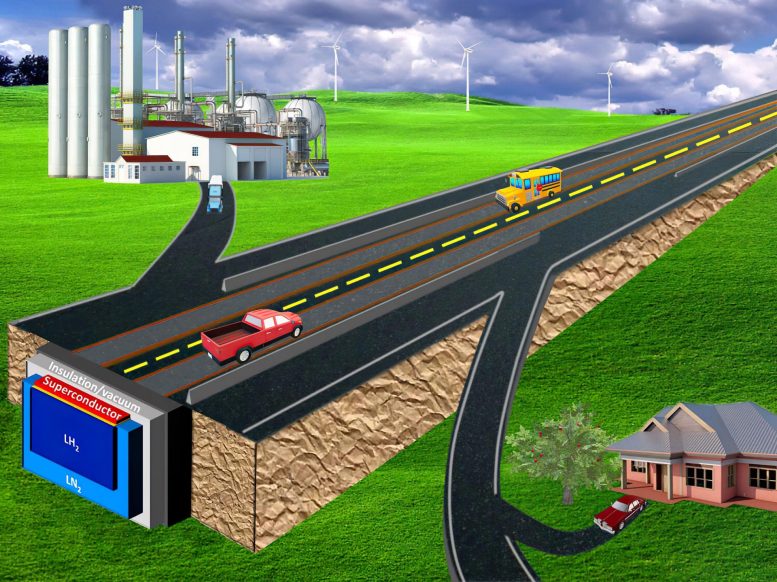
Revolutionary design could combine superconductor levitation, lossless electricity transmission, and liquid hydrogen transportation into one system.
A proof of concept for a superconducting highway has been developed, which can transport vehicles and electricity while using a liquid hydrogen pipeline for cooling. This innovative design could enable high-speed transportation of people and goods at 400+ miles per hour.
Superconductors can conduct electricity without any resistance or power loss, and they can effortlessly cause magnets to levitate above them. These properties would make superconductors useful for high-speed trains or long-distance power transmission, except for one glaring problem: superconductors only work at low temperatures, more than a hundred degrees below zero.
This one requirement makes building a hyperefficient electrical grid or high-speed rail network very expensive. Unless, that is, a superconductor network could accomplish both tasks at the same time.
A Dual-Purpose Solution: The Superconducting Highway
In the journal APL Energy, by AIP Publishing, researchers from the University of Houston, Adelwitz Technologiezentrum GmbH, and the Leibniz Institute for Solid State and Materials Research developed a proof of concept for a superconducting highway that could transport vehicles and electricity, cooling the necessary superconductors with a pipeline of liquid hydrogen.
Most magnetic levitation designs feature the superconductor inside the vehicle, which is suspended above a magnetic track. The authors decided to flip that arrangement upside down, putting the superconductor on the ground and giving each vehicle a magnet. The result is a system with multiple uses, placing it within the realm of affordability.
“Superconductor-levitated magnetic vehicles, instead of magnet-levitated superconducting vehicles, can provide additional benefits such as electrical power transmission and storage,” said author Zhifeng Ren. “We developed a new superconducting system that can transport and store a huge amount of energy and also transport people and goods with speeds of at least 400 miles per hour.”
Cooling with Liquid Hydrogen: A Cost-Effective Approach
Their design solves the problem of superconductor cooling with a liquid hydrogen pipeline. Hydrogen is a promising clean fuel source with a complex handling issue: It is a gas at room temperature, so transporting and storing it involves either dangerous pressurized tanks or costly cryogenic temperatures. In the team’s proposal, the cost of cooling the superconductor and the cost of transporting hydrogen become the same.
Using a scale model in the lab, they demonstrated that these applications can coexist, and now they hope to build a full-scale demonstration. The authors envision their system would sit underneath existing highways to make use of current infrastructure.
“People can drive onto the superconducting highway any time without waiting for a train or airplane, and modifying the existing highways means there is no need to acquire land for the tracks,” said Ren. “With enough financial support, we could make a working system over a relatively short distance, like from Houston to Austin.”
For more on this research, see Moving Energy, People and Cargo at 400 Miles per Hour.
Reference: “A multifunctional highway system incorporating superconductor levitated vehicles and liquefied hydrogen” by O. Vakaliuk, Shaowei Song, U. Floegel-Delor, F. Werfel, Kornelius Nielsch and Zhifeng Ren, 24 April 2023, APL Energy.
DOI: 10.1063/5.0139834
Never miss a breakthrough: Join the SciTechDaily newsletter.
Follow us on Google and Google News.
1 Comment
It is a beautiful design. There is work done on room-temperature superconductors that could advance the concept. It reminds me of electrified-surface road designs, conductive to power vehicles or to transmit information.
Unfortunately it’s utterly impractical, for now. We essentially make roads from dirt and tar, and it’s already very expensive. Adding just an electric wire would significantly increase the cost. Roads are extremely durable, but still need constant repair. A road filled with liquid nitrogen and liquid hydrogen surrounded by a vacuum would be extremely likely to explode when the ground freezes and thaws or just develops a pothole. Going maglev for cars would reduce friction, but it’s already just rolling friction, so the biggest inefficiency becomes air resistance; the energy cost of levitating all traffic would be immense.
It’s a beautiful idea, and very physicist of them. I’d suggest they look into The Boring Company with its tunnel depressuriziation idea, and the Minnesota Experimental City for its utilidor concept. May as well check out EPCOT’s original designs too. Unfortunately, the biggest gains for road improvements are probably to be had developing an inexpensive durable waterproof surface coating. Maybe extremely high cost roads combining hydrogen fuel could be affordable in energy-intensive high-traffic high-pollution urban centers where land is at a premium, instead of Texas, which is actually quite large and unoccupied and full of oil.