
Close Menu
    Facebook X (Twitter) Instagram
    SciTechDaily
    • Biology
    • Chemistry
    • Earth
    • Health
    • Physics
    • Science
    • Space
    • Technology
    Facebook X (Twitter) Pinterest YouTube RSS
    SciTechDaily
    Home»Biology»Plankton Power: How Understanding Symbiodiniaceae Could Save Coral Reefs
    Biology

    Plankton Power: How Understanding Symbiodiniaceae Could Save Coral Reefs

    By PeerJMay 2, 2023No Comments4 Mins Read
    Facebook Twitter Pinterest Telegram LinkedIn WhatsApp Email Reddit
    Share
    Facebook Twitter LinkedIn Pinterest Telegram Email Reddit
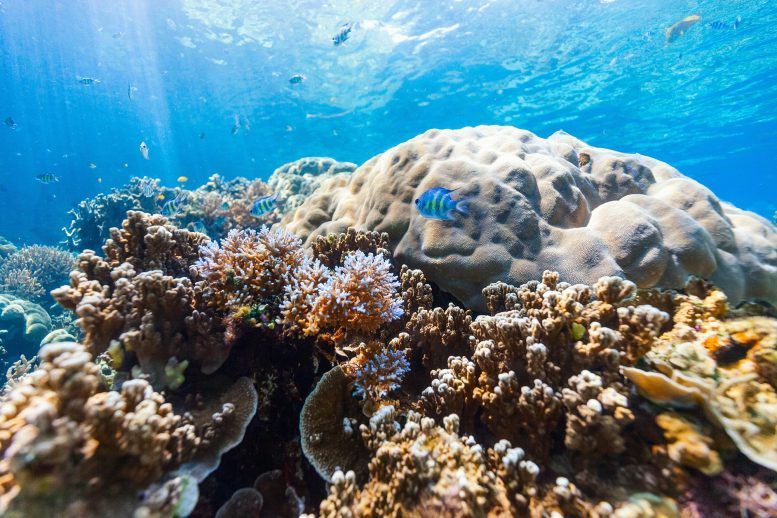
    Coral Reef Underwater
    A new study seeks to establish a common understanding of Symbiodiniaceae diversity, according to lead author Dr. Sarah Davis and her international team of scientists. Symbiodiniaceae, a family of marine plankton known for symbiotic relationships with reef-building corals and other marine invertebrates, is critical to the conservation and restoration of threatened coral reefs worldwide. Despite strides in Symbiodiniaceae genomics, differing interpretations of genetic data have created barriers to progress in the field.

    Researchers led by Dr. Sarah Davis have published a study in the journal PeerJ Life and Environment aiming to build consensus on the understanding of Symbiodiniaceae, a type of marine plankton vital to coral reef health. The team highlights the need for agreed interpretation of genetic data, collaboration, and the use of new technologies to address knowledge gaps and advance coral reef science.

    New research published today (May 2) in the journal PeerJ Life and Environment by Dr. Sarah Davis and sixty-one scientists from 12 countries presents a perspective to build consensus around the assessment and interpretation of Symbiodiniaceae diversity. Symbiodiniaceae is a family of marine dinoflagellates (plankton) notable for their symbiotic associations with reef-building corals, sea anemones, jellyfish, marine sponges, and other marine invertebrates. Understanding Symbiodiniaceae is important to those working to protect and regenerate coral reefs that are under threat around the world.

    “The authors hope this paper will provide a springboard to launch novel, transformative investigations into coral symbiosis at this critical juncture for reefs,” said Dr. Sarah Davis.

    Despite advances in Symbiodiniaceae genomics, a lack of consensus among researchers with respect to interpreting genetic data has slowed progress in the field and acted as a barrier to reconciling observations. The authors identify key challenges regarding the assessment and interpretation of Symbiodiniaceae genetic diversity across three levels: species, populations, and communities.
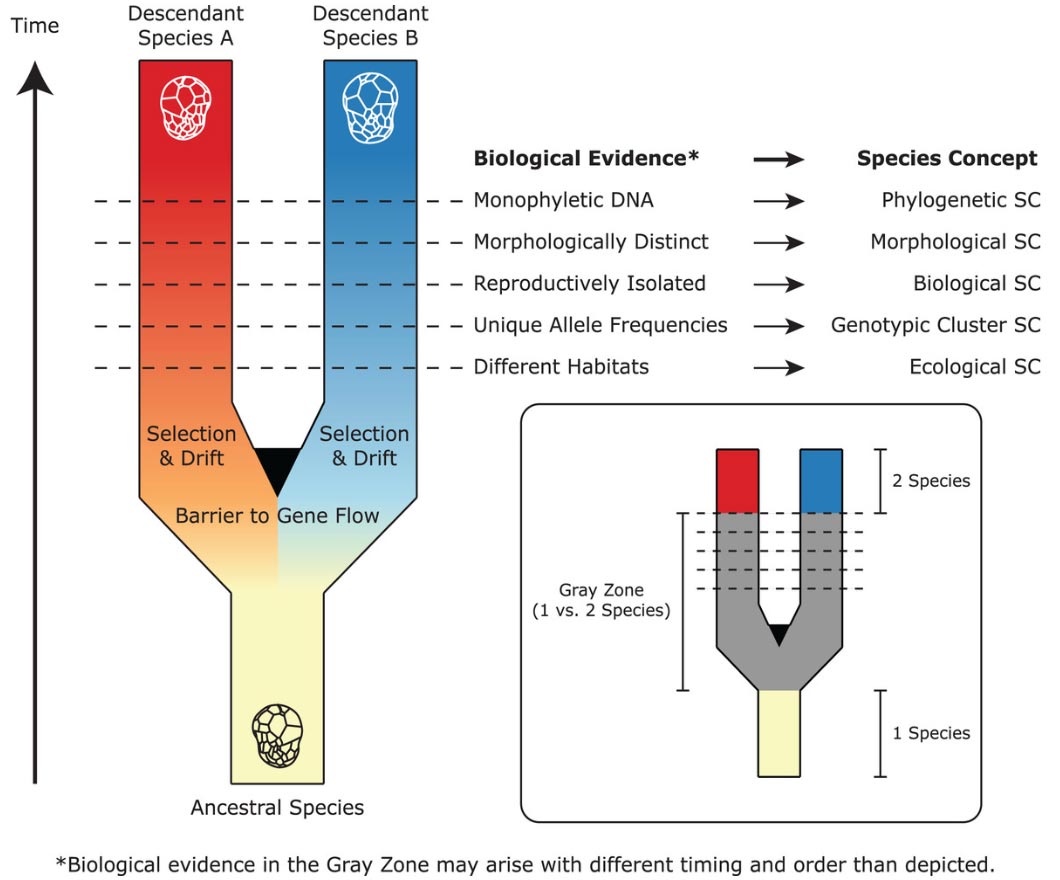
    Symbiodiniaceae Speciation
    A simplified representation of Symbiodiniaceae speciation, species concepts (SC), and associated biological evidence. Credit: PeerJ Life and Environment

    “This manuscript was the result of an NSF-funded workshop aimed at bringing members of the Symbiodiniaceae research community together to discuss past scientific disagreements, identify areas of shared consensus, and craft a more inclusive path forward,” said Dr. Sarah Davis.

    The research summarizes areas of agreement and highlights techniques and approaches that are broadly accepted. In areas where debate remains, the authors identify unresolved issues and discuss technologies and approaches that can help to fill knowledge gaps related to genetic and phenotypic diversity.

    “We also discuss ways to stimulate progress, in particular by fostering a more inclusive and collaborative research community. We hope that this perspective will inspire and accelerate coral reef science by serving as a resource to those designing experiments, publishing research, and applying for funding related to Symbiodiniaceae and their symbiotic partnerships” write the authors.

    Reference: “Building consensus around the assessment and interpretation of Symbiodiniaceae diversity” by Sarah W. Davies, Matthew H. Gamache, Lauren I. Howe-Kerr, Nicola G. Kriefall, Andrew C. Baker, Anastazia T. Banaszak, Line Kolind Bay, Anthony J. Bellantuono, Debashish Bhattacharya, Cheong Xin Chan, Danielle C. Claar, Mary Alice Coffroth, Ross Cunning, Simon K. Davy, Javier del Campo, Erika M. Díaz-Almeyda, Jörg C. Frommlet, Lauren E. Fuess, Raúl A. González-Pech, Tamar L. Goulet, Kenneth D. Hoadley, Emily J. Howells, Benjamin C. C. Hume, Dustin W. Kemp, Carly D. Kenkel, Sheila A. Kitchen, Todd C. LaJeunesse, Senjie Lin, Shelby E. McIlroy, Ryan McMinds, Matthew R. Nitschke, Clinton A. Oakley, Raquel S. Peixoto, Carlos Prada, Hollie M. Putnam, Kate Quigley, Hannah G. Reich, James Davis Reimer, Mauricio Rodriguez-Lanetty, Stephanie M. Rosales, Osama S. Saad, Eugenia M. Sampayo, Scott R. Santos, Eiichi Shoguchi, Edward G. Smith, Michael Stat, Timothy G. Stephens, Marie E. Strader, David J. Suggett, Timothy D. Swain, Cawa Tran, Nikki Traylor-Knowles, Christian R. Voolstra, Mark E. Warner, Virginia M. Weis, Rachel M. Wright, Tingting Xiang, Hiroshi Yamashita, Maren Ziegler, Adrienne M. S. Correa, John Everett Parkinson, 2 May 2023, PeerJ Life and Environment.
    DOI: 10.7717/peerj.15023

    Never miss a breakthrough: Join the SciTechDaily newsletter.
    Follow us on Google and Google News.

    Biodiversity Coral Reefs Environment
    Share. Facebook Twitter Pinterest LinkedIn Email Reddit

    Related Articles

    Surprisingly, Plants Are Better Pollinated in Cities Than in the Countryside

    Climate May Affect Biodiversity in Rainforests Even More Than Deforestation

    Alien Species Invasions in Antarctica Predicted

    True Identity of Mystery Invader in Florida Waters Uncovered After 20 Years – “Sometimes Scientists Make Mistakes”

    Rare Species of Animals and Plants Organize in Ghettos to Survive

    Meet the “Extinct Species” That Was Just Rediscovered After 200 Years

    Species Moving in Response to Climate Change, but Many Have Nowhere to Go

    New Deep-Water Coral Discovered in Part of Unexplored Marine Ecosystem

    Guppies Unlock a Key Question About Evolution

    Leave A Reply Cancel Reply

    • Facebook
    • Twitter
    • Pinterest
    • YouTube

    Don't Miss a Discovery

    Subscribe for the Latest in Science & Tech!

    Trending News

    Scientists May Have Solved a Long-Standing Melanoma Treatment Mystery

    This Flesh-Eating Fly Is Back in the U.S. – Scientists Are Tracking Where It Could Strike Next

    Scientists Have Uncovered a Troubling New Pattern Hidden in America’s Rivers

    “Entirely Surprising” – Scientists Have Found a Martian Meteorite Unlike Any Known Before

    “Find of the Year” – Archaeologists Discover the Smallest Ice Age Figurines Ever Found

    New Research Challenges Common Exercise Advice for Bone Health

    Avoiding These 3 Health Risks in Midlife Linked to 13 More Years Without Dementia

    Where Were All the Tiny Dinosaurs? Scientists May Finally Have an Answer

    Follow SciTechDaily
    • Facebook
    • Twitter
    • YouTube
    • Pinterest
    • Newsletter
    • RSS
    SciTech News
    • Biology News
    • Chemistry News
    • Earth News
    • Health News
    • Physics News
    • Science News
    • Space News
    • Technology News
    Recent Posts
    • Scientists Discover a Hidden Hormone Pathway That Protects the Liver From Damage
    • Quitting Alcohol Can Change the Brain in Surprising Ways, Mouse Study Finds
    • FDA-Approved Drug Shows Promise for Reversing Osteoarthritis Damage
    • A 2-Billion-Year-Old Clue Challenges a Popular Earth Science Theory
    • Paleontologists Reconstruct 56-Million-Year-Old Forests – and Find a Chilling Warning for Today
    Copyright © 1998 - 2026 SciTechDaily. All Rights Reserved.
    • Science News
    • About
    • Contact
    • Editorial Board
    • Privacy Policy
    • Terms of Use

    Type above and press Enter to search. Press Esc to cancel.