
Close Menu
    Facebook X (Twitter) Instagram
    SciTechDaily
    • Biology
    • Chemistry
    • Earth
    • Health
    • Physics
    • Science
    • Space
    • Technology
    Facebook X (Twitter) Pinterest YouTube RSS
    SciTechDaily
    Home»Space»Scientists Reveal Neutron Star Glitches Have a Minimum Size
    Space

    Scientists Reveal Neutron Star Glitches Have a Minimum Size

    By University of AmsterdamApril 17, 2014No Comments3 Mins Read
    Facebook Twitter Pinterest Telegram LinkedIn WhatsApp Email Reddit
    Share
    Facebook Twitter LinkedIn Pinterest Telegram Email Reddit
    New Research Reveals that Neutron Star Glitches Have a Minimum Size
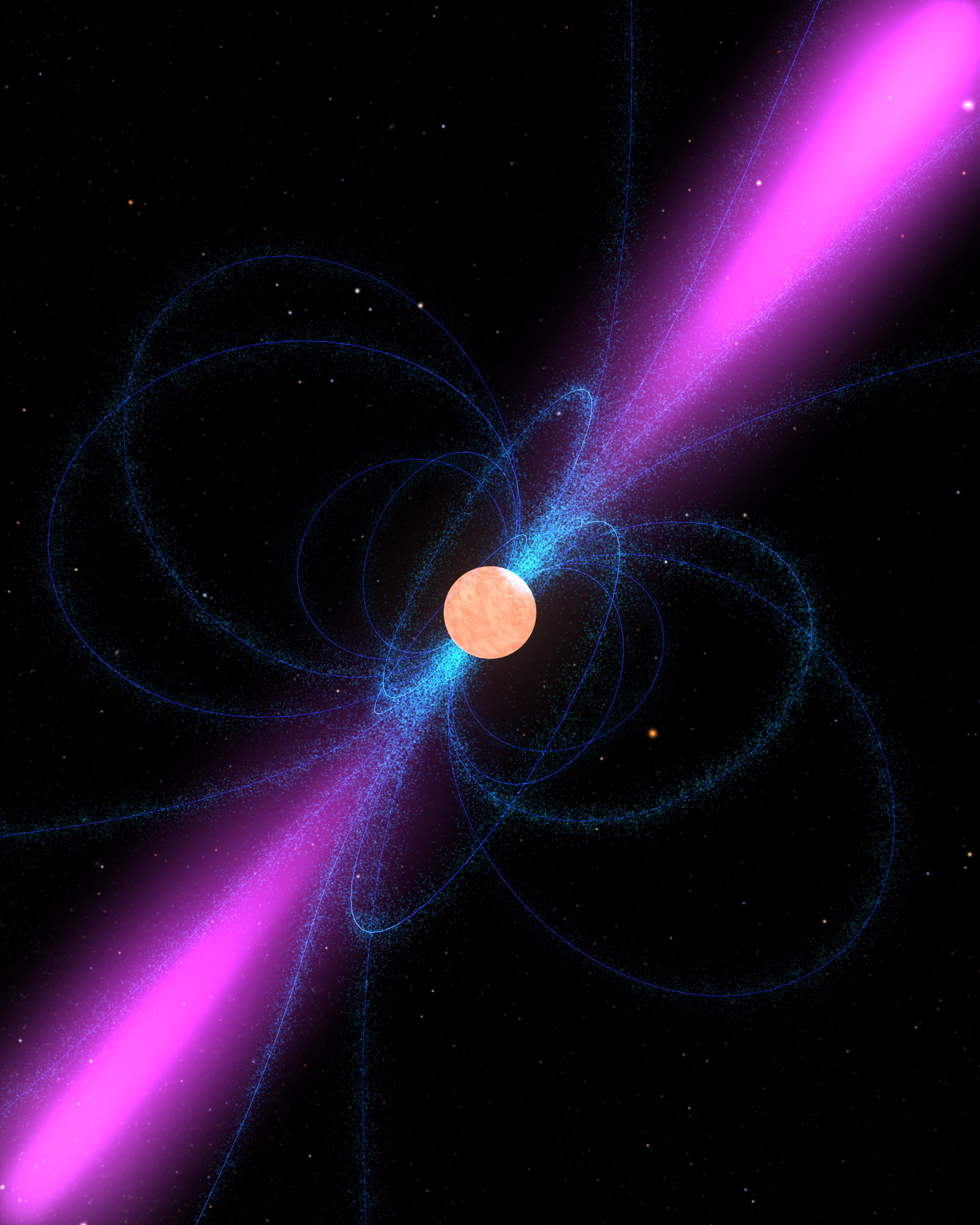
    New research shows that pulsar rotational speed jumps result from the displacement of billions of superfluid vortices, not just one. Credit: NASA

    New research reveals that sudden speed jumps in the rotational velocity of pulsars have a minimum size, and that they are caused not by the unpinning and displacement of just one sub-surface superfluid vortex, but by billions.

    A team of astronomers, including Danai Antonopoulou and Anna Watts from the Anton Pannekoek Institute of Astronomy (UvA), has discovered that sudden speed jumps in the rotational velocity of pulsars have a minimum size, and that they are caused not by the unpinning and displacement of just one sub-surface superfluid vortex, but by billions.

    This result is important to our understanding of the behavior of matter under extreme conditions, and has been published this week in the journal Monthly Notices of the Royal Astronomical Society.

    Pulsars are rotating neutron stars: remnants of massive stars that end their lives in supernova explosions. They act like cosmic lighthouses whose beams sweep through the universe. Their rotational velocity decreases in time, but can suddenly increase in rare events called glitches. These glitches are caused by the unpinning and displacement of vortices that connect the crust with the mixture of particles containing superfluid neutrons beneath the crust.

    The team of astronomers discovered that the glitches of the Crab pulsar always involve a decrease in the rotational period of at least 0,055 nanoseconds. The Crab Pulsar was one of the first pulsars to be discovered and has been observed almost daily with the 42-ft Telescope at the Jodrell Bank Observatory over the last 29 years. The huge amount of data makes this object the best choice to study glitches.

    The smallest glitch is likely to be caused by the unpinning and movement of billions of vortices. ‘Surprisingly, no one tried to determine a lower limit to glitch size before. Many assumed that the smallest glitch would be caused by a single vortex unpinning. The smallest glitch is clearly much larger than we expected,’ says Danai Antonopoulou from the University of Amsterdam (UvA).

    ‘Astronomers would of course like to know whether the smallest glitches of other pulsars are also caused by billions of vortices. The next step is to sift through the data of other pulsars and to continue observing’, says first author Cristobal Espinoza (IA-PUC, Chile). Antonopoulou’s supervisor Anna Watts (UvA) adds: ‘By comparing the observations with theoretical predictions we learn about the behavior of matter in these exotic objects. The precise cause of glitches is still a mystery to us, and this result offers a new challenge to theorists.’

    Reference: “Neutron star glitches have a substantial minimum size” by C. M. Espinoza, D. Antonopoulou, B.W. Stappers, A. Watts and A.G. Lyne, 9 April 2014, MNRAS.
    DOI: 10.1093/mnras/stu395
    arXiv: 1402.7219

    Never miss a breakthrough: Join the SciTechDaily newsletter.
    Follow us on Google and Google News.

    Astronomy Astrophysics Pulsars University of Amsterdam
    Share. Facebook Twitter Pinterest LinkedIn Email Reddit

    Related Articles

    Searching for Elusive Continuous Gravitational Waves From the Densest Objects in the Universe

    Mysterious Cosmic “Spider” Found To Be Source of Powerful Gamma-Rays

    Dense, Spinning, Dead Star Discovered by Outback Radio Telescope

    Enhanced X-ray Emissions Coincide With Giant Radio Pulses From Crab Pulsar

    Mysterious Giant Radio Pulses From Pulsars Are Hundreds of Times More Energetic Than Previously Believed

    Weird X-ray Surges Detected in Crab Pulsar’s Radio Bursts by NASA’s NICER

    New Clues About Early Universe From Black Hole Powered Cosmic Jet 13 Billion Light-Years From Earth

    Gravitational Wave Search Finds Tantalizing New Clue: Unexplained Fluctuations in Space-Time

    Milky Way’s Dark Side Revealed by Measurements of Pulsar Acceleration

    Leave A Reply Cancel Reply

    • Facebook
    • Twitter
    • Pinterest
    • YouTube

    Don't Miss a Discovery

    Subscribe for the Latest in Science & Tech!

    Trending News

    Don’t Miss: A Brilliant Venus and Glowing Harvest Moon Light Up the Sky

    New Twist on the Einstein Problem Reveals Unexpected Physics

    JWST Captures Stunning Evidence of How Supermassive Black Holes Feed

    Early Exercise May Permanently Change How Much Energy the Body Uses To Move

    New Molecule Wipes Out Aggressive Lymphoma Tumors in Mice in Just 11 Days

    The Human Family Tree May Need a Major Rewrite

    Scientists Find a Surprising Cancer-Fighting Effect in Dark Sweet Cherries

    New AI Detects Hidden Warning Signs of Solar Eruptions Hours Before They Emerge

    Follow SciTechDaily
    • Facebook
    • Twitter
    • YouTube
    • Pinterest
    • Newsletter
    • RSS
    SciTech News
    • Biology News
    • Chemistry News
    • Earth News
    • Health News
    • Physics News
    • Science News
    • Space News
    • Technology News
    Recent Posts
    • Could Alien Life Be Conscious in Ways We Can’t Imagine?
    • Scientists Develop a Fruit Wash That Removes Pesticide Residues and Keeps Produce Fresh Longer
    • Scientists May Have Finally Explained Why Astronauts Get Constipated in Space
    • Pomegranates Could Unlock a New Treatment for Heart Failure
    • Africa’s Giant Herbivores Were Disappearing Millions of Years Before Humans Could Hunt Them
    Copyright © 1998 - 2026 SciTechDaily. All Rights Reserved.
    • Science News
    • About
    • Contact
    • Editorial Board
    • Privacy Policy
    • Terms of Use

    Type above and press Enter to search. Press Esc to cancel.