
Close Menu
    Facebook X (Twitter) Instagram
    SciTechDaily
    • Biology
    • Chemistry
    • Earth
    • Health
    • Physics
    • Science
    • Space
    • Technology
    Facebook X (Twitter) Pinterest YouTube RSS
    SciTechDaily
    Home»Space»Enhanced X-ray Emissions Coincide With Giant Radio Pulses From Crab Pulsar
    Space

    Enhanced X-ray Emissions Coincide With Giant Radio Pulses From Crab Pulsar

    By American Association for the Advancement of ScienceApril 24, 20212 Comments3 Mins Read
    Facebook Twitter Pinterest Telegram LinkedIn WhatsApp Email Reddit
    Share
    Facebook Twitter LinkedIn Pinterest Telegram Email Reddit
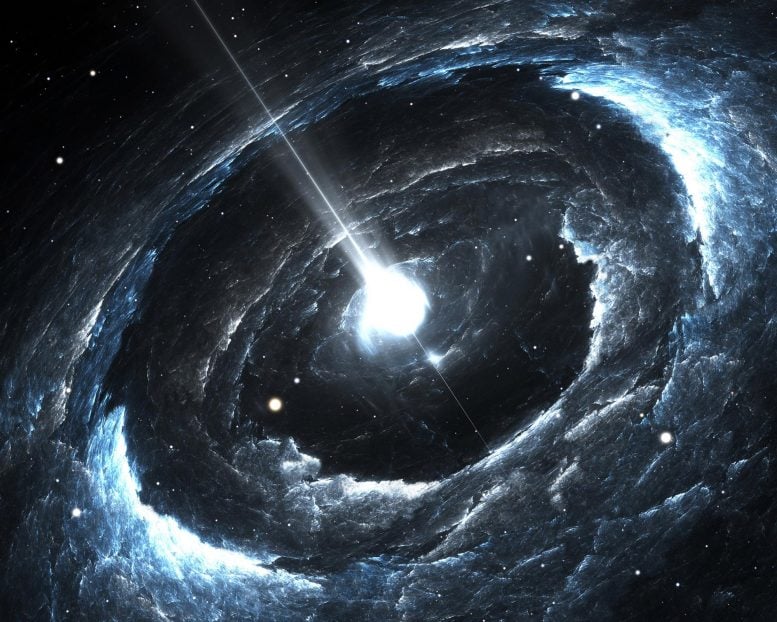
    Pulsar Artist's Concept
    New research findings provide constraints on the mechanisms underlying giant radio pulses and may provide insights into other transient radio phenomena observed throughout the Universe.

    Crab Pulsar’s GRPs Show Unexpected X-ray Brightening

    X-ray emissions from the Crab Pulsar are more intense during giant radio pulses (GRPs), researchers report. The new findings provide constraints on the mechanisms underlying GRPs and may provide new insights into other transient radio phenomena observed throughout the Universe.

    Pulsars, or rapidly spinning neutron stars, emit pulses of electromagnetic radiation from their magnetospheres and are observed from Earth as regular sequences of radio pulses. Most radio pulses from these distant objects are of a consistent intensity. Occasionally, however, sporadic and short-lived bursts from these sources are observed hundreds to thousands of times brighter than normal.


    Scientists using data from NASA’s Neutron star Interior Composition Explorer (NICER) telescope on the International Space Station have discovered X-ray surges accompanying radio bursts from the pulsar in the Crab Nebula. The finding shows that these bursts, called giant radio pulses, release far more energy than previously suspected. Credit: NASA’s Goddard Space Flight Center

    What causes these unpredictable bursts, also known as GRPs, is unknown. Teruaki Enoto and colleagues observed the Crab Pulsar using both X-ray and radio telescopes and found that X-ray emission during GRPs is slightly brighter than during normal pulses.
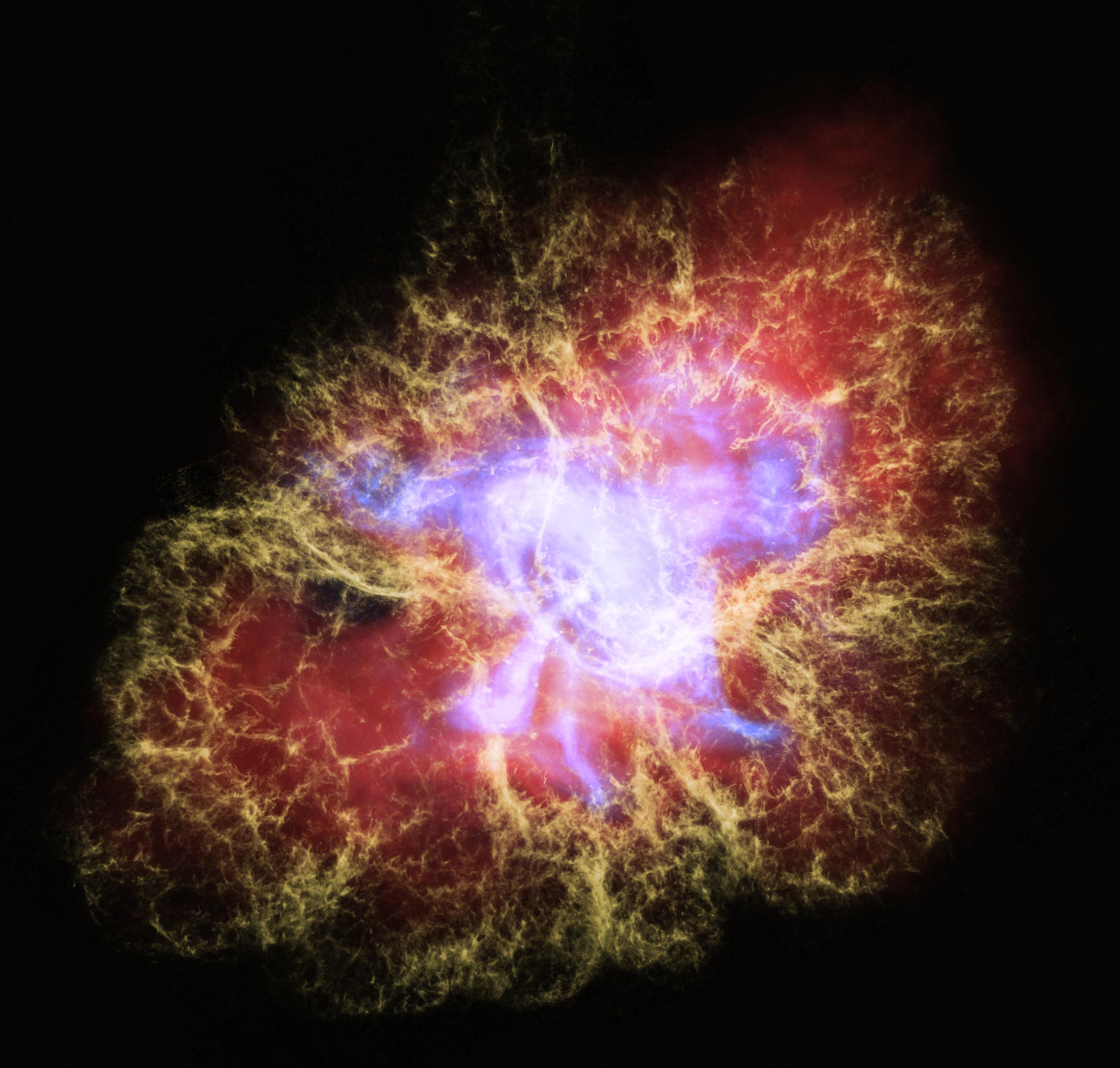
    Crab Nebula
    This new multiwavelength image of the Crab Nebula combines X-ray light from the Chandra X-ray Observatory (in blue) with visible light from the Hubble Space Telescope (in yellow) and infrared light seen by the Spitzer Space Telescope (in red). This particular combination of light from across the electromagnetic spectrum highlights the nested structure of the pulsar wind nebula. Credit: NASA, ESA, J. DePasquale (STScI), and R. Hurt (Caltech/IPAC)

    By comparing the radio and X-ray enhancements, Enoto et al. found that the total emitted energy from GRPs is tens to hundreds of times higher than previously known. According to the authors, the findings also help constrain extragalactic fast radio bursts (FRBs), whose mysterious origins remain unknown.
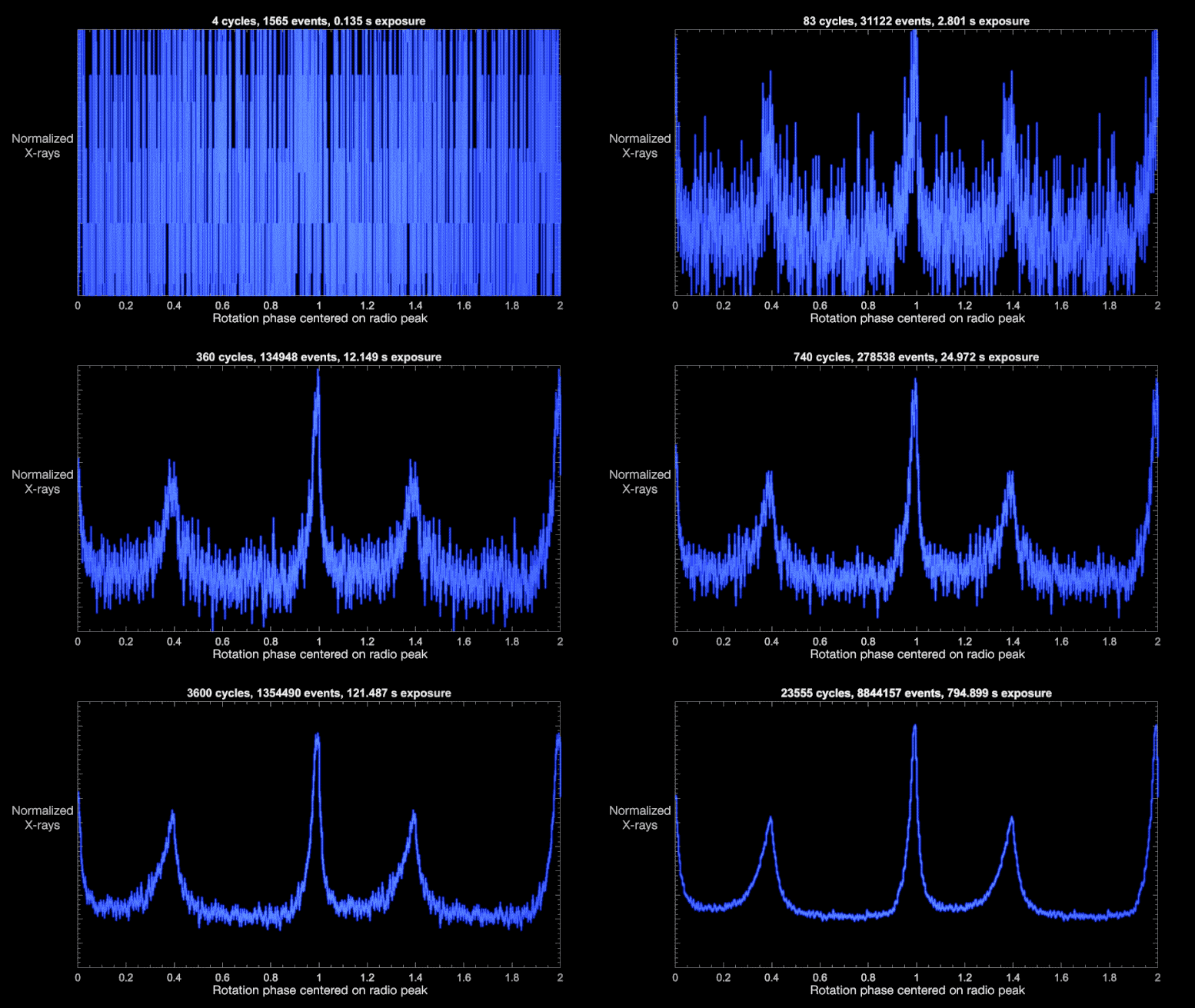
    NICER Observations Crab Pulsar
    Between 2017 and 2019, NASA’s Neutron star Interior Composition Explorer (NICER) and radio telescopes in Japan studied the Crab pulsar at the same time. In this visualization, which represents just 13 minutes of NICER observations, millions of X-rays are plotted relative to the pulsar’s rotational phase, which is centered on the strongest radio emission. For clarity, two full rotations are shown. As the pulsar beams sweep across our line of sight, they produce two peaks for each rotation, with the brighter one associated with greater numbers of giant radio pulses. For the first time, NICER data show a slight increase in X-ray emission associated with these events. Credit: NASA’s Goddard Space Flight Center/Enoto et al. 2021

    For more on this discovery:

    • Weird X-ray Surges Detected in Crab Pulsar’s Radio Bursts by NASA’s NICER
    • Mysterious Giant Radio Pulses From Pulsars Are Hundreds of Times More Energetic Than Previously Believed

    Reference: “Enhanced x-ray emission coinciding with giant radio pulses from the Crab Pulsar” by Teruaki Enoto, Toshio Terasawa, Shota Kisaka, Chin-Ping Hu, Sebastien Guillot, Natalia Lewandowska, Christian Malacaria, Paul S. Ray, Wynn C.G. Ho, Alice K. Harding, Takashi Okajima, Zaven Arzoumanian, Keith C. Gendreau, Zorawar Wadiasingh, Craig B. Markwardt, Yang Soong, Steve Kenyon, Slavko Bogdanov, Walid A. Majid, Tolga Güver, Gaurava K. Jaisawal, Rick Foster, Yasuhiro Murata, Hiroshi Takeuchi, Kazuhiro Takefuji, Mamoru Sekido, Yoshinori Yonekura, Hiroaki Misawa, Fuminori Tsuchiya, Takahiko Aoki, Munetoshi Tokumaru, Mareki Honma, Osamu Kameya, Tomoaki Oyama, Katsuaki Asano, Shinpei Shibata and Shuta J. Tanaka, 9 April 2021, Science.
    DOI: 10.1126/science.abd4659

    Never miss a breakthrough: Join the SciTechDaily newsletter.
    Follow us on Google and Google News.

    American Association for the Advancement of Science Astronomy Astrophysics Fast Radio Bursts Pulsars
    Share. Facebook Twitter Pinterest LinkedIn Email Reddit

    Related Articles

    Astronomers Finally Solve the Mystery of Strange Repeating Radio Bursts From Space

    Cosmic Enigma Solved? Extreme Stars May Hold the Key to Mysterious Radio Bursts

    Bright Sparks & Dark Secrets: How Fast Radio Bursts Illuminate the Distant Cosmos

    Mysterious Galactic Signals: Magnetar Observations Shed New Light on Fast Radio Bursts

    New Clues About Early Universe From Black Hole Powered Cosmic Jet 13 Billion Light-Years From Earth

    New Measurement of the Hubble Constant – Rate of Expansion of the Universe – From Combined Observations of Neutron Stars

    Dazzling Array of Complex Shapes Found in Planetary Nebulae Generated by Stellar Winds Interaction With Binary Companions

    Gravitational Wave Search Finds Tantalizing New Clue: Unexplained Fluctuations in Space-Time

    Milky Way’s Dark Side Revealed by Measurements of Pulsar Acceleration

    2 Comments

    1. Bibhutibhusanpatel on April 24, 2021 8:47 am

      Commonly pulses with two peaks are seen to be emitted with high intensity when a galaxy passes nere by.

      Reply
    2. Gavin Rider on April 24, 2021 11:05 am

      Why is the smaller x-ray pulse at 1.4 rather than. 1.5?

      Reply
    Leave A Reply Cancel Reply

    • Facebook
    • Twitter
    • Pinterest
    • YouTube

    Don't Miss a Discovery

    Subscribe for the Latest in Science & Tech!

    Trending News

    The Strange “Spacetime Crystal” That Can Suddenly Turn Into a Black Hole

    The Surprising Way Asteroids May Have Helped Life Begin on Earth

    Vast Hidden Structure Discovered Under Miles of Ice in East Antarctica

    A Surprising Discovery Suggests Autism Is Not One Condition

    New Alzheimer’s Discovery Could Change How Scientists Fight the Disease

    Yale Discovery Overturns Long-Held “Evolutionary Dead End” Theory

    UCLA Scientists Uncover a “Hidden Weakness” in Some of the World’s Deadliest Cancers

    Humpback Whale Stuns Scientists With 15,000 Kilometer Journey Across Oceans

    Follow SciTechDaily
    • Facebook
    • Twitter
    • YouTube
    • Pinterest
    • Newsletter
    • RSS
    SciTech News
    • Biology News
    • Chemistry News
    • Earth News
    • Health News
    • Physics News
    • Science News
    • Space News
    • Technology News
    Recent Posts
    • Meet the Artemis III Astronauts Preparing for NASA’s Boldest Moon Mission Yet
    • Scientists Develop a New Way To Measure Gravitational Waves in the Expanding Universe
    • MIT’s New Dual-Mode Rocket System Could Send Tiny Satellites to Mars
    • Scientists Discover a Biological Clock Unlike Anything Seen Before
    • This “Zombie” Sea Creature Keeps Growing After Being Cut Apart
    Copyright © 1998 - 2026 SciTechDaily. All Rights Reserved.
    • Science News
    • About
    • Contact
    • Editorial Board
    • Privacy Policy
    • Terms of Use

    Type above and press Enter to search. Press Esc to cancel.