
Close Menu
    Facebook X (Twitter) Instagram
    SciTechDaily
    • Biology
    • Chemistry
    • Earth
    • Health
    • Physics
    • Science
    • Space
    • Technology
    Facebook X (Twitter) Pinterest YouTube RSS
    SciTechDaily
    Home»Space»Astronomers Reveal Relationship Between the Color of a Galaxy and the Size of Its Bulge
    Space

    Astronomers Reveal Relationship Between the Color of a Galaxy and the Size of Its Bulge

    By Royal Astronomical SocietyApril 22, 20141 Comment3 Mins Read
    Facebook Twitter Pinterest Telegram LinkedIn WhatsApp Email Reddit
    Share
    Facebook Twitter LinkedIn Pinterest Telegram Email Reddit
    Researchers Discover Relationship Between the Color of a Galaxy and the Size of Its Bulge
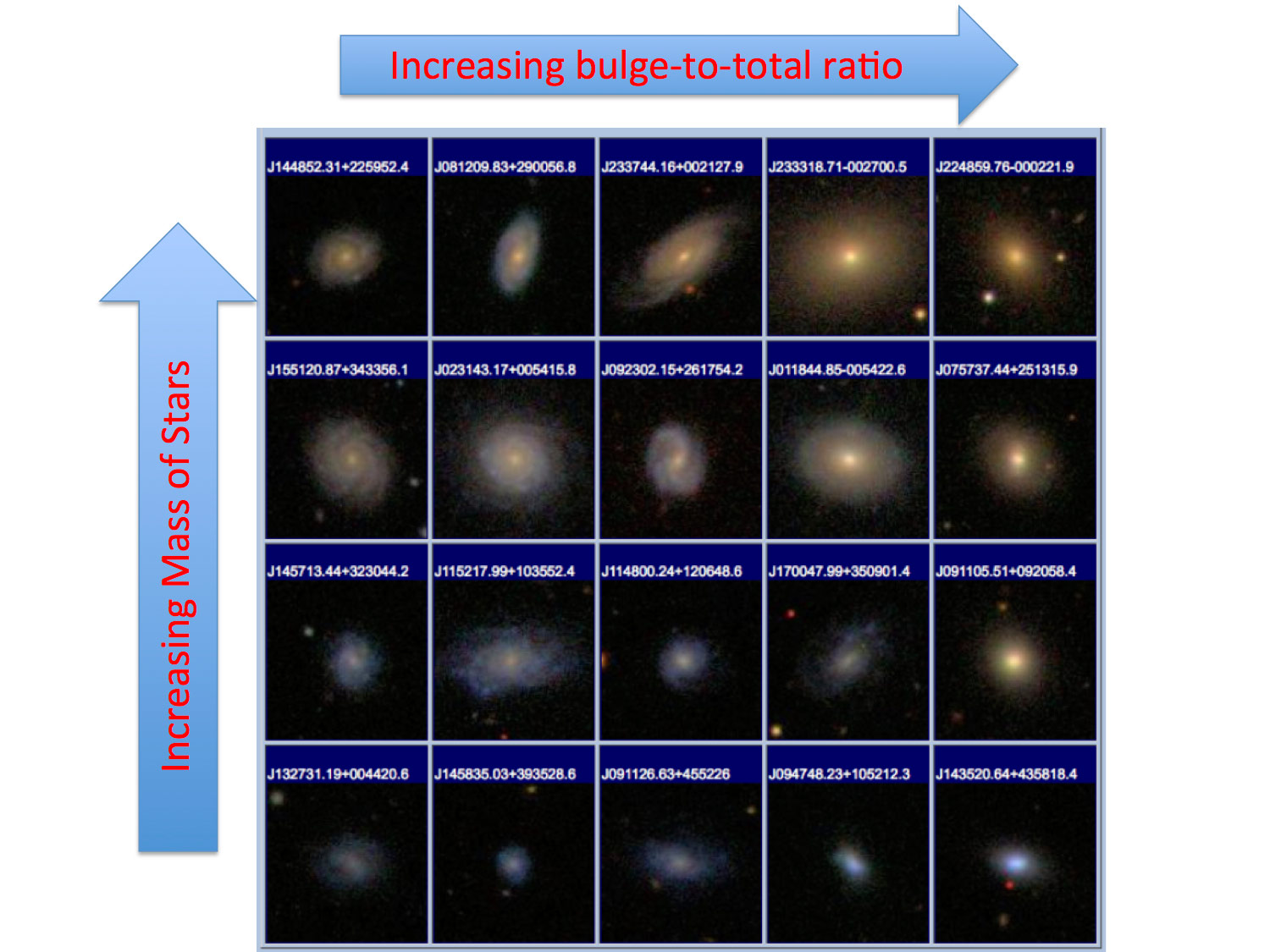
    Images of a small fraction of the galaxies analyzed in the new study. The galaxies are ordered by total mass of stars (rising from bottom to top) and by ‘bulge to total stellar mass ratio’ (rising from left to right). Galaxies that appear redder have high values for both of these measurements, meaning that the mass of the bulge –and central black hole – determines their color. Credit: A. Bluck.

    Using data from the Sloan Digital Sky Survey to group together over half a million galaxies of all different colors, shapes, and masses, new research reveals a relatively simple relationship between the color of a galaxy and the size of its bulge – the more massive the bulge the redder the galaxy.

    The universe we can see is made up of billions of galaxies, each containing anywhere from hundreds of thousands to hundreds of billions of stars. Large numbers of galaxies are elliptical in shape, red, and mostly made up of old stars. Another (more familiar) type is the spiral, where arms wind out in a blue thin disk from a central red bulge. On average stars in spiral galaxies tend to be much younger than those in ellipticals.

    Now a group of astronomers led by Asa Bluck of the University of Victoria in Canada have found a (relatively) simple relationship between the color of a galaxy and the size of its bulge – the more massive the bulge the redder the galaxy. The researchers publish their results in the Oxford University Press journal Monthly Notices of the Royal Astronomical Society.

    Asa and his team used data from the Sloan Digital Sky Survey to group together over half a million galaxies of all different colors, shapes, and masses. They then used pattern recognition software to measure the shape of each one, to see how the proportion of red stars in a galaxy varies with its other properties.

    They found that the mass in the central bulge (regardless of how big the disk surrounding it may be) is the key to knowing the color of the whole galaxy. Above a given bulge mass, galaxies are red and have no new young stars.

    Almost all galaxies have supermassive black holes at their centers. The mass of the bulge is closely related to the mass of the black hole; the more massive the black hole the more energy is released into the surrounding galaxy in the form of powerful jets and X-ray emission. This can blow away and heat up gas, stopping new stars from forming.

    Asa comments: “A relatively simple result, that large galaxy bulges mean red galaxies, has profound consequences. Big bulges mean big black holes and these can put an end to star formation.”

    Reference: “Bulge mass is king: The dominant role of the bulge in determining the fraction of passive galaxies in the Sloan Digital Sky Survey” by Asa F. L. Bluck, J. Trevor Mendel, Sara L. Ellison, Jorge Moreno, Luc Simard, David R. Patton and Else Starkenburg, 28 April 2014, MNRAS.
    DOI: 10.1093/mnras/stu594
    arXiv: 1403.5269


    Never miss a breakthrough: Join the SciTechDaily newsletter.
    Follow us on Google and Google News.

    Astronomy Astrophysics Black Hole Royal Astronomical Society University of Victoria
    Share. Facebook Twitter Pinterest LinkedIn Email Reddit

    Related Articles

    The Center of Our Galaxy May Not Be a Black Hole

    Breaking a 50-Year Law: New Evidence Challenges Fundamental Black Hole Physics

    Astronomers Spot Possible Biggest Black Hole in the Universe

    Monster Black Hole Jets in a Spiral Galaxy Could Forecast the Milky Way’s Frightening Future

    Gravitational Gluttony: How Galactic Mergers Bring Hidden Supermassive Black Holes to Life

    Astronomers Discover Rapidly Growing Black Hole in Extreme Galaxy in the Very Early Universe

    Black Hole at Center of Milky Way Is Unpredictable and Chaotic – Mysterious Flares Erupt Every Day

    Artificial Intelligence Helps Resolve Long-Running Astrophysics Debate on Supermassive Black Holes

    New Research Finds That Supermassive Black Holes Could Form From Dark Matter

    1 Comment

    1. Steve on April 24, 2014 2:46 pm

      That is an unfortunate headline.

      Reply
    Leave A Reply Cancel Reply

    • Facebook
    • Twitter
    • Pinterest
    • YouTube

    Don't Miss a Discovery

    Subscribe for the Latest in Science & Tech!

    Trending News

    This Copper Drug Clears Alzheimer’s Brain Toxins and Boosts Memory

    Adults Over 65 Lost Massive Amounts of Weight With Ozempic

    How Flocking Birds “Defy” One of Physics’ Most Fundamental Laws

    Physicists Create a New Kind of Schrödinger’s Cat State From Exotic Quantum Building Blocks

    Your Diet Could Be Missing the Key Ingredient for Heart Protection

    Researchers Warn Widely Prescribed Blood Pressure Drugs Could Be Harming Diabetic Kidneys

    James Webb Spots Something Strange Between Day and Night on an Alien Planet

    How Ancient People Moved a 6-Ton Stone 700 Kilometers to Stonehenge

    Follow SciTechDaily
    • Facebook
    • Twitter
    • YouTube
    • Pinterest
    • Newsletter
    • RSS
    SciTech News
    • Biology News
    • Chemistry News
    • Earth News
    • Health News
    • Physics News
    • Science News
    • Space News
    • Technology News
    Recent Posts
    • Scientists Uncover Cause of Inflammatory Bowel Disease Solving Decades-Old Mystery
    • The Surprising Reason Swimming Could Be Better for Your Heart Than Running
    • Could Vitamin C Be the Secret to Keeping Your Brain Younger?
    • The Surprising Fix for Robot Traffic Jams
    • Near Absolute Zero, This Transistor Starts Acting Like a Brain Cell
    Copyright © 1998 - 2026 SciTechDaily. All Rights Reserved.
    • Science News
    • About
    • Contact
    • Editorial Board
    • Privacy Policy
    • Terms of Use

    Type above and press Enter to search. Press Esc to cancel.