
Galaxy Mergers Drive Black Hole Growth
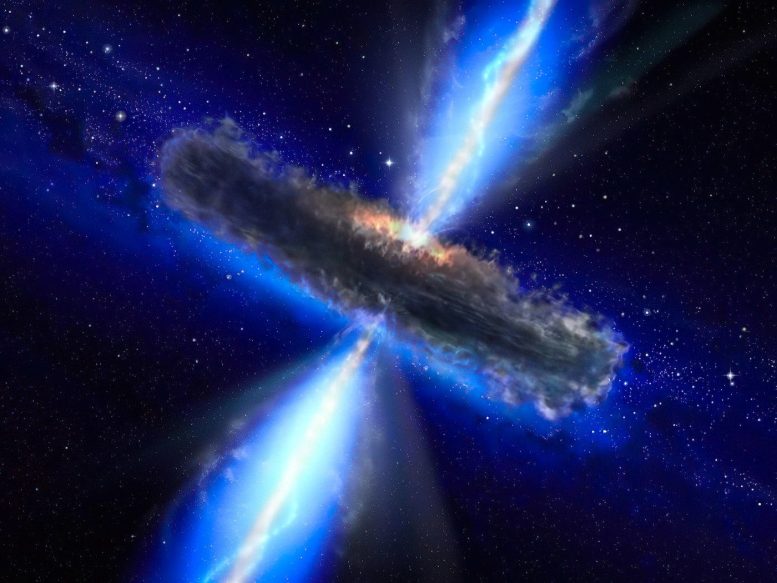
New research led by Newcastle University and published in the Monthly Notices of the Royal Astronomical Society has revealed that supermassive black holes obscured by dust are more likely to grow and release tremendous amounts of energy when they are inside galaxies that are expected to collide with a neighboring galaxy.
Supermassive black holes, with masses millions or even billions of times that of our Sun, are found at the heart of galaxies, including our Milky Way. These black holes increase their size by consuming gas that spirals into them. However, the factors that push the gas close enough to the black holes for consumption remain a subject of ongoing inquiry.
One possibility is that when galaxies are close enough together, they are likely to be gravitationally pulled towards each other and ‘merge’ into one larger galaxy.
Infrared Light Unlocks Hidden Black Holes
In the final stages of its journey into a black hole, gas lights up and produces a huge amount of energy. This energy is typically detected using visible light or X-rays. However, the astronomers conducting this study were only able to detect the growing black holes using infrared light. The team made use of data from many different telescopes, including the Hubble Space Telescope and the infrared Spitzer Space Telescope.
The researchers developed a new technique to determine how likely it is that two galaxies are very close together and are expected to collide in the future. They applied this new method to hundreds of thousands of galaxies in the distant universe (looking at galaxies formed 2 to 6 billion years after the Big Bang) in an attempt to better understand the so-called ‘cosmic noon’, a time when most of the Universe’s galaxy and black hole growth is expected to have taken place.
Understanding how black holes grew during this time is fundamental in modern-day galactic research, especially as it may give us an insight into the supermassive black hole situated inside the Milky Way, and how our galaxy evolved over time.
As they are so far away, only a small number of cosmic noon galaxies meet the required criteria to get precise measurements of their distances. This makes it very difficult to know with high precision if any two galaxies are very close to each other.
A Statistical Approach to Measuring Galactic Distances
This study presents a new statistical method to overcome the previous limitations of measuring accurate distances of galaxies and supermassive black holes at cosmic noon. It applies a statistical approach to determine galaxy distances using images at different wavelengths and removes the need for spectroscopic distance measurements for individual galaxies.
Data arriving from the James Webb Space Telescope over the coming years is expected to revolutionize studies in the infrared and reveal even more secrets about how these dusty black holes grow.
Sean Dougherty, a postgraduate student at Newcastle University and lead author of the paper, says, “Our novel approach looks at hundreds of thousands of distant galaxies with a statistical approach and asks how likely any two galaxies are to be close together and so likely to be on a collision course.”
Dr Chris Harrison, co-author of the study, “These supermassive black holes are very challenging to find because the X-ray light, which astronomers have typically used to find these growing black holes, is blocked, and not detected by our telescopes. But these same black holes can be found using infrared light, which is produced by the hot dust surrounding them.”
He adds, “The difficulty in finding these black holes and in establishing precise distance measurements explains why this result has previously been challenging to pin down these distant ‘cosmic noon’ galaxies. With JWST we are expecting to find many more of these hidden growing black holes. JWST will be far better at finding them, therefore we will have many more to study, including ones that are the most difficult to find. From there, we can do more to understand the dust that surrounds them, and find out how many are hidden in distant galaxies.”
Reference: “Obscured AGN enhancement in galaxy pairs at cosmic noon: evidence from a probabilistic treatment of photometric redshifts” by Sean L Dougherty, C M Harrison, Dale D Kocevski and D J Rosario, 8 May 2023, Monthly Notices of the Royal Astronomical Society.
DOI: 10.1093/mnras/stad1300
Never miss a breakthrough: Join the SciTechDaily newsletter.
Follow us on Google and Google News.