
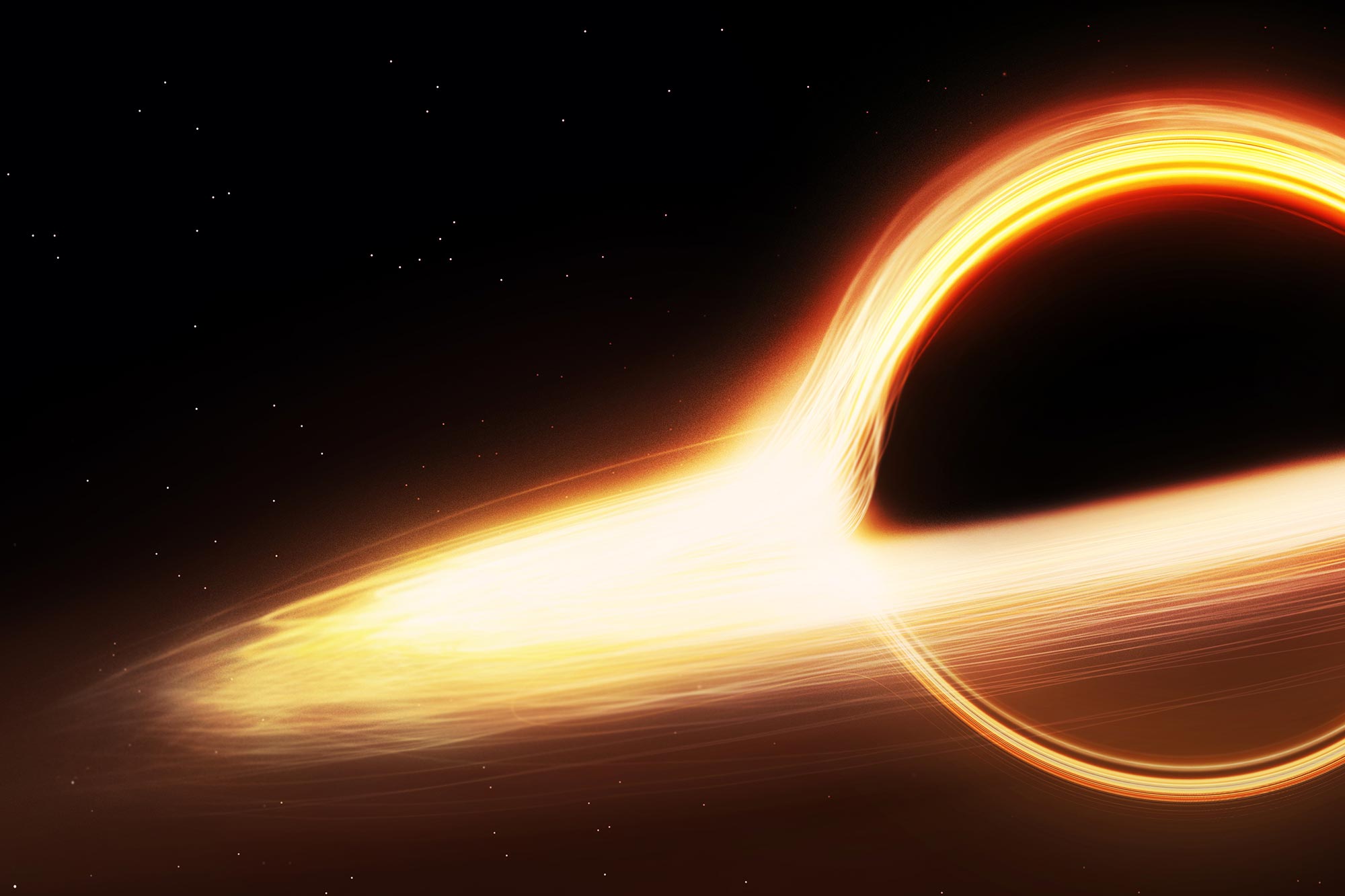
Astronomers have identified an ultramassive black hole that could be the largest ever measured, hidden in a distant galaxy known as the Cosmic Horseshoe.
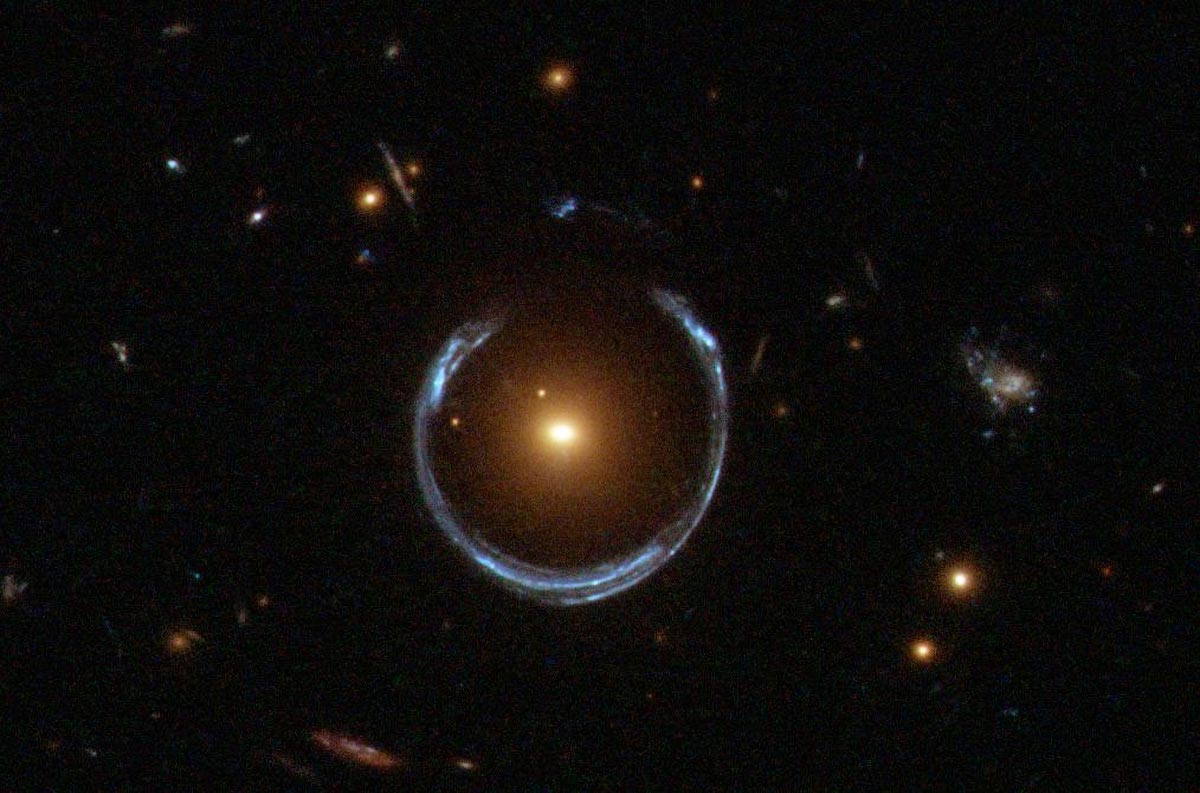
This gargantuan object, weighing about 36 billion Suns, warps space so strongly that light from a background galaxy is bent into a perfect Einstein ring.
Record-Breaking Cosmic Giant
Astronomers have identified what could be the most massive black hole ever found.
This colossal object is close to the maximum size thought possible in the universe and is about 10,000 times more massive than the black hole at the center of the Milky Way.
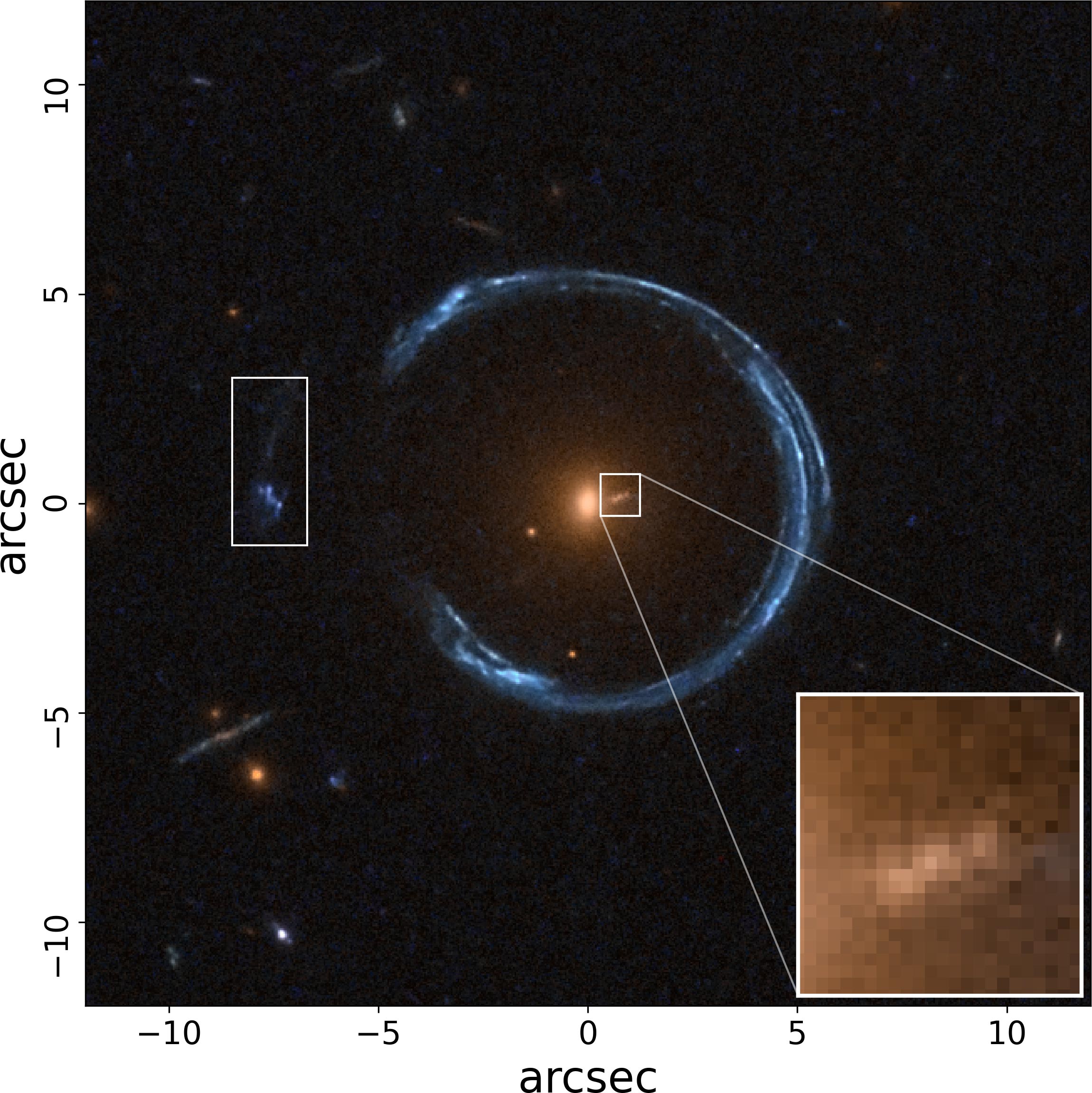
It sits within one of the largest known galaxies, called the Cosmic Horseshoe. This enormous galaxy bends spacetime so strongly that it distorts light from a more distant galaxy, creating a vast, horseshoe-shaped feature known as an Einstein ring.
According to a study published on August 7 in Monthly Notices of the Royal Astronomical Society, the black hole’s mass is estimated at an astonishing 36 billion times that of our Sun.
Measuring an Ultramassive Mystery
Astronomers believe that every galaxy contains a supermassive black hole at its core, and that the largest galaxies are home to even bigger ones, referred to as ultramassive black holes.
“This is amongst the top 10 most massive black holes ever discovered, and quite possibly the most massive,” said researcher Professor Thomas Collett, of the University of Portsmouth.
“Most of the other black hole mass measurements are indirect and have quite large uncertainties, so we really don’t know for sure which is biggest. However, we’ve got much more certainty about the mass of this black hole thanks to our new method.”
Unlocking the Mass with New Techniques
Researchers detected the Cosmic Horseshoe black hole using a combination of gravitational lensing and stellar kinematics (the study of the motion of stars within galaxies and the speed and way they move around black holes).
The latter is seen as the gold standard for measuring black hole masses, but doesn’t really work outside of the very nearby universe because galaxies appear too small on the sky to resolve the region where a supermassive or ultramassive black hole lies.
Adding in gravitational lensing helped the team “push much further out into the universe,” Professor Collett said.
“We detected the effect of the black hole in two ways – it is altering the path that light takes as it travels past the black hole, and it is causing the stars in the inner regions of its host galaxy to move extremely quickly (almost 400 km/s).
“By combining these two measurements, we can be completely confident that the black hole is real.”
A Silent But Powerful Giant
Lead researcher, PhD candidate Carlos Melo, of the Universidade Federal do Rio Grande do Sul (UFRGS) in Brazil, added: “This discovery was made for a ‘dormant’ black hole – one that isn’t actively accreting material at the time of observation.
“Its detection relied purely on its immense gravitational pull and the effect it has on its surroundings.
“What is particularly exciting is that this method allows us to detect and measure the mass of these hidden ultramassive black holes across the universe, even when they are completely silent.”
Measuring the Distant and Dormant
The Cosmic Horseshoe black hole is located a long way away from Earth, at a distance of some 5 billion light-years.
“Typically, for such remote systems, black hole mass measurements are only possible when the black hole is active,” Melo said. “But those accretion-based estimates often come with significant uncertainties.
“Our approach, combining strong lensing with stellar dynamics, offers a more direct and robust measurement, even for these distant systems.”
Black Holes and Galaxy Evolution
The discovery is significant because it will help astronomers understand the connection between supermassive black holes and their host galaxies.
“We think the size of both is intimately linked,” Professor Collett added, “because when galaxies grow, they can funnel matter down onto the central black hole.
“Some of this matter grows the black hole, but lots of it shines away in an incredibly bright source called a quasar. These quasars dump huge amounts of energy into their host galaxies, which stops gas clouds from condensing into new stars.”
Our own galaxy, the Milky Way, hosts a 4 million solar mass black hole. Currently it’s not growing fast enough to blast out energy as a quasar but we know it has done in the past, and it may will do again in the future.
The Andromeda Galaxy and our Milky Way are moving together and are expected to merge in about 4.5 billion years, which is the most likely time for our supermassive black hole to become a quasar once again, the researchers say.
End States of Galaxies and Black Holes
An interesting feature of the Cosmic Horseshoe system is that the host galaxy is a so-called fossil group.
Fossil groups are the end state of the most massive gravitationally bound structures in the universe, arising when they have collapsed down to a single extremely massive galaxy, with no bright companions.
“It is likely that all of the supermassive black holes that were originally in the companion galaxies have also now merged to form the ultramassive black hole that we have detected,” said Professor Collett.
“So we’re seeing the end state of galaxy formation and the end state of black hole formation.”
A Fortunate Dark Matter Detour
The discovery of the Cosmic Horseshoe black hole was somewhat of a serendipitous discovery. It came about as the researchers were studying the galaxy’s dark matter distribution in an attempt to learn more about the mysterious hypothetical substance.
Now that they’ve realised their new method works for black holes, they hope to use data from the European Space Agency’s Euclid space telescope to detect more supermassive black holes and their hosts to help understand how black holes stop galaxies from forming stars.
Reference: “Unveiling a 36 billion solar mass black hole at the centre of the Cosmic Horseshoe gravitational lens” by Carlos R Melo-Carneiro, Thomas E Collett, Lindsay J Oldham, Wolfgang Enzi, Cristina Furlanetto, Ana L Chies-Santos and Tian Li, 7 August 2025, Monthly Notices of the Royal Astronomical Society.
DOI: 10.1093/mnras/staf1036
Never miss a breakthrough: Join the SciTechDaily newsletter.
Follow us on Google and Google News.
1 Comment
We’re seeing what it was like 5 billion years ago! By now, it could have eaten that whole galaxy and a few of its neighbors.