
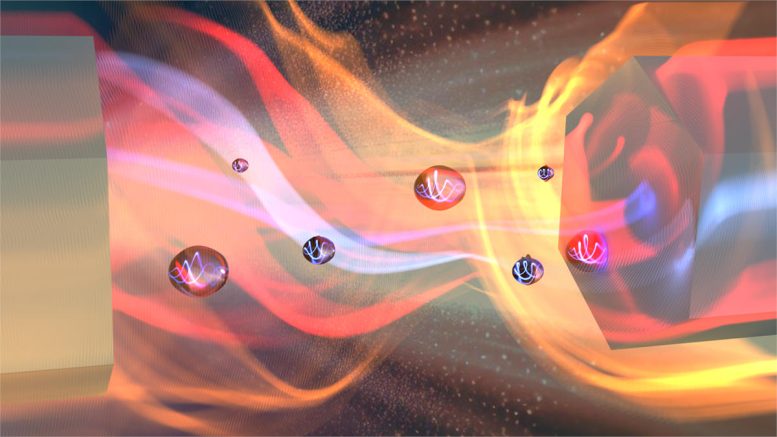
Physicists have discovered that sound can travel through a vacuum under specific conditions. Their study shows that piezoelectric materials can use electric fields to transmit sound waves across vacuum gaps smaller than the sound wave’s wavelength. This finding could revolutionize microelectronics, smartphone technology, and heat control.
The iconic movie Alien once claimed: “In space, no one can hear you scream.” However, physicists Zhuoran Geng and Ilari Maasilta from the Nanoscience Center at the University of Jyväskylä, Finland, beg to differ. Their recent research suggests that under specific conditions, sound can indeed be transmitted powerfully across a vacuum.
Their findings, published recently in the journal Communications Physics, reveal that in certain scenarios, sound waves can “tunnel” through a vacuum gap between two solid objects, provided those objects are piezoelectric. These particular materials generate an electrical response when subjected to sound waves or vibrations. Given that an electric field can be present in a vacuum, it can effectively carry these sound waves across.
The requirement is that the size of the gap is smaller than the wavelength of the sound wave. This effect works not only in the audio range of frequencies (Hz-kHz), but also in ultrasound (MHz) and hypersound (GHz) frequencies, as long as the vacuum gap is made smaller as the frequencies increase.
“In most cases the effect is small, but we also found situations, where the full energy of the wave jumps across the vacuum with 100 % efficiency, without any reflections. As such, the phenomenon could find applications in microelectromechanical components (MEMS, smartphone technology) and in the control of heat,” says Professor Ilari Maasilta from the Nanoscience Center at the University of Jyväskylä.
Reference: “Complete tunneling of acoustic waves between piezoelectric crystals” by Zhuoran Geng and Ilari J. Maasilta, 14 July 2023, Communications Physics.
DOI: 10.1038/s42005-023-01293-y
The study was funded by the Academy of Finland and the European Union’s Horizon 2020 program.
Never miss a breakthrough: Join the SciTechDaily newsletter.
Follow us on Google and Google News.
10 Comments
This is BS. The sound is not propogating through a vaccuum, an electric field is.
According to the topological vortex gravitational field theory, sound waves are similar to light waves that the formation and propagation are inseparable from the interaction of vortex gravitational fields, and produce different physical effects in different vortex environments. Vortex gravity is the source of all things and the most essential force that maintains and connects the world. From the accretion disk of the universe to quantum spin, there is no exception.
Ho hum. We’ve been transmitting sound through vacuum for decades…by converting it to radio waves. Essentially similar to what they described. Nothing new here.
Oh please, that’s not sound through vacuum.
You can just as easily modulate light to carry sound to the edge of the universe.
The blog you posted is beautiful and it has been very beneficial. Start shopping for school must-have items for less. Back-to-school uniforms under $10 can be gotten at Amazon. Moreover, these wears are well designed and you will love them. Please don't hesitate to check my content on this same topic.
On the cusp of long range space communication a gapless time delay. I have a question can sound waves halt the combustion process of fire disrupting the reaction stage.
Sound waves dislike halting combustion, and will only do so if given proper recognition for their work, and are taken out for ice cream afterwards.
Wayall… I’ll tell ya what. If this is true then there is gonnuh be a bunch of sound already existing maybe it will have some intelligible content. Record it. Let the world hear it.
“Scientists prove the sound can pass over vacuum provided at the source is a microphone and at the receiver end is a speaker. Coupled together”
In the beginning was the word!