

Close Menu
    Facebook X (Twitter) Instagram
    SciTechDaily
    • Biology
    • Chemistry
    • Earth
    • Health
    • Physics
    • Science
    • Space
    • Technology
    Facebook X (Twitter) Pinterest YouTube RSS
    SciTechDaily
    Home»Biology»Having a Bad Hair Day? Genetic Mapping Uncovers the Secrets of Hair Whorl Patterns
    Biology

    Having a Bad Hair Day? Genetic Mapping Uncovers the Secrets of Hair Whorl Patterns

    By ElsevierAugust 16, 2023No Comments3 Mins Read
    Facebook Twitter Pinterest Telegram LinkedIn WhatsApp Email Reddit
    Share
    Facebook Twitter LinkedIn Pinterest Telegram Email Reddit
    Bad Hair Day Art Concept
    The first genome-wide association study on human scalp hair whorls identified that hair whorl direction is influenced by multiple genes, rather than a single gene. Four genetic variants likely to affect this direction were found, and the research disproved previous theories linking hair whorl patterns to neurological development.

    A new study in the Journal of Investigative Dermatology uncovers the genes that dictate the direction of hair whorls.

    The first gene mapping study on human scalp hair whorls not only demonstrates that hair whorl direction has a genetic basis, but also that it is influenced by multiple genes. Four associated genetic variants that are likely to influence hair whorl direction are identified, as reported in the Journal of Investigative Dermatology, published by Elsevier.

    Hair Whorl Significance

    A hair whorl is a patch of hair growing in a circular pattern around a point defined by hair follicle orientations. Scalp hair whorl pattern, a readily observable human trait, is usually characterized by the whorl number (single or double whorl) and whorl direction (e.g., clockwise, counterclockwise, or diffuse).

    Because atypical whorl patterns have been observed in patients with abnormal neurological development, comprehending the genetic foundation of whorl patterns might help shed light on vital biological processes.

    Research Process

    The first genome-wide association study (GWAS) on human scalp hair whorls was conducted among 2,149 Chinese individuals from the National Survey of Physical Traits cohort. This was followed by a replication study in 1,950 Chinese individuals from the Taizhou Longitudinal Study cohort.
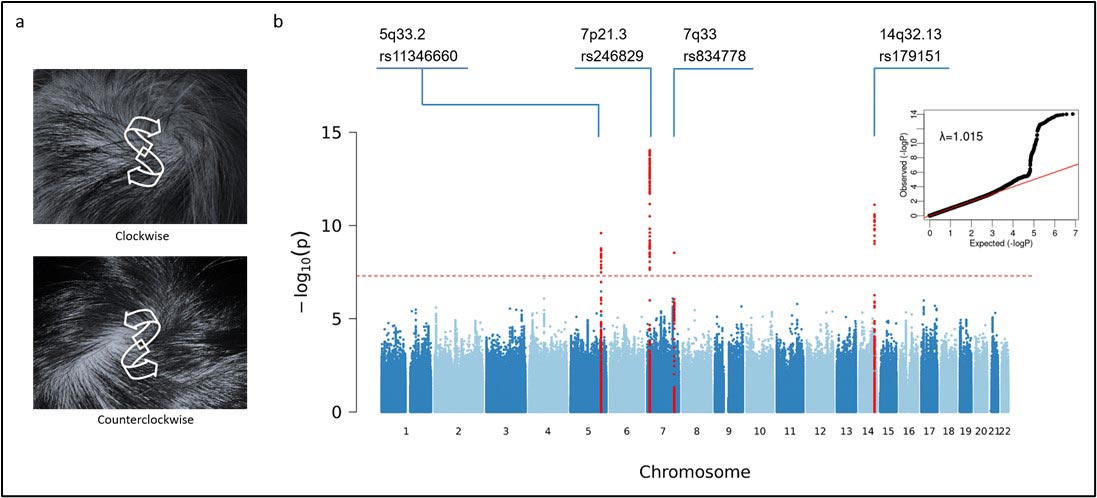
    Genome Hair Whorl Direction
    a) Patterns of whorl direction. (b) Manhattan plot and quantile-quantile plot from the discovery and replication cohorts. Credit: Journal of Investigative Dermatology

    Lead investigator Sijia Wang, PhD, Shanghai Institute of Nutrition and Health, Chinese Academy of Sciences, explained, “We know very little about why we look like we do. Our group has been looking for the genes underlying various interesting traits of physical appearance, including fingerprint patterns, eyebrow thickness, earlobe shape, and hair curliness. Hair whorl is one of the traits that we were curious about. The prevailing opinion was that hair whorl direction is controlled by a single gene, exhibiting Mendelian inheritance. However, our results demonstrate that hair whorl direction is influenced by the cumulative effects of multiple genes, suggesting a polygenic inheritance.”

    Genetic Variants and Potential Effects

    The study identifies four associated genetic variants (at 7p21.3, 5q33.2, 7q33, and 14q32.13). These genetic variants are likely to influence hair whorl direction by regulating the cell polarity of hair follicles. Additionally, cranial neural tube closure and growth could play a part in this process.

    Professor Wang continued, “While previous work proposed the hypothesis of associations between hair whorl patterns and abnormal neurological development, no significant genetic associations were observed between hair whorl direction and behavioral, cognitive, or neurological phenotypes. Although we still know very little about why we look like we do, we are confident that curiosity will eventually drive us to the answers.”

    Reference: “GWAs Identify DNA Variants Influencing Eyebrow Thickness Variation in Europeans and Across Continental Populations” by Fuduan Peng, Ziyi Xiong, Gu Zhu, Pirro G. Hysi, Ryan J. Eller, Sijie Wu, Kaustubh Adhikari, Yan Chen, Yi Li, Rolando Gonzalez-José, Lavinia Schüler-Faccini, Maria-Cátira Bortolini, Victor Acuña-Alonzo, Samuel Canizales-Quinteros, Carla Gallo, Giovanni Poletti, Gabriel Bedoya, Francisco Rothhammer, André G. Uitterlinden, M. Arfan Ikram, Tamar Nijsten, Andrés Ruiz-Linares, Sijia Wang, Susan Walsh, Timothy D. Spector, Nicholas G. Martin, Manfred Kayser and Fan Liu on behalf of theInternational Visible Trait Genetics (VisiGen) Consortium, 19 April 2023, Journal of Investigative Dermatology.
    DOI: 10.1016/j.jid.2022.11.026

    Never miss a breakthrough: Join the SciTechDaily newsletter.
    Follow us on Google and Google News.

    Dermatology Genetics Hair
    Share. Facebook Twitter Pinterest LinkedIn Email Reddit

    Related Articles

    MIT Scientists Uncover Rapid Microbial Evolution on Eczema-Afflicted Skin

    Discovery Leads to Schizophrenia Biomarker and New Insights on Cause and Treatment

    Scientists Untangle the Science of How Hair Follicles Grow

    A Possible New Treatment for Baldness, Regulatory T Cells Facilitate Hair Growth

    Yale Study Shows Topical Ruxolitinib Grows Hair

    Scientists Show That Blocking Enzymes in Hair Follicles Promotes Hair Growth

    FDA Approved Arthritis Drug Spurs Hair Growth

    Hair Restoration Method Generates New Human Hair Growth

    Hairy People Better at Catching Bedbugs

    Leave A Reply Cancel Reply

    • Facebook
    • Twitter
    • Pinterest
    • YouTube

    Don't Miss a Discovery

    Subscribe for the Latest in Science & Tech!

    Trending News

    Don’t Miss: A Brilliant Venus and Glowing Harvest Moon Light Up the Sky

    New Twist on the Einstein Problem Reveals Unexpected Physics

    JWST Captures Stunning Evidence of How Supermassive Black Holes Feed

    Early Exercise May Permanently Change How Much Energy the Body Uses To Move

    New Molecule Wipes Out Aggressive Lymphoma Tumors in Mice in Just 11 Days

    The Human Family Tree May Need a Major Rewrite

    Scientists Find a Surprising Cancer-Fighting Effect in Dark Sweet Cherries

    New AI Detects Hidden Warning Signs of Solar Eruptions Hours Before They Emerge

    Follow SciTechDaily
    • Facebook
    • Twitter
    • YouTube
    • Pinterest
    • Newsletter
    • RSS
    SciTech News
    • Biology News
    • Chemistry News
    • Earth News
    • Health News
    • Physics News
    • Science News
    • Space News
    • Technology News
    Recent Posts
    • Could Alien Life Be Conscious in Ways We Can’t Imagine?
    • Scientists Develop a Fruit Wash That Removes Pesticide Residues and Keeps Produce Fresh Longer
    • Scientists May Have Finally Explained Why Astronauts Get Constipated in Space
    • Pomegranates Could Unlock a New Treatment for Heart Failure
    • Africa’s Giant Herbivores Were Disappearing Millions of Years Before Humans Could Hunt Them
    Copyright © 1998 - 2026 SciTechDaily. All Rights Reserved.
    • Science News
    • About
    • Contact
    • Editorial Board
    • Privacy Policy
    • Terms of Use

    Type above and press Enter to search. Press Esc to cancel.