
Close Menu
    Facebook X (Twitter) Instagram
    SciTechDaily
    • Biology
    • Chemistry
    • Earth
    • Health
    • Physics
    • Science
    • Space
    • Technology
    Facebook X (Twitter) Pinterest YouTube RSS
    SciTechDaily
    Home»Space»Maser Mystique: Hubble’s Gaze Into a Stellar Cradle
    Space

    Maser Mystique: Hubble’s Gaze Into a Stellar Cradle

    By ESA/HubbleAugust 27, 2023No Comments2 Mins Read
    Facebook Twitter Pinterest Telegram LinkedIn WhatsApp Email Reddit
    Share
    Facebook Twitter LinkedIn Pinterest Telegram Email Reddit
    Protostellar Object OH 339.88-1.26
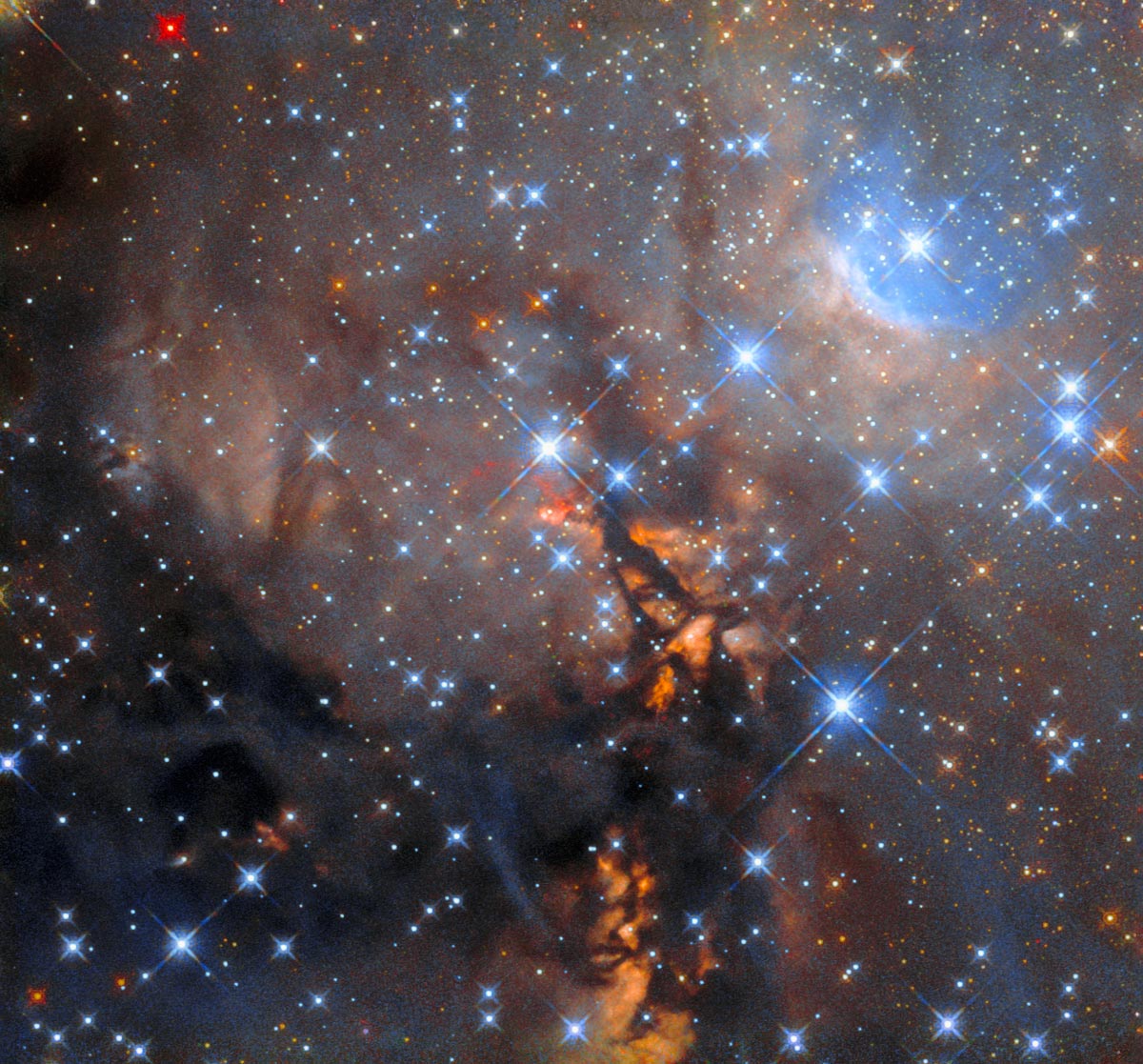
    Hubble Space Telescope image of protostellar object OH 339.88-1.26, which lies 8,900 light-years from Earth in the constellation Ara. Credit: ESA/Hubble & NASA, J. Tan

    The NASA/ESA Hubble Space Telescope has captured an entrancing dust-filled image of the protostellar object OH 339.88-1.26. Located 8,900 light-years away in the constellation Ara. This image showcases winding lanes of dark dust intertwined with bright stars, their brilliance emphasized by crisscrossing diffraction spikes.

    Unveiling the Secrets of OH 339.88-1.26

    The dark vertical streak in the center of the image conceals OH 339.88-1.26, which is an astrophysical maser. A maser — which is an acronym for “microwave amplification by stimulated emission of radiation” — is essentially a laser that produces coherent light at microwave wavelengths. These intriguing phenomena naturally arise in a range of astrophysical contexts, from the north pole of Jupiter to star-forming regions like the one depicted here.

    Hubble’s Deep Dive into Star Formation

    This image comes from a set of Hubble observations that peer into the hearts of regions where massive stars are born, with the goal of constraining the nature of massive protostars and testing theories of their formation. Astronomers turned to Hubble’s Wide Field Camera 3 (WFC3) to explore five intermediate-mass protostars at infrared wavelengths.

    The Hubble observations were supported by other state-of-the-art observatories including ALMA, the Atacama Large Millimeter/submillimeter Array. ALMA is composed of 66 moveable high-precision antennas that can be arranged over distances of up to 16 kilometers (10 miles) on a plateau perched high in the Chilean Andes. Further data were contributed by the Stratospheric Observatory For Infrared Astronomy (SOFIA), which is a telescope that — until recently — operated out of a converted 747 aircraft.

    Never miss a breakthrough: Join the SciTechDaily newsletter.
    Follow us on Google and Google News.

    Astronomy European Space Agency Hubble Space Telescope
    Share. Facebook Twitter Pinterest LinkedIn Email Reddit

    Related Articles

    A Diamond Necklace of Cosmic Proportions

    Hubble Snaps a Stunning Close-Up of a Magnificent Spiral Galaxy

    Extraordinary Hubble Image: Light Bends From the Beyond

    Hubble Space Telescope Sees Volcanic Activity Reforming the Atmosphere on a Rocky Exoplanet

    Hubble Spies a Luminous Heart With Dark Tendrils

    Spectacular Return to the Veil Nebula

    Hubble Spots a Peculiar Sight: Unusual Spiral Galaxy With a Heavy Arm

    A Flash of Life: Hubble Spies an Unusual Planetary Nebula

    Through the Cosmic Clouds: Hubble Spots a Beautiful Stellar Nursery

    Leave A Reply Cancel Reply

    • Facebook
    • Twitter
    • Pinterest
    • YouTube

    Don't Miss a Discovery

    Subscribe for the Latest in Science & Tech!

    Trending News

    The 4,000-Year-Old City That Defied History’s Rules on Wealth and Power

    The World’s Biggest Population Fear Has Flipped – and It Could Change Everything

    This “Fake” Pill Improved Memory and Physical Performance in Just 3 Weeks

    Scientists Say Frequent Ejaculation May Improve Sperm Quality and Fertility

    Scientists Have Found “The Heaven Sword” After Years of Looking

    Can Time Flow in Reverse? A Quantum Breakthrough Challenges Our Assumptions

    Hidden Alzheimer’s Biomarker Could Change How Doctors Prescribe Hormone Therapy

    Koalas Nearly Vanished 100,000 Years Ago – Long Before Humans Arrived

    Follow SciTechDaily
    • Facebook
    • Twitter
    • YouTube
    • Pinterest
    • Newsletter
    • RSS
    SciTech News
    • Biology News
    • Chemistry News
    • Earth News
    • Health News
    • Physics News
    • Science News
    • Space News
    • Technology News
    Recent Posts
    • 17,000 Brain Scans Reveal Surprising Ethnic Differences in Alzheimer’s Biology
    • New Autism Treatment Strategy Restores Key Brain Receptor Function
    • Younger Generations Are Aging Faster – and It May Be Fueling a Surge in Cancer
    • Scientists Turn Ordinary Sunlight Into UV Light in Major Energy Breakthrough
    • New Discovery Could Unlock Quantum Computers the Size of a Coin
    Copyright © 1998 - 2026 SciTechDaily. All Rights Reserved.
    • Science News
    • About
    • Contact
    • Editorial Board
    • Privacy Policy
    • Terms of Use

    Type above and press Enter to search. Press Esc to cancel.