
Close Menu
    Facebook X (Twitter) Instagram
    SciTechDaily
    • Biology
    • Chemistry
    • Earth
    • Health
    • Physics
    • Science
    • Space
    • Technology
    Facebook X (Twitter) Pinterest YouTube RSS
    SciTechDaily
    Home»Space»Extraordinary Hubble Image: Light Bends From the Beyond
    Space

    Extraordinary Hubble Image: Light Bends From the Beyond

    By ESA/HubbleApril 11, 2021No Comments2 Mins Read
    Facebook Twitter Pinterest Telegram LinkedIn WhatsApp Email Reddit
    Share
    Facebook Twitter LinkedIn Pinterest Telegram Email Reddit
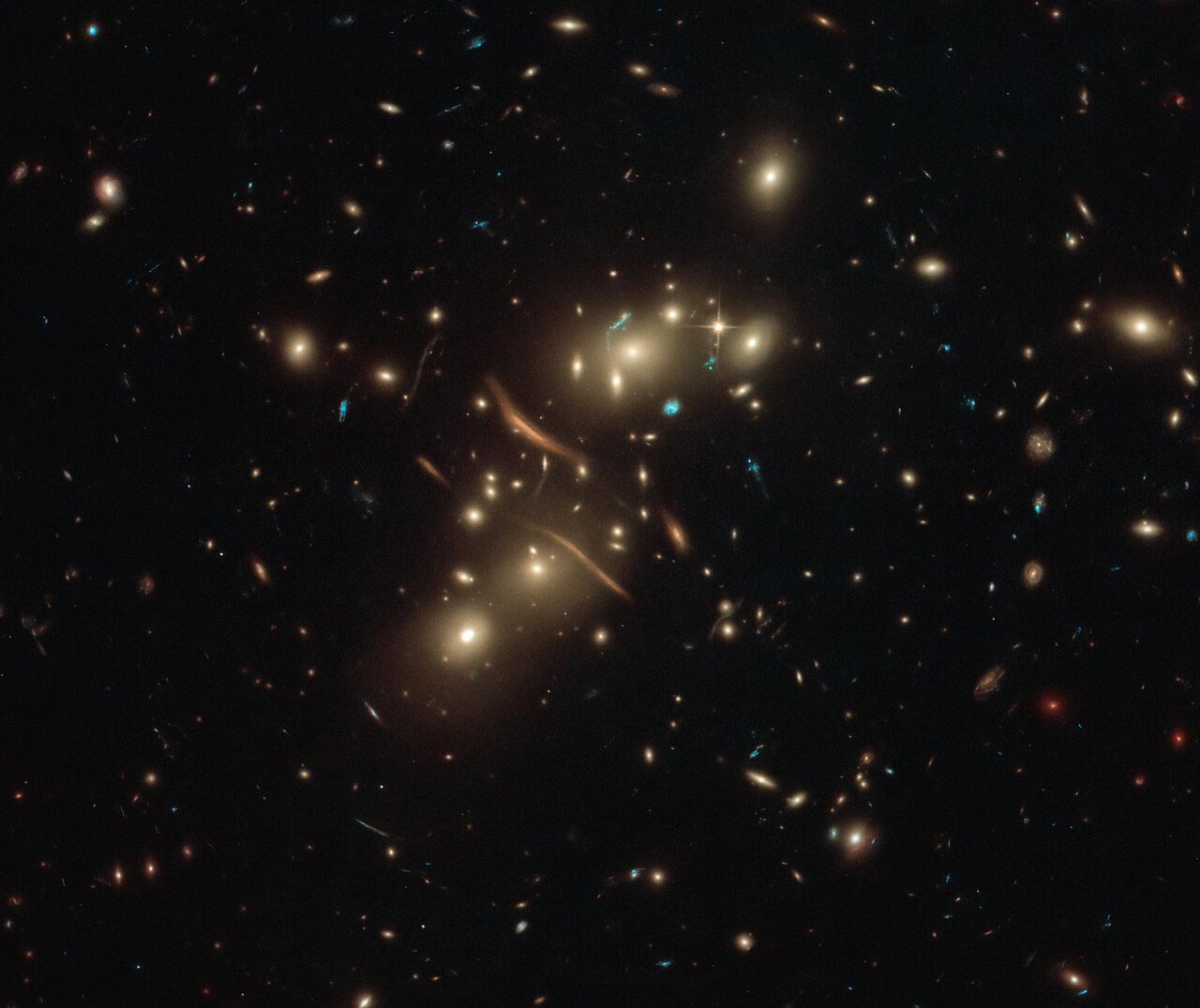
    Galaxy Cluster Abell 2813
    Hubble Space Telescope image of the galaxy cluster Abell 2813 (also known as ACO 2813). Credit: ESA/Hubble & NASA, D. Coe

    This extraordinary image from the NASA/ESA Hubble Space Telescope of the galaxy cluster Abell 2813 (also known as ACO 2813) has an almost delicate beauty, which also illustrates the remarkable physics at work within it. The image spectacularly demonstrates the concept of gravitational lensing.

    Among the tiny dots, spirals, and ovals that are the galaxies that belong to the cluster, there are several distinct crescent shapes. These curved arcs of light are strong examples of a phenomenon known as gravitational lensing. The image was compiled using observations taken with the Hubble Space Telescope’s Advanced Camera for Surveys (ACS) and Wide Field Camera 3 (WFC3).

    Gravitational lensing occurs when an object’s mass causes light to bend. The curved crescents and s-shapes of light in this image are not curved galaxies, but are light from galaxies that actually lie beyond Abell 2813. The galaxy cluster has so much mass that it acts as a gravitational lens, causing light from more distant galaxies to bend around it. These distortions can appear as many different shapes, such as long lines or arcs.

    This very visual evidence that mass causes light to bend has been famously used as a proof of one of the most famous scientific theories: Einstein’s theory of general relativity.

    Never miss a breakthrough: Join the SciTechDaily newsletter.
    Follow us on Google and Google News.

    Astronomy European Space Agency Hubble Space Telescope NASA Popular
    Share. Facebook Twitter Pinterest LinkedIn Email Reddit

    Related Articles

    NASA’s Hubble Accidentally Witnesses a Comet Shattering in Space

    Hubble’s Newest Discovery Isn’t a Star, It’s a Window Into the Dark Universe

    Hubble Celebrates 34th Anniversary With a Spectacular View of the Little Dumbbell Nebula

    Hubble Captures Face-On Image of Messier 61

    Hubble Views an Ongoing Cosmic Collision

    Hubble Views Newborn Stars in Galaxy IC 5052

    New XDF Image, The Deepest-Ever View of the Universe

    Hubble Zooms in on the Center of M4

    Hubble Image of Peculiar Galaxy Pair Arp 116

    Leave A Reply Cancel Reply

    • Facebook
    • Twitter
    • Pinterest
    • YouTube

    Don't Miss a Discovery

    Subscribe for the Latest in Science & Tech!

    Trending News

    JWST Finds a “Star” 100 Billion Times Brighter Than Any Star Should Be

    Scientists Find a Hidden Biological Link Across Different Forms of Autism

    Astronomers Discover a Ghostly River of Stars That Could Reveal Dark Matter

    Why Is Colorectal Cancer Rising in People Under 50? New Clues Point to the Environment

    Quantum Fluctuations Break a Crystal’s Symmetry Rules

    Why Does an Irregular Heartbeat Strike 40 Years Early in Some People?

    Scientists Reveal How ADHD Could Fuel Creative Thinking

    Scientists Find Just 3 Minutes of Sprinting Can Transform Blood Chemistry

    Follow SciTechDaily
    • Facebook
    • Twitter
    • YouTube
    • Pinterest
    • Newsletter
    • RSS
    SciTech News
    • Biology News
    • Chemistry News
    • Earth News
    • Health News
    • Physics News
    • Science News
    • Space News
    • Technology News
    Recent Posts
    • Common Plant Chemical Linked to Widespread Organ Damage in Aquatic Animals
    • Scientists Discover a Hidden Baobab Species in Madagascar
    • Dogs and Humans May Share a Surprising Biological Secret to Longevity
    • A 150-Million-Year-Old Dinosaur Flight Mystery May Finally Have an Answer
    • Giant Crocodylians Ruled South America’s Ancient Food Chain
    Copyright © 1998 - 2026 SciTechDaily. All Rights Reserved.
    • Science News
    • About
    • Contact
    • Editorial Board
    • Privacy Policy
    • Terms of Use

    Type above and press Enter to search. Press Esc to cancel.