
Close Menu
    Facebook X (Twitter) Instagram
    SciTechDaily
    • Biology
    • Chemistry
    • Earth
    • Health
    • Physics
    • Science
    • Space
    • Technology
    Facebook X (Twitter) Pinterest YouTube RSS
    SciTechDaily
    Home»Space»Hubble Spies a Luminous Heart With Dark Tendrils
    Space

    Hubble Spies a Luminous Heart With Dark Tendrils

    By ESA/HubbleApril 4, 2021No Comments2 Mins Read
    Facebook Twitter Pinterest Telegram LinkedIn WhatsApp Email Reddit
    Share
    Facebook Twitter LinkedIn Pinterest Telegram Email Reddit
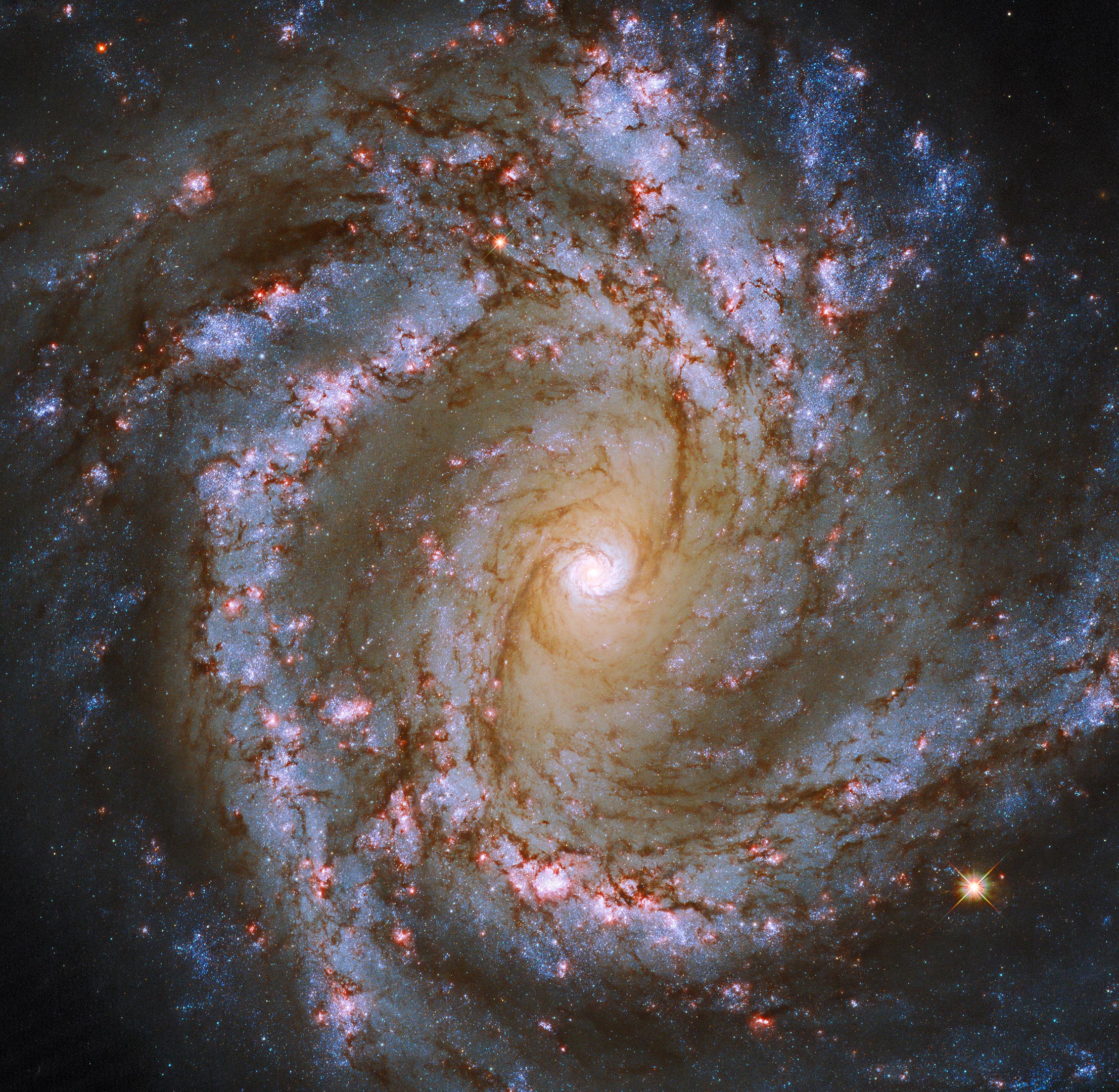
    Galaxy M61
    Image of Messier 61 (M61 or NGC 4303), an intermediate barred spiral galaxy in the Virgo Cluster of galaxies. Credit: ESA/Hubble & NASA, ESO, J. Lee and the PHANGS-HST Team

    M61’s vibrant spiral arms, bursting with new stars, surround a hidden supermassive black hole. Combined telescope data captures the galaxy’s stunning structure and cosmic activity in high detail.

    The luminous heart of the galaxy M61 dominates this image, framed by its winding spiral arms threaded with dark tendrils of dust. As well as the usual bright bands of stars, the spiral arms of M61 are studded with ruby-red patches of light. Tell-tale signs of recent star formation, these glowing regions lead to M61’s classification as a starburst galaxy.

    Though the gleaming spiral of this galaxy makes for a spectacular sight, one of the most interesting features of M61 lurks unseen at the center of this image. As well as widespread pockets of star formation, M61 hosts a supermassive black hole more than 5 million times as massive as the Sun.

    M61 appears almost face-on, making it a popular subject for astronomical images, even though the galaxy lies more than 52 million light-years from Earth. This particular astronomical image incorporates data from not only Hubble, but also the FORS camera at the European Southern Observatory’s Very Large Telescope, together revealing M61 in unprecedented detail. This striking image is one of many examples of telescope teamwork — astronomers frequently combine data from ground-based and space-based telescopes to learn more about the Universe.

    Never miss a breakthrough: Join the SciTechDaily newsletter.
    Follow us on Google and Google News.

    Astronomy European Space Agency Hubble Space Telescope NASA
    Share. Facebook Twitter Pinterest LinkedIn Email Reddit

    Related Articles

    Hubble’s Newest Discovery Isn’t a Star, It’s a Window Into the Dark Universe

    This Nearby Galaxy Shows How Frozen Clouds Ignite Into Stars

    This Chaotic Spiral Galaxy Is Still Recovering From a Cosmic Collision

    This Strange Spiral Galaxy Is Hiding a Massive Black Hole

    Hubble Zooms In on a Galaxy That Maps the Universe’s Expansion

    Hubble Captures a Dazzling Spiral Galaxy Alive With Birth and Destruction

    Hubble Spots a Glowing “Ring of Fire” in a Distant Spiral Galaxy

    Dust, Light & Ancient Collisions: The Sombrero Galaxy Like You’ve Never Seen It

    Star Formation in Motion: Hubble Reveals Spiraling Stars and Sculpted Nebulae

    Leave A Reply Cancel Reply

    • Facebook
    • Twitter
    • Pinterest
    • YouTube

    Don't Miss a Discovery

    Subscribe for the Latest in Science & Tech!

    Trending News

    Why Popular Diabetes Drugs Like Ozempic Don’t Work for Everyone: The “Genetic Glitch”

    Scientists Stunned After Finding Plant Thought Extinct for 60 Years

    Scientists Discover Tiny New Spider That Hunts Prey 6x Its Size

    Natural Component From Licorice Shows Promise for Treating Inflammatory Bowel Disease

    Scientists Warn: Popular Sweetener Linked to Dangerous Metabolic Effects

    Monster Storms on Jupiter Unleash Lightning Beyond Anything on Earth

    Scientists Create “Liquid Gears” That Spin Without Touching

    The Simple Habit That Could Help Prevent Cancer

    Follow SciTechDaily
    • Facebook
    • Twitter
    • YouTube
    • Pinterest
    • Newsletter
    • RSS
    SciTech News
    • Biology News
    • Chemistry News
    • Earth News
    • Health News
    • Physics News
    • Science News
    • Space News
    • Technology News
    Recent Posts
    • The Atomic Gap That Could Cost the Semiconductor Industry Billions
    • Earth’s Secret Advantage: Why Most Alien Worlds May Be Too Dry for Life
    • Ancient Bacteria Turned a DNA System Into a Cell Skeleton
    • Researchers Finally Solve 50-Year-Old Blood Group Mystery
    • Scientists Discover “Molecular Switch” That Fuels Alzheimer’s Brain Inflammation
    Copyright © 1998 - 2026 SciTechDaily. All Rights Reserved.
    • Science News
    • About
    • Contact
    • Editorial Board
    • Privacy Policy
    • Terms of Use

    Type above and press Enter to search. Press Esc to cancel.