
Close Menu
    Facebook X (Twitter) Instagram
    SciTechDaily
    • Biology
    • Chemistry
    • Earth
    • Health
    • Physics
    • Science
    • Space
    • Technology
    Facebook X (Twitter) Pinterest YouTube RSS
    SciTechDaily
    Home»Physics»Faster Than Can Be Explained – Photonic Time Crystals Could Revolutionize Optics
    Physics

    Faster Than Can Be Explained – Photonic Time Crystals Could Revolutionize Optics

    By De GruyterSeptember 4, 20233 Comments3 Mins Read
    Facebook Twitter Pinterest Telegram LinkedIn WhatsApp Email Reddit
    Share
    Facebook Twitter LinkedIn Pinterest Telegram Email Reddit
    Abstract Time Crystal Concept
    Researchers have produced photonic time crystals in the near-visible spectrum, potentially revolutionizing light science applications. This breakthrough expands the previously understood range of PTCs, which were only seen in radio waves.

    A recent study reveals oscillations in the refractive index that are faster than can be explained by current theories.

    A study recently published in the journal Nanophotonics reveals that by rapidly modulating the refractive index – which is the ratio of the speed of electromagnetic radiation in a medium compared to its speed in a vacuum – it’s possible to produce photonic time crystals (PTCs) in the near-visible part of the spectrum.

    The study’s authors suggest that the ability to sustain PTCs in the optical domain could have profound implications for the science of light, enabling truly disruptive applications in the future.

    PTCs, materials in which the refractive index rises and falls rapidly in time, are the temporal equivalent of photonic crystals in which the refractive index oscillates periodically in space causing, for example, the iridescence of precious minerals and insect wings.
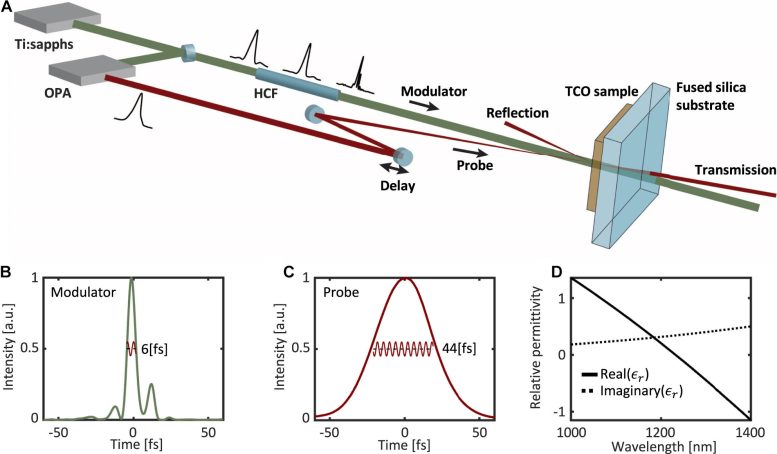
    Experimental Setup for Measuring Time Refraction in the Single Cycle Regime
    Experimental setup for measuring time-refraction in the single-cycle regime. Credit: Eran Lustig et al.

    A PTC is only stable if the refractive index can be made to rise and fall in line with a single cycle of electromagnetic waves at the frequency concerned so, unsurprisingly, PTCs have thus far been observed at the lowest-frequency end of the electromagnetic spectrum: with radio waves.

    Experimental Breakthrough in the Optical Domain

    In this new study, lead author Mordechai Segev of the Technion-Israel Institute of Technology, Haifa, Israel, with collaborators Vladimir Shalaev and AlexndraBoltasseva from Purdue University, Indiana, USA, and their teams, sent extremely short (5-6 femtosecond) pulses of laser light at a wavelength of 800 nanometers through transparent conductive oxide materials.

    This caused a rapid shift in refractive index that was explored using a probe laser beam at a slightly longer (near infrared) wavelength. The probe beam was rapidly red-shifted (that is, its wavelength increased) and then blue-shifted (wavelength decreased) as the material’s refractive index relaxed back to its normal value.
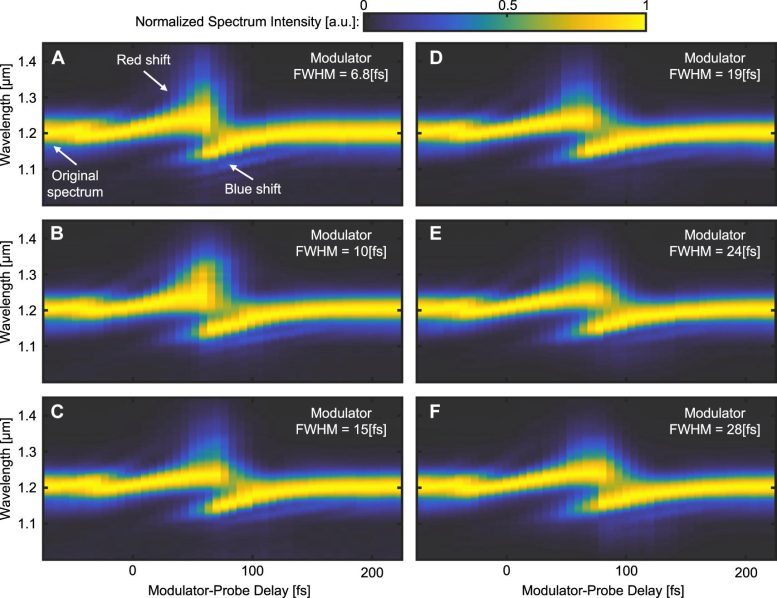
    Transmission Spectrograms of 44 Fs Probe Pulses That Have Passed Through the ITO Sample, for Modulator Pulses of Different Temporal Widths
    Transmission spectrograms of 44 fs probe pulses that have passed through the ITO sample, for modulator pulses of different temporal widths. Credit: Eran Lustig et al.

    The time taken for each of these refractive index changes was minuscule – less than 10 femtoseconds – and, therefore, within the single cycle necessary to form a stable PTC.

    Unexpected Ultra-Fast Relaxation in Electrons

    “Electrons excited to high energy in crystals generally need over ten times as long to relax back to their ground states, and many researchers thought that the ultra-fast relaxation we observe here would be impossible,” Segev said. “We don’t yet understand exactly how it happens.”

    Co-author Shalaev further suggests that the ability to sustain PTCs in the optical domain, as demonstrated here, will “open a new chapter in the science of light and enable truly disruptive applications”. However, we know as little of what these might be as physicists in the 1960s knew of the possible applications of lasers.

    Reference: “Time-refraction optics with single cycle modulation” by Eran Lustig, Ohad Segal, Soham Saha, Eliyahu Bordo, Sarah N. Chowdhury, Yonatan Sharabi, Avner Fleischer, Alexandra Boltasseva, Oren Cohen, Vladimir M. Shalaev and Mordechai Segev, 31 May 2023, Nanophotonics.
    DOI: 10.1515/nanoph-2023-0126

    The research was funded by the German Research Foundation.

    Never miss a breakthrough: Join the SciTechDaily newsletter.
    Follow us on Google and Google News.

    De Gruyter Nanophotonics Optics Photonics Popular
    Share. Facebook Twitter Pinterest LinkedIn Email Reddit

    Related Articles

    Ultrafast Electronic Characterization of Proteins and Materials

    In Einstein’s Footsteps and Beyond: New Insights Into the Foundations of Quantum Mechanics

    Scientists Create Synthetic Dimensions To Better Understand the Fundamental Laws of the Universe

    “Invisibility Cloaks” May Soon Be Real: Creating Invisibility With Superconducting Materials

    Color-Changing Magnifying Glass Gives Clear View of Invisible Infrared Light

    Taming Silicon to Interact With Light for Next-Generation Microelectronics

    Indestructible Light Beam: Special Light Waves Created That Can Penetrate Even Opaque Materials

    Scientists Test Einstein’s Theory of General Relativity Using the Tokyo Skytree

    Physicists Test the Response Time of Electrons

    3 Comments

    1. Bao-hua ZHANG on September 4, 2023 2:24 am

      Do you understand how light forms and spreads? Do you think the scientific theory you believe is scientific?
      If you are really interested in science, you can browse https://zhuanlan.zhihu.com/p/569722770.

      Reply
    2. Clyde Spencer on September 4, 2023 10:21 am

      It appears that these experiments are confined to materials with a negligible imaginary (in the complex number sense) component, the extinction coefficient. Because reflection is influenced by the extinction coefficient, where it becomes dominant in highly-reflective opaque materials like metals, a general theory will have to take into consideration the complex refractive index.

      Reply
    3. Haru Ki on September 4, 2023 1:19 pm

      Why “Expand To Show Full Article”?
      It’s annoying!

      Reply
    Leave A Reply Cancel Reply

    • Facebook
    • Twitter
    • Pinterest
    • YouTube

    Don't Miss a Discovery

    Subscribe for the Latest in Science & Tech!

    Trending News

    Mezcal “Worm” in a Bottle Mystery: DNA Testing Reveals a Surprise

    New Research Reveals That Your Morning Coffee Activates an Ancient Longevity Switch

    This Is What Makes You Irresistible to Mosquitoes

    Shockingly Powerful Giant Octopuses Ruled the Seas 100 Million Years Ago

    Scientists Stunned by New Organic Molecules Found on Mars

    Rewriting Dinosaur Evolution: Scientists Unearth Remarkable 150-Million-Year-Old Stegosaur Skull

    Omega-3 Supplements Linked to Cognitive Decline in Surprising New Study

    First-of-Its-Kind Discovery: Homer’s Iliad Found Embedded in a 1,600-Year-Old Egyptian Mummy

    Follow SciTechDaily
    • Facebook
    • Twitter
    • YouTube
    • Pinterest
    • Newsletter
    • RSS
    SciTech News
    • Biology News
    • Chemistry News
    • Earth News
    • Health News
    • Physics News
    • Science News
    • Space News
    • Technology News
    Recent Posts
    • Male Birth Control Breakthrough: Scientists Find Way To Turn Sperm Production Off and Back On
    • A Common Vitamin Could Hold the Key to Treating Fatty Liver Disease
    • New Research Shows Vitamin B12 May Hold the Key to Healthy Aging
    • Scientists Map Thousands of Brain Connections With RNA Barcodes
    • This Gene Tweak Turns Strawberries Into Healthier, Tastier Superfruit
    Copyright © 1998 - 2026 SciTechDaily. All Rights Reserved.
    • Science News
    • About
    • Contact
    • Editorial Board
    • Privacy Policy
    • Terms of Use

    Type above and press Enter to search. Press Esc to cancel.