
Close Menu
    Facebook X (Twitter) Instagram
    SciTechDaily
    • Biology
    • Chemistry
    • Earth
    • Health
    • Physics
    • Science
    • Space
    • Technology
    Facebook X (Twitter) Pinterest YouTube RSS
    SciTechDaily
    Home»Earth»Nightlights in Libya: Tracking the Aftermath of a Powerful Medicane
    Earth

    Nightlights in Libya: Tracking the Aftermath of a Powerful Medicane

    By Emily Cassidy, NASA Earth ObservatorySeptember 29, 2023No Comments4 Mins Read
    Facebook Twitter Pinterest Telegram LinkedIn WhatsApp Email Reddit
    Share
    Facebook Twitter LinkedIn Pinterest Telegram Email Reddit
    Tracking Nightlights in Libya
    A severe medicane in September 2023 led to extensive flooding and displacement in northeastern Libya. Satellite images post-disaster revealed widespread power outages, especially in Derna and Al Bayda, with ongoing recovery efforts.

    Cities and towns darkened after a cyclone unleashed torrential flooding along the country’s coast.

    On September 10, 2023, a powerful storm brought heavy rain to northeastern Libya, causing significant loss of life and devastation to cities along the coast. Data from satellites show that after the storm, many communities in the region had lost electric power.

    The storm—a Mediterranean hurricane-like system known as a medicane—brought 414 millimeters (16 inches) of rain to the city of Al Bayda. Nearby, the port city of Derna received more than 100 millimeters (4 inches)—far exceeding the city’s average monthly rainfall for September of less than 1.5 millimeters (0.1 inches).

    Flash floods swept away roads and entire neighborhoods, displacing around 40,000 people across the country. Preliminary estimates by the United Nations Satellite Center (UNOSAT) indicate that about 10,000 buildings were damaged by floodwater, although assessment of the damage was still ongoing as of September 22. Infrastructure damage led to power outages, which can be seen in satellite images acquired at night.
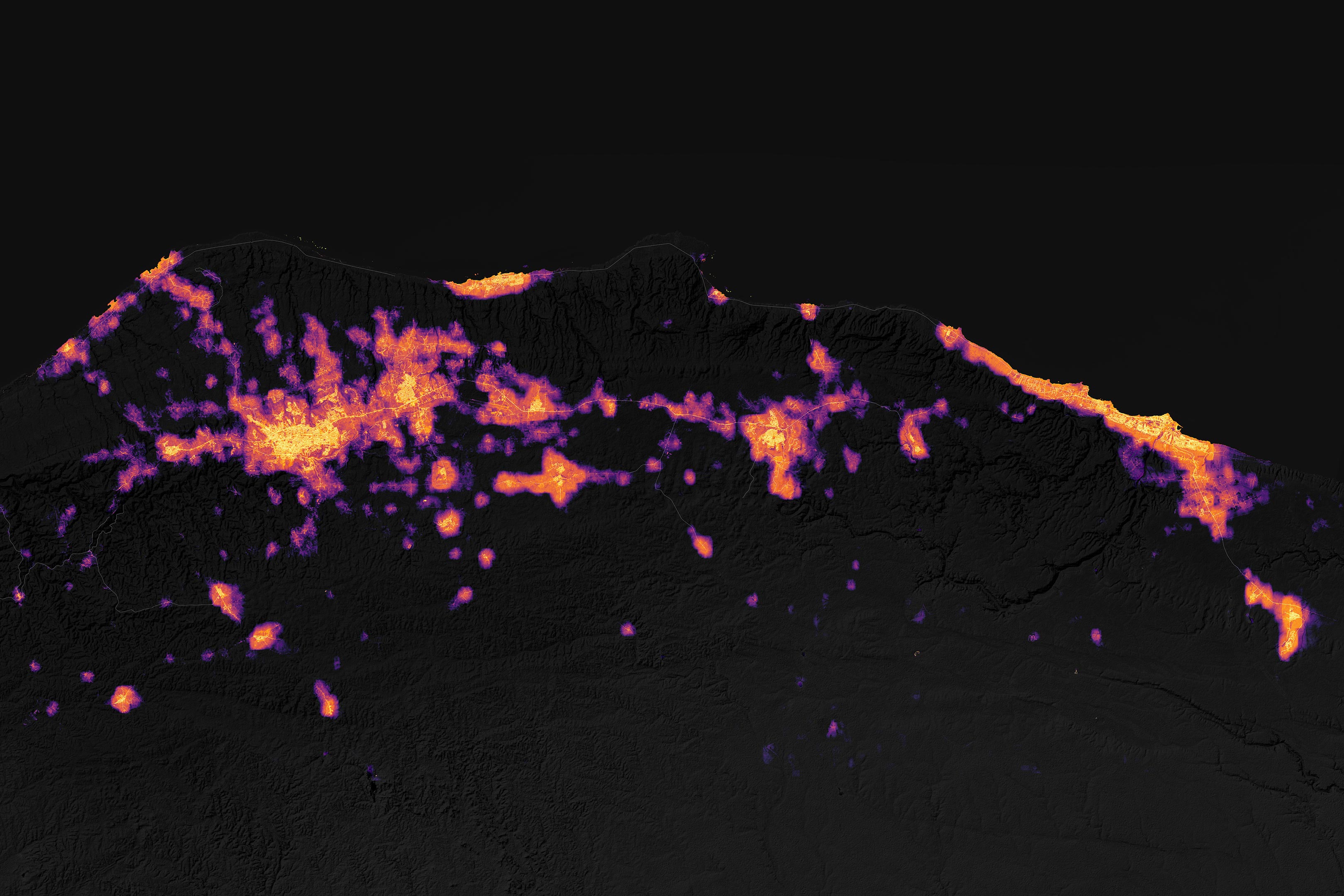
    Nightlights in Libya September 8, 2023, Annotated
    Satellite map of light emitted from Libya on September 8, 2023 — before the storm.
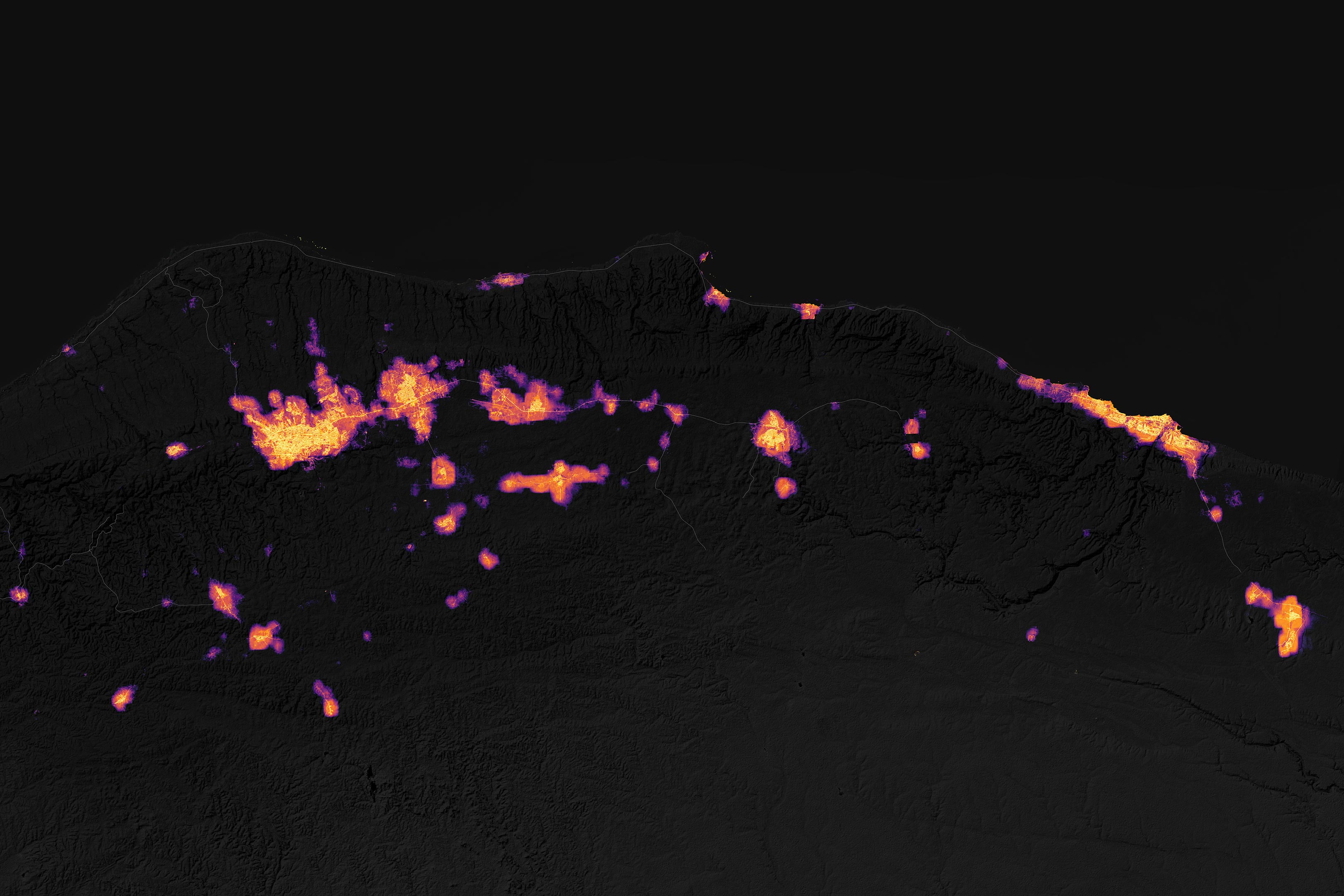
    Nightlights in Libya September 13, 2023, Annotated
    Satellite map of light emitted from Libya on September 13, 2023 —  after the storm.

    The maps above show the amount of light emitted from affected communities in northeastern Libya before and after the storm and the peak of the torrential flooding. The upper map shows the area on September 8, 2023; the lower map shows the same area on September 13, three days after the storm made landfall.

    “There was a substantial loss of power evident in the vicinity of Derna and Al Bayda in the September 13 image when compared to the baseline image,” said Ranjay Shrestha of NASA’s Black Marble science team. The maps come from the Black Marble HD product, provided by Shrestha and Zhuosen Wang, a principal investigator on the science team, and are based on data from the Visible Infrared Imaging Radiometer Suite (VIIRS) sensor on the NASA-NOAA Suomi NPP satellite. The basemap was built from data collected by Landsat 8 and Landsat 9 satellites.

    Derna was devastated by the storm. Flooding in the city led to the collapse of two dams along a usually dry riverbed, or wadi. The dam failures unleashed 3- to 7-meter-high floodwater that tore through the city, sweeping roads and buildings out to sea.

    The city became significantly darker after the storm hit. In a recent report, UNOSAT documented changes in Derna’s brightness. UNOSAT uses Black Marble nighttime light products to support ground teams in disaster response.
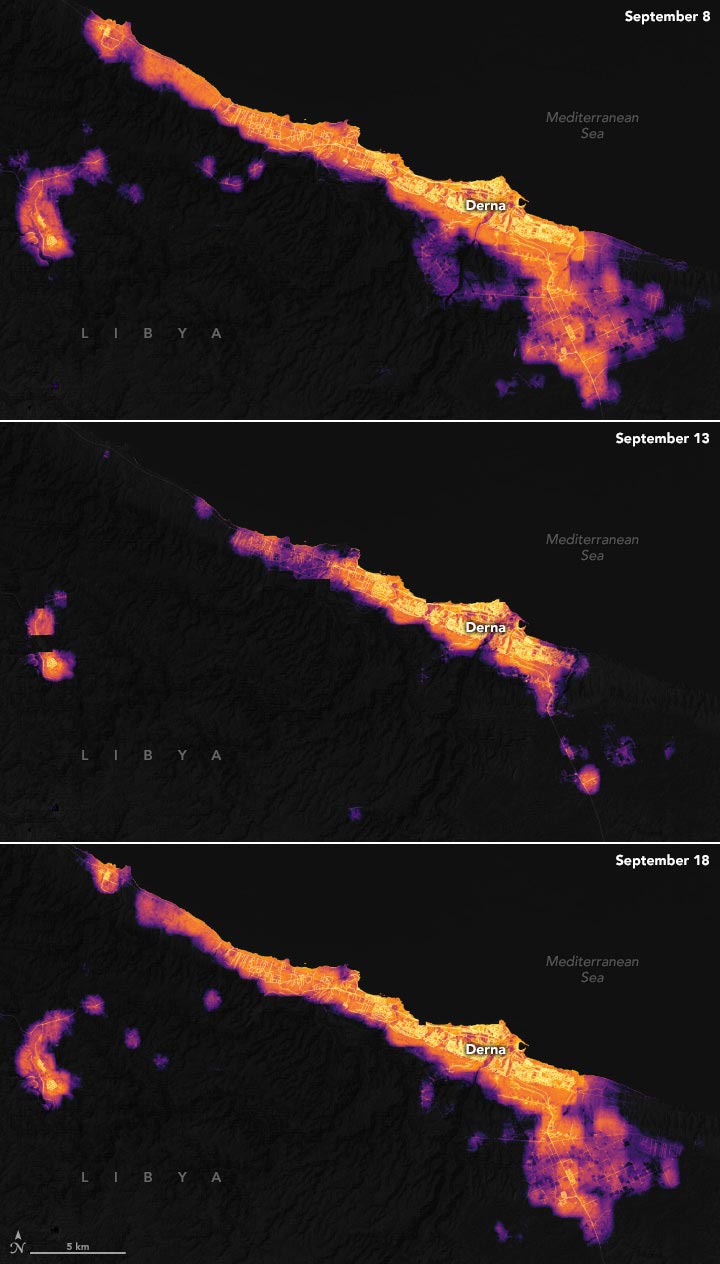
    Tracking Nightlights in Derna Libya
    Satellite map of light emitted from Derna Libya on September 8, 13, and 18, 2023.

    Some communities near Derna went four days without electricity, according to NPR reporting. But by September 18, 2023, the brightness of outdoor lighting in Derna was approaching pre-storm levels. “There’s a lot more recovery compared to the September 13 image,” said Shrestha. “However, there are still pockets of areas, particularly in the outskirts of the Al Bayda area, where recovery seems ongoing.”

    Raw, unprocessed images of night lights can be misleading because moonlight, clouds, air pollution, snow cover, seasonal vegetation, and even the position of the satellite, can change how light is reflected. The Black Marble science team processes the data to account for these factors.

    NASA Earth Observatory images by Wanmei Liang, using Black Marble data courtesy of Ranjay Shrestha and Zhuosen Wang/NASA Goddard Space Flight Center, Landsat data from the U.S. Geological Survey, and data from OpenStreetMap.

    Never miss a breakthrough: Join the SciTechDaily newsletter.
    Follow us on Google and Google News.

    Cyclone NASA NASA Earth Observatory Storms
    Share. Facebook Twitter Pinterest LinkedIn Email Reddit

    Related Articles

    Six Cyclones, Two Oceans, One Rare Storm Surge Shaking the Southern Hemisphere

    Before and After: Mayotte’s Shocking Makeover by Cyclone Chido

    Bomb Cyclone Batters the Pacific Northwest Leaving 600,000 in the Dark

    Filipo’s Fury: Unleashing Nature’s Wrath on Mozambique

    Cyclone Jasper’s Fury: From Roaring Category-4 to Queensland’s Doorstep

    Unprecedented Wonder: Tropical Cyclone Freddy’s Record-Breaking Month-Long Journey Across the Indian Ocean

    Tropical Cyclone Freddy Hits Madagascar

    Typhoon Hinnamnor: First Category 5 Cyclone on Earth in 2022

    Intense Extratropical “Bomb Cyclones” Drench US West Coast

    Leave A Reply Cancel Reply

    • Facebook
    • Twitter
    • Pinterest
    • YouTube

    Don't Miss a Discovery

    Subscribe for the Latest in Science & Tech!

    Trending News

    Scientists Finally Uncover How a “Forever Chemical” Causes Birth Defects

    Scientists Uncover the Earliest Brain Changes That May Predict Alzheimer’s Decades Before Symptoms

    Surprising New Study Challenges a Century-Old Theory of Habit Formation

    Scientists Turn Seawater Into Drinking Water Without Toxic Brine

    Vitamin D Drug Shows Surprising Promise Against One of the Deadliest Cancers

    NASA’s X-59 Sonic Boom Killer Is Ready for Its Biggest Test Yet

    The Best Exercise Combination for Longevity, According to a 30-Year Study

    Popular Weight-Loss Drug Found To Slow Biological Aging in Landmark Human Trial

    Follow SciTechDaily
    • Facebook
    • Twitter
    • YouTube
    • Pinterest
    • Newsletter
    • RSS
    SciTech News
    • Biology News
    • Chemistry News
    • Earth News
    • Health News
    • Physics News
    • Science News
    • Space News
    • Technology News
    Recent Posts
    • This Simple Drink Could Help Calm the Inflammation Behind Many Diseases
    • Doctors May Be Overlooking the Real Cause of Persistent Arthritis Pain
    • According to Scientists, This Simple Dietary Change Is Linked to Lower Depression Scores
    • Researchers Discover a Hidden Vitamin D Problem That Persists Year-Round
    • Scientists Are Building Electronics That Stretch Like Human Skin and Learn Like a Brain
    Copyright © 1998 - 2026 SciTechDaily. All Rights Reserved.
    • Science News
    • About
    • Contact
    • Editorial Board
    • Privacy Policy
    • Terms of Use

    Type above and press Enter to search. Press Esc to cancel.