
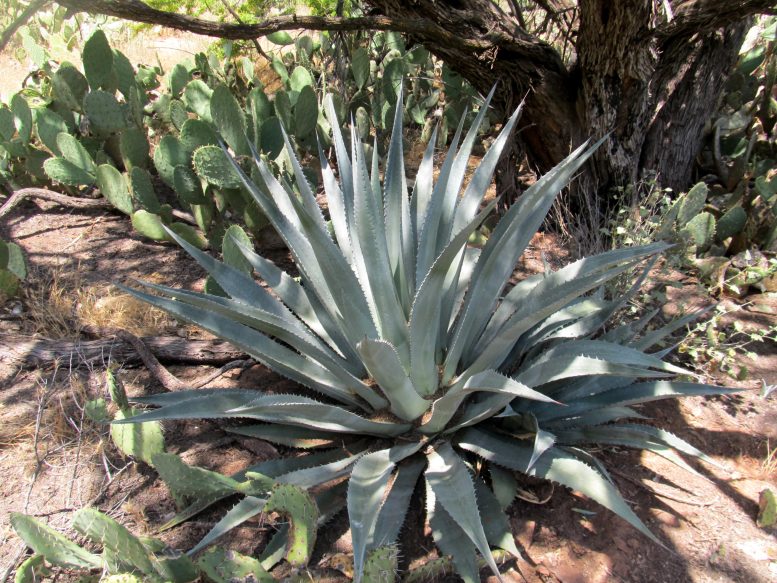
Unaltered agave species cultivated by early cultures offer insights into sustainable, drought-resistant agriculture.
New findings recently published in the journal Annals of Botany reveal that researchers have found unaltered agave plant species cultivated by several early cultures including the Hohokam people, a large Native American group in the Southwest that existed between 300 and 1500 CE.
Agave plants have been of great economic and social importance in the Americas for at least 9,000 years. Before people cultivated corn, agave plants were one of their main carbohydrate sources. Archaeological research indicates the Hohokam increased agricultural potential by building terraces for agave dry farming. Agricultural features such as terraces and rock piles were especially characteristic of this culture’s farming practices with the increase of dense, aggregated populations.
While crops native to the Americas (corn/maize, peanuts, potatoes, tomatoes, etc.) are common around the world today, virtually all these plants have been modified extensively by European colonists and their descendants.
Modern Exploration and Re-Discovery
Since the 1980s, concurrent with archaeological explorations, Desert Botanical Garden research staff continue to document and study agaves throughout Arizona and the Southwest and northern Mexico. Their work resulted in the rediscovery and naming of five of the six known agave species that represent remnant populations of plants domesticated and farmed by pre-contact peoples in today’s Arizona landscape: Agave murpheyi, Agave delamateri, Agave phillipsiana, Agave sanpedroensis, Agave verdensis, and Agave yavapaiensis. Although once grown on a large scale, some clones of these agaves have continued to persist through the centuries still within ancient, constructed fields in today’s modern landscape from southern Arizona north to the Grand Canyon.
These pre-contact domesticated agaves are morphologically distinct from Southwest U.S. and northern Mexico wild agaves and Mesoamerican wild and domesticated species. The remnant clones present a rare opportunity to examine plant species that are virtually unchanged since they were last cultivated prehistorically.
Significance and Conservation of These Agave Species
The researchers here believe that providing protection to these newly uncovered agave species is particularly relevant today because of increased interest and research in the surviving wild relatives of contemporary crops. This is particularly true of plants that occupy hot, dry environments, where climate change has rendered such plants more attractive for agricultural development.
“It is hoped that our work, made more fruitful as a result of input from archaeologists and Indigenous Peoples, will foster our understanding of today’s landscapes as legacies of past human activities, rather than pristine environments,” said the paper’s lead author, Wendy Hodgson. “Pre-contact peoples were superb agriculturists, selecting, domesticating, and cultivating crops in the arid Southwest. We have the rare opportunity to study how and what kinds of agaves ancient farmers grew, especially significant today when there is a need to explore the benefits of growing drought-adapted crops using sustainable agroecological methods.”
Reference: “Pre-contact agave domesticates – living legacy plants in Arizona’s landscape” by Wendy C Hodgson, E Jane Rosenthal and Andrew M Salywon, 10 October 2023, Annals of Botany.
DOI: 10.1093/aob/mcad113
Never miss a breakthrough: Join the SciTechDaily newsletter.
Follow us on Google and Google News.