
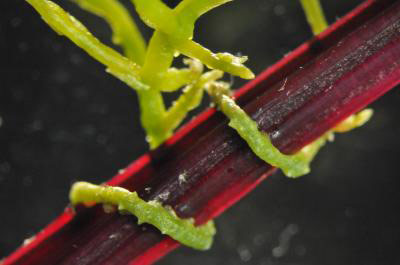
New research from Virginia Tech reveals that plants may use a newly discovered molecular language to communicate with each other, opening the door to a new arena of science that explores how plants communicate with each other on a molecular level.
A Virginia Tech scientist has discovered a potentially new form of plant communication, one that allows them to share an extraordinary amount of genetic information with one another.
The finding by Jim Westwood, a professor of plant pathology, physiology, and weed science in the College of Agriculture and Life Sciences, throws open the door to a new arena of science that explores how plants communicate with each other on a molecular level. It also gives scientists new insight into ways to fight parasitic weeds that wreak havoc on food crops in some of the poorest parts of the world.
His findings were published on August 15 in the journal Science.
“The discovery of this novel form of inter-organism communication shows that this is happening a lot more than anyone has previously realized,” said Westwood, who is an affiliated researcher with the Fralin Life Science Institute. “Now that we have found that they are sharing all this information, the next question is, ‘What exactly are they telling each other?’.”
Westwood examined the relationship between a parasitic plant, dodder, and two host plants, Arabidopsis and tomatoes. In order to suck the moisture and nutrients out of the host plants, dodder uses an appendage called a haustorium to penetrate the plant. Westwood previously broke new ground when he found that during this parasitic interaction, there is a transport of RNA between the two species. RNA translates information passed down from DNA, which is an organism’s blueprint.
His new work expands the scope of this exchange and examines the mRNA, or messenger RNA, which sends messages within cells telling them which actions to take, such as which proteins to code. It was thought that mRNA was very fragile and short-lived, so transferring it between species was unimaginable.
But Westwood found that during this parasitic relationship, thousands upon thousands of mRNA molecules were being exchanged between both plants, creating this open dialogue between the species that allows them to freely communicate.
Through this exchange, the parasitic plants may be dictating what the host plant should do, such as lowering its defenses so that the parasitic plant can more easily attack it. Westwood’s next project is aimed at finding out exactly what the mRNA is saying. His work is sponsored by the National Science Foundation.
Using this newfound information, scientists can now examine if other organisms such as bacteria and fungi also exchange information in a similar fashion. His findings could also help solve issues of food scarcity.
“Parasitic plants such as witchweed and broomrape are serious problems for legumes and other crops that help feed some of the poorest regions in Africa and elsewhere,” said Julie Scholes, a professor at the University of Sheffield, U.K., who is familiar with Westwood’s work but was not part of this project. “In addition to shedding new light on host-parasite communication, Westwood’s findings have exciting implications for the design of novel control strategies based on disrupting the mRNA information that the parasite uses to reprogram the host.”
Westwood said that while his finding is fascinating, how this is applied will be equally as interesting.
“The beauty of this discovery is that this mRNA could be the Achilles heel for parasites,” Westwood said. “This is all really exciting because there are so many potential implications surrounding this new information.”
Nationally ranked among the top research institutions of its kind, Virginia Tech’s College of Agriculture and Life Sciences focuses on the science and business of living systems through learning, discovery, and engagement. The college’s comprehensive curriculum gives more than 3,100 students in a dozen academic departments a balanced education that ranges from food and fiber production to economics to human health. Students learn from the world’s leading agricultural scientists, who bring the latest science and technology into the classroom.
Reference: “Genomic-scale exchange of mRNA between a parasitic plant and its hosts” by Gunjune Kim, Megan L. Leblanc, Eric K. Wafula, Claude W. Depamphilis and James H. Westwood, 15 August 2014, Science.
DOI: 10.1126/science.1253122
Never miss a breakthrough: Join the SciTechDaily newsletter.
Follow us on Google and Google News.