
Close Menu
    Facebook X (Twitter) Instagram
    SciTechDaily
    • Biology
    • Chemistry
    • Earth
    • Health
    • Physics
    • Science
    • Space
    • Technology
    Facebook X (Twitter) Pinterest YouTube RSS
    SciTechDaily
    Home»Earth»Coral Crisis: Massive Accumulation of Heat Stress in Summer 2023
    Earth

    Coral Crisis: Massive Accumulation of Heat Stress in Summer 2023

    By Kathryn Hansen, NASA Earth ObservatoryOctober 16, 20232 Comments3 Mins Read
    Facebook Twitter Pinterest Telegram LinkedIn WhatsApp Email Reddit
    Share
    Facebook Twitter LinkedIn Pinterest Telegram Email Reddit
    Accumulated Heat Stress July September 2023
    In 2023, rising sea temperatures, amplified by human activities and El Niño, threatened coral reefs, especially around Florida, Cuba, and the Bahamas. Satellite data indicated high risks of coral bleaching and mortality in these regions by mid-October.

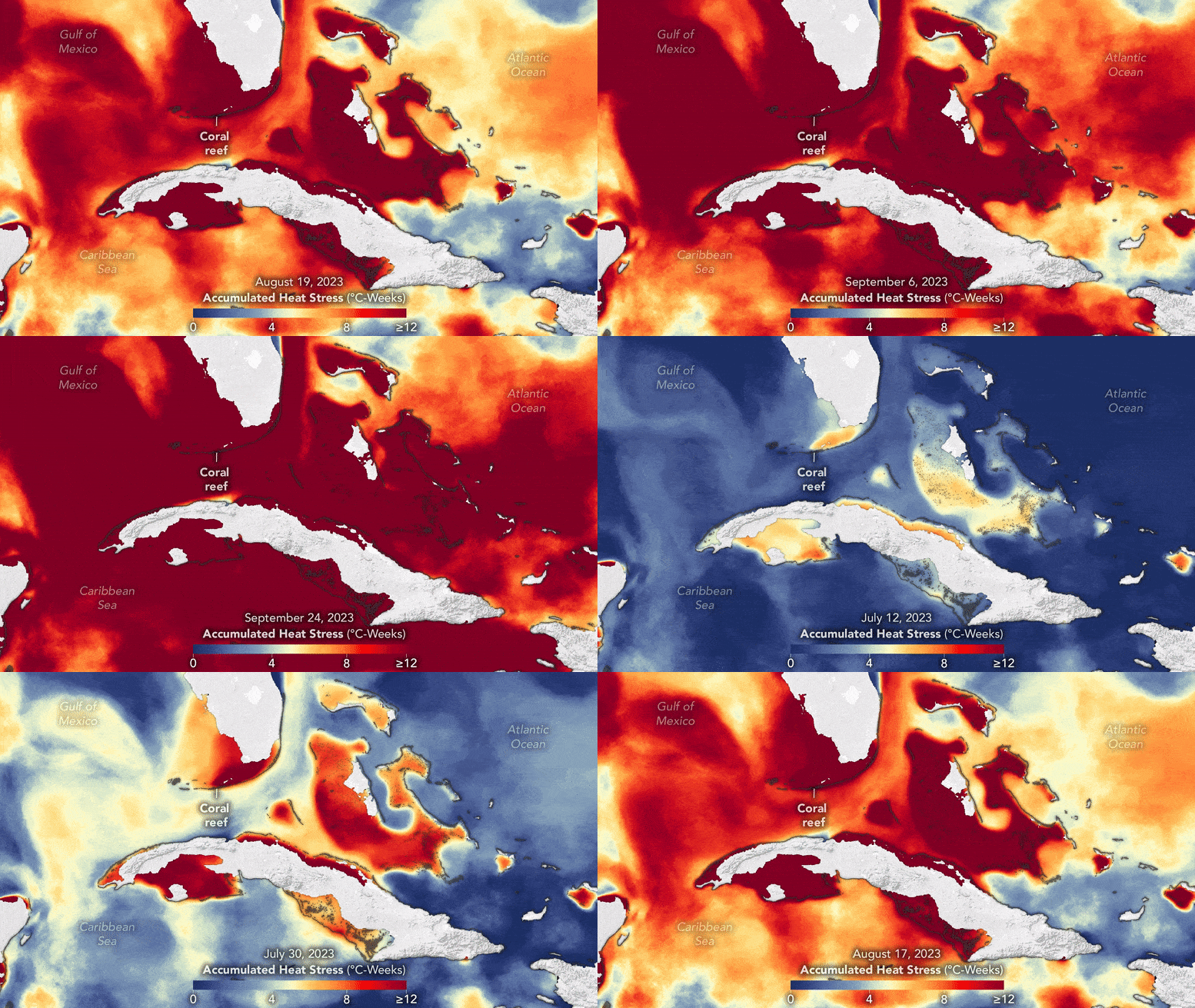
    The seas around Florida, Cuba, and the Bahamas saw large accumulations of heat stress beginning in summer 2023, with implications for the health of coral reefs.

    For several months in 2023, global sea surface temperatures reached record-high levels. This surge was fueled by decades of human-caused climate warming and a recent boost from the natural climate phenomenon El Niño. Some areas—including the seas around Florida, Cuba, and the Bahamas—saw particularly high temperatures, with implications for the health of coral reefs.

    The Impact on Coral Reefs

    Corals flourish within a small temperature range and become stressed when water is too hot or cold. Bleaching occurs when stressed corals expel the algae that live inside them, stripping corals of their color. Extreme bleaching can leave a reef susceptible to starvation, disease, and even death. Observations made by divers in the Florida Keys found that the marine heatwave in the summer of 2023 caused widespread bleaching.


    This animation shows the evolution of accumulated heat stress from July through September 2023.

    Using Satellite Data to Monitor Corals

    Satellite data offers insights into the stress levels of corals. The animation above shows the evolution of accumulated heat stress from July through September 2023. The colors depict “degree heating weeks” (°C-weeks)—a measure that provides an estimate of the severity and duration of thermal stress. Data for the product are compiled by NOAA’s Coral Reef Watch, which blends observations from polar orbiting satellites such as the NASA-NOAA Suomi NPP, and from geostationary satellites such as GOES, with computer models.

    Observations have shown that when the accumulated heat stress reaches a value of 4, significant coral bleaching can result. At values of 8, coral bleaching and widespread mortality are likely. By midway through this animation, in August, heat stress across much of the region already soared well above both of those thresholds. According to NOAA, cumulative heat stress by late September 2023 hit 22°C-weeks (40°F-weeks), nearly triple the previous record for the region.

    Early Signs and Effects of Bleaching

    Bleaching was already observed in some areas as early as July. Notice that areas of coral reef (gray) near the Florida Keys, Cuba, and the Bahamas, are among the first areas to show high cumulative heat stress. Hurricane Idalia in late August helped cool surface waters somewhat, but only temporarily.

    Nearing mid-October, waters around the Florida Keys were under a bleaching watch. Further south, waters around parts of Cuba and the Bahamas remained at bleaching alert level 2, the highest level of the scale, signifying that severe bleaching and mortality are likely.

    NASA Earth Observatory animation by Wanmei Liang, using Daily 5km Degree Heating Weeks data from Coral Reef Watch. Coral reef data from UNEP-WCMC, WorldFish Centre, WRI, TNC.

    Never miss a breakthrough: Join the SciTechDaily newsletter.
    Follow us on Google and Google News.

    Coral Reefs Marine Biology NASA NASA Earth Observatory Oceanography
    Share. Facebook Twitter Pinterest LinkedIn Email Reddit

    Related Articles

    Bleached Out: Heat Stress Cooks Great Barrier Reef

    Blown Away: How Desert Dust Fuels Ocean Life

    Truly Giant Cuttlefish in False Bay, South Australia

    Sounding the Seafloor With Light: Mapping the Shallows With Freely Available Satellite Data

    Biochemical Clues Reveal How Some Corals Resist Bleaching From Climate Change That Is Killing Coral Reefs

    Pumping Up Cold Water From Deep Within the Ocean to Halt Coral Bleaching

    Sea Ice in Denmark Strait – Drifted More Than 1,000 Km (600 Miles) From the Arctic Ocean

    Decades of Knowledge of Marine Protected Areas Ruined by Climate Change

    Plankton-Fueled Agulhas Current Ocean Eddy Is 93 Miles Wide

    2 Comments

    1. Clyde Spencer on October 16, 2023 2:33 pm

      “…, nearly triple the previous record for the region.”

      And, the antarctic ‘Ozone Hole” had an anomalously early start this year, with the extent and depth of the hole also being unusual as well. Are these the result of the Hunga Tonga volcano explosion last year, or is it a coincidence? That is, is this a weather event, or is it symptomatic of anthropogenic global warming?

      Reply
    2. Clyde Spencer on October 16, 2023 2:36 pm

      “Satellite data indicated high risks of coral bleaching and mortality in these regions by mid-October.”

      It is past mid-October. What is happening now?

      Reply
    Leave A Reply Cancel Reply

    • Facebook
    • Twitter
    • Pinterest
    • YouTube

    Don't Miss a Discovery

    Subscribe for the Latest in Science & Tech!

    Trending News

    Giant Crocodylians Ruled South America’s Ancient Food Chain

    Breakthrough in a Bizarre Galaxy Could Help Unlock the Mystery of Dark Matter

    Just 4 Minutes of Daily Strength Training Can Quadruple Fitness in Older Adults

    Almost All Plant-Based Meat Alternatives Contain Mycotoxins, Study Finds

    Astronomers Detect a Record-Breaking “Cosmic Laser” From 8 Billion Light-Years Away

    A 47-Year-Old Scientist Tracked Himself for Months – His Biological Age Fell to 32

    Construction Crew Uncovers Giant 20-Meter Dinosaur in Brazil

    30 Years of Hurricane Data Reveal 4 Warning Signs Before Storms Strengthen

    Follow SciTechDaily
    • Facebook
    • Twitter
    • YouTube
    • Pinterest
    • Newsletter
    • RSS
    SciTech News
    • Biology News
    • Chemistry News
    • Earth News
    • Health News
    • Physics News
    • Science News
    • Space News
    • Technology News
    Recent Posts
    • A 20-Year Study Finds Preschool Can Influence Success for Years
    • 55-Million-Year-Old Penguin Fossils Preserve Clues to a Warmer Antarctica
    • A 35,000-Year-Old Neanderthal Pelvis May Explain Why Men and Women Walk Differently
    • Hidden Brain Wiring May Help Preserve Thinking As Gray Matter Shrinks
    • Dual Stem Cell Treatment Restores Vision in First Human Trial
    Copyright © 1998 - 2026 SciTechDaily. All Rights Reserved.
    • Science News
    • About
    • Contact
    • Editorial Board
    • Privacy Policy
    • Terms of Use

    Type above and press Enter to search. Press Esc to cancel.