
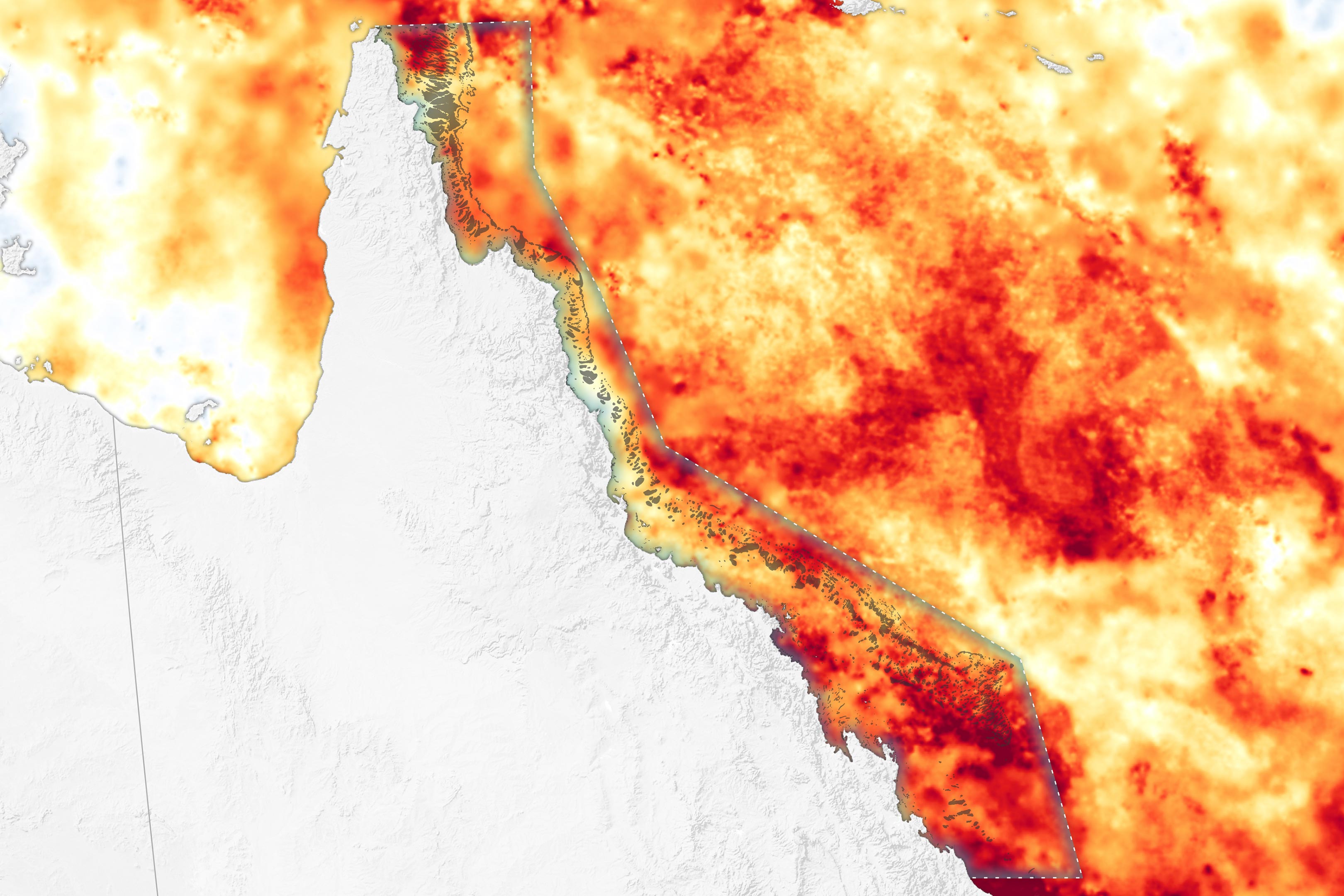
Weeks of warmer-than-average ocean temperatures caused extensive bleaching in the world’s largest coral reef system.
Australia’s Great Barrier Reef has been hit by widespread coral bleaching caused by heat stress, government officials confirmed on March 8, 2024. This is the fifth mass bleaching of the reef since 2016.
Aerial surveys of over 300 reefs conducted by the Great Barrier Reef Marine Park Authority, which monitors the health of the coral, found bleaching in shallow water areas spanning two-thirds of the reef.
Impact of Heat Stress on Coral
“The results of the aerial survey and the coral bleaching that we are seeing are consistent with the patterns of heat stress that have been building over the reef over the summer months,” said Roger Beeden, chief scientist at the reef authority.
The Great Barrier Reef lies off the northeast coast of Queensland, Australia. It is one of the richest and most biodiverse natural ecosystems on Earth. Spread across 346,000 square kilometers (134,000 square miles) of the Coral Sea, it comprises 2,500 individual reefs and more than 900 islands.
Bleaching events are caused by sustained, warmer-than-average ocean temperatures. Corals have a symbiotic relationship with photosynthetic algae known as zooxanthellae, which provide the coral polyps with nutrients as well as their bright colors. Heat stress causes the corals to expel the zooxanthellae, leaving the skeletal structures with a “bleached” appearance.
Factors Influencing Coral Health
A common metric used to assess the risk to coral reefs from high water temperature is the number of weeks that sea surface temperatures have exceeded the mean monthly maximum temperature by 1 degree Celsius. Significant coral bleaching may occur after 4 weeks of elevated temperatures, and severe, widespread coral bleaching is likely after 8 such weeks. As of early March, parts of the reef had been exposed to between 8 and 10 hotter-than-normal weeks, according to the reef authority.
The map above shows sea surface temperature anomalies off the coast of eastern Australia on March 4, 2024. It is based on data from the MUR SST (Multi-scale Ultra-high Resolution Sea Surface Temperature) project, an effort by NASA’s Jet Propulsion Laboratory (JPL) that blends measurements of sea surface temperatures from multiple NASA, NOAA, and international satellites, as well as ship and buoy observations. Rather than showing absolute temperature, the anomaly reflects the difference between the sea surface temperature on March 4, 2024, and the 2003-2014 average for that day.
Historical Context and Climate Patterns
Previous mass bleaching events on the reef occurred in 1998, 2002, 2016, 2017, 2020 and 2022. According to the Australian Institute of Marine Science, “Prior to these years, there is no evidence of such widespread events in the Great Barrier Reef’s 500-year coral record history.”
During the latter half of 2023 and beginning of 2024, trade winds in the Pacific Ocean relaxed, allowing warm water from the western Pacific to push into the eastern Pacific—a phenomenon known as El Niño. This pattern, on top of human-caused climate change, has driven global average sea surface temperatures to record highs for the past 10 months. However, the relationship between El Niño and sea surface temperatures off the coast of eastern Australia is a bit more complicated.
“Sea surface temperatures during El Niño and La Niña events act a bit like a seesaw,” said Josh Willis, a climate scientist at JPL. “When ocean temperatures during an El Niño are higher in the eastern Pacific, they’re typically lower in the western Pacific.”
Research has found that patterns in large-scale ocean circulation and climate change alone do not fully explain trends in sea surface temperatures and bleaching in the Coral Sea. Rather, weather patterns during El Niño events have historically suppressed the Australian summer monsoon, resulting in reduced cloud cover and higher-than-average air temperatures. These conditions play a big role in determining temperatures in the Coral Sea and the extent and location of coral bleaching in the Great Barrier Reef.
NASA Earth Observatory image by Michala Garrison, using data from the MUR SST (Multi-scale Ultra-high Resolution Sea Surface Temperature) project and reef information from the Great Barrier Reef Marine Park Authority (GBRMPA). Story by
Never miss a breakthrough: Join the SciTechDaily newsletter.
Follow us on Google and Google News.