
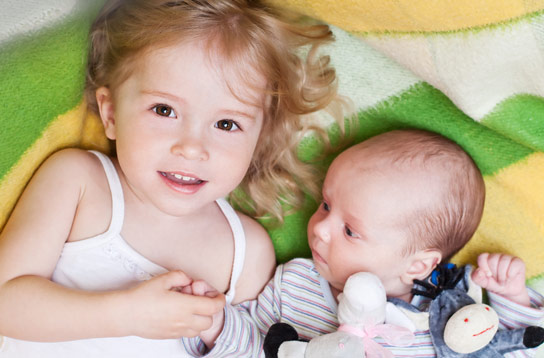
A new study from Yale University found that younger siblings of children with ASD showed symptoms as early as 18 months old, reinforcing the need for repeated diagnostic screening in the first three years of life to identify individual cases of ASD as soon as behavioral symptoms are apparent.
About 20% of younger siblings of children with Autism Spectrum Disorder (ASD) will develop the condition by age 3. A new study by Yale School of Medicine researchers has found that 57% of these younger siblings who later develop the condition already showed symptoms at age 18 months.
Published in the October Journal of the American Academy of Child & Adolescent Psychiatry, this is the first large-scale, multi-site study aimed at identifying specific social-communicative behaviors that distinguish infants with ASD from their typically and atypically developing high-risk peers as early as 18 months of age.
“While the majority of siblings of children with ASD will not develop the condition themselves, for those who do, one of the key priorities is finding more effective ways of identifying and treating them as early as possible,” said lead author Katarzyna Chawarska, associate professor in the Yale Child Study Center and the Department of Pediatrics at Yale School of Medicine. “Our study reinforces the need for repeated diagnostic screening in the first three years of life to identify individual cases of ASD as soon as behavioral symptoms are apparent.”
Chawarska and her co-authors pooled data from eight sites participating in the Autism Speaks Baby Siblings Research Consortium. The team closely examined social, communicative, and repetitive behaviors in 719 infants when they were 18 months old. The team looked for patterns that might predict a later diagnosis of ASD. They then followed up when the participants were age 3.
“Our research suggests that approximately half of the siblings who are later diagnosed with ASD display signs suggestive of ASD at 18 months, and in those who appeared asymptomatic at 18 months, symptoms appeared between 18 and 36 months,” said Chawarska.
Chawarska said what was most interesting to the research team was that different patterns of behaviors at 18 months may be predictive of ASD later on. In about 50% of siblings, a combination of poor eye contact and lack of communicative gestures or imaginative play is most strongly associated with later ASD diagnosis. In a small percentage of those later diagnosed with ASD, eye contact may be relatively normal, but they begin to display early signs of repetitive behaviors and have limited non-verbal communication skills.
“So not only do the behavioral symptoms appear at different ages, but different combinations of early symptoms may predict the diagnostic outcome,” Chawarska added. “Linking these developmental dynamics with underlying neurobiology may advance our understanding of causes of ASD and further efforts to personalize treatment for ASD by tailoring it to specific clinical profiles and their developmental dynamics.”
Other authors on the study included Suzanne Macari, Frederick Shic, Daniel J. Campbell, Jessica Brian, Rebecca Landa, Ted Hutman, Charles A. Nelson, Sally Ozonoff, Helen Tager-Flusberg, Gregory S. Young, Lonnie Zwaigenbaum, Ira L. Cohen, Tony Charman, Daniel S. Messinger, Ami Klin, Scott Johnson, and Susan Bryson.
Reference: “18-Month Predictors of Later Outcomes in Younger Siblings of Children With Autism Spectrum Disorder: A Baby Siblings Research Consortium Study” by Katarzyna Chawarska, PhD; Frederick Shic, PhD; Suzanne Macari, PhD; Daniel J. Campbell, PhD; Jessica Brian, PhD; Rebecca Landa, PhD; Ted Hutman, PhD; Charles A. Nelson, PhD; Sally Ozonoff, PhD; Helen Tager-Flusberg, PhD; Gregory S. Young, PhD; Lonnie Zwaigenbaum, MD; Ira L. Cohen, PhD; Tony Charman, PhD; Daniel S. Messinger, PhD; Ami Klin, PhD; Scott Johnson, PhD and Susan Bryson, PhD, 4 October 2014, Journal of the American Academy of Child & Adolescent Psychiatry.
DOI: 10.1016/j.jaac.2014.09.015
Never miss a breakthrough: Join the SciTechDaily newsletter.
Follow us on Google and Google News.
1 Comment
Let’s see, we have a normal child, then we get them vaccines and now that same child has autism, sometimes within only hours of getting those vaccines. Why not do a study that compares the autism rate of vaccinated and unvaccinated children. Seems like an appropriate place to start huh? Not much common sense in these people from Yale.