
Close Menu
    Facebook X (Twitter) Instagram
    SciTechDaily
    • Biology
    • Chemistry
    • Earth
    • Health
    • Physics
    • Science
    • Space
    • Technology
    Facebook X (Twitter) Pinterest YouTube RSS
    SciTechDaily
    Home»Space»Astronomers Detect Magnetic Fields on Solar-Type Stars
    Space

    Astronomers Detect Magnetic Fields on Solar-Type Stars

    By Harvard-Smithsonian Center for AstrophysicsDecember 12, 2014No Comments3 Mins Read
    Facebook Twitter Pinterest Telegram LinkedIn WhatsApp Email Reddit
    Share
    Facebook Twitter LinkedIn Pinterest Telegram Email Reddit
    Astronomers Study the Magnetic Fields Stars
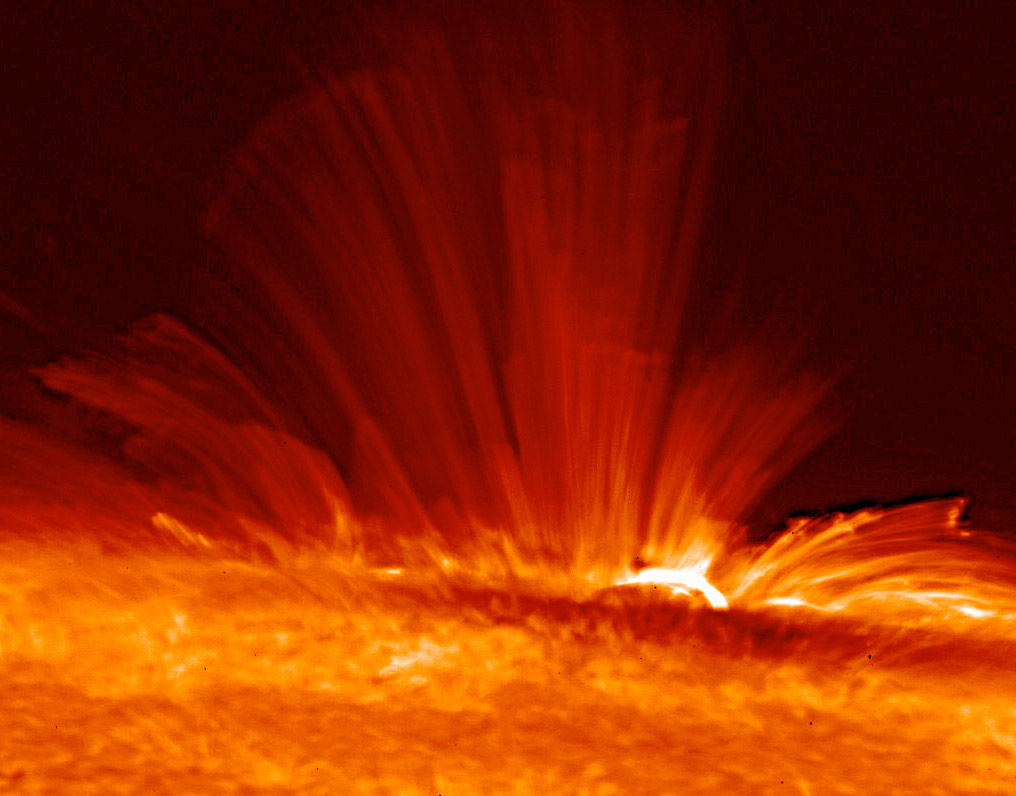
    Vivid orange streamers of super-hot, electrically charged gas (plasma) arcing from the Sun’s surface unveil the structure of the solar magnetic field ascending vertically from a sunspot. Credit: Hinode, JAXA/NASA

    A team of astronomers has just completed the most extensive polarization survey of stars to date, detecting magnetic fields on sixty-seven stars with twenty-one of them being classified as solar-type. That is about four times as many solar-type stars as had been previously classified.

    The Sun rotates slowly, about once every 24 days at its equator although the hot gas at every latitude rotates at a slightly different rate. Rotation helps to drive the mechanisms that power stellar magnetic fields, and in slowly rotating solar-type stars also helps to explain the solar activity cycle. In the case of solar-type stars that rotate much faster than the modern-day Sun, the dynamo appears to be generated by fundamentally different mechanisms that, along with many details of solar magnetic field generation, are not well understood.

    Astronomers trying to understand dynamos across a range of solar-type stars (and how they evolve) have been observing a variety of active stars, both slow and fast rotators, to probe how various physical parameters of stars enhance or inhibit dynamo processes.

    Most techniques used to observe stellar magnetism rely on indirect proxies of the field, for example on characteristics of the radiation emitted by atoms. Surveys using these proxies have found clear dependencies between rotation and the stellar dynamo and the star’s magnetic cycles, among other things. Recent advances in instrumentation that can sense the polarization of the light extend these methods and have made it possible to directly measure solar-strength magnetic fields on other stars.

    Harvard-Smithsonian Center for Astrophysics (CfA) astronomer Jose-Dias do Nascimento is a member of a team of astronomers that has just completed the most extensive polarization survey of stars to date. They detected magnetic fields on sixty-seven stars, twenty-one of them classified as solar-type, about four times as many solar-type stars as had been previously classified.

    The scientists found that the average field increases with the stellar rotation rate and decreases with stellar age, and that its strength correlates with emission from the stars’ hot outer layers, their chromospheres. Not only does this paper represent the most extensive survey to date of its kind, it demonstrates the power of the polarization technique. It signals that it is possible to greatly expand the study of magnetic fields in solar-type stars, which efforts will continue to improve our understanding of the surface fields in the Sun.

    Reference: “A BCool magnetic snapshot survey of solar-type stars” by S. C. Marsden, P. Petit, S. V. Jeffers, J. Morin, R. Fares, A. Reiners, J.-D. do Nascimento, Jr, M. Aurière, J. Bouvier, B. D. Carter, C. Catala, B. Dintrans, J.-F. Donati, T. Gastine, M. Jardine, R. Konstantinova-Antova, J. Lanoux, F. Lignières, A. Morgenthaler, J. C. Ramìrez-Vèlez, S. Théado, V. Van Grootel and the BCool Collaboration, 11 November 2014, Monthly Notices of the Royal Astronomical Society.
    DOI: 10.1093/mnras/stu1663

    Never miss a breakthrough: Join the SciTechDaily newsletter.
    Follow us on Google and Google News.

    Astronomy Astrophysics Harvard-Smithsonian Center for Astrophysics Stars
    Share. Facebook Twitter Pinterest LinkedIn Email Reddit

    Related Articles

    Astronomers Explore Cosmic Ray Influences on Star Formation in Galaxies

    Astronomers Observe a New Type of Binary Star – “Exciting, Missing Evolutionary Link”

    Astronomers Have Discovered a Gigantic Sphere-Shaped Cavity in Space

    Mystery Solved: Astronomers Unravel the Puzzle of Betelgeuse’s “Great Dimming”

    Mega-Flares From Stars: 10 Million Times More Energetic Than the Most Powerful Flare Ever Observed on the Sun

    The Give and Take of Stellar Mega-Flares: By Studying Thousands of Young Stars, New Information Has Emerged

    Growing up Stardust: Astronomers Discover That Stars and Planets May Be Siblings

    Massive Rotating Stars in the Pleiades Cluster

    Chandra Studies Extraordinary Magnetar: Fastest Spinning and Possibly the Youngest Magnetar Known

    Leave A Reply Cancel Reply

    • Facebook
    • Twitter
    • Pinterest
    • YouTube

    Don't Miss a Discovery

    Subscribe for the Latest in Science & Tech!

    Trending News

    The Universe Is Expanding Too Fast and Scientists Can’t Explain Why

    “Like Liquid Metal”: Scientists Create Strange Shape-Shifting Material

    Early Warning Signals of Esophageal Cancer May Be Hiding in Plain Sight

    Common Blood Pressure Drug Shows Surprising Power Against Deadly Antibiotic-Resistant Superbug

    Scientists Uncover Dangerous Connection Between Serotonin and Heart Valve Disease

    Scientists Discover a “Protector” Protein That Could Help Reverse Hair Loss

    Bone-Strengthening Discovery Could Reverse Osteoporosis

    Scientists Uncover Hidden Trigger Behind Stem Cell Aging

    Follow SciTechDaily
    • Facebook
    • Twitter
    • YouTube
    • Pinterest
    • Newsletter
    • RSS
    SciTech News
    • Biology News
    • Chemistry News
    • Earth News
    • Health News
    • Physics News
    • Science News
    • Space News
    • Technology News
    Recent Posts
    • A Common Diabetes Drug May Hold the Key to Stopping HIV From Coming Back
    • Ancient “Syphilis-Like” Disease in Vietnam Challenges Key Scientific Assumptions
    • Drinking Alcohol To Cope in Your 20s Could Damage Your Brain for Life
    • Scientists Crack Alfalfa’s Chromosome Mystery After Decades of Debate
    • Ancient Ant-Plant Alliance Collapses As Predatory Wasps Move In
    Copyright © 1998 - 2026 SciTechDaily. All Rights Reserved.
    • Science News
    • About
    • Contact
    • Editorial Board
    • Privacy Policy
    • Terms of Use

    Type above and press Enter to search. Press Esc to cancel.