
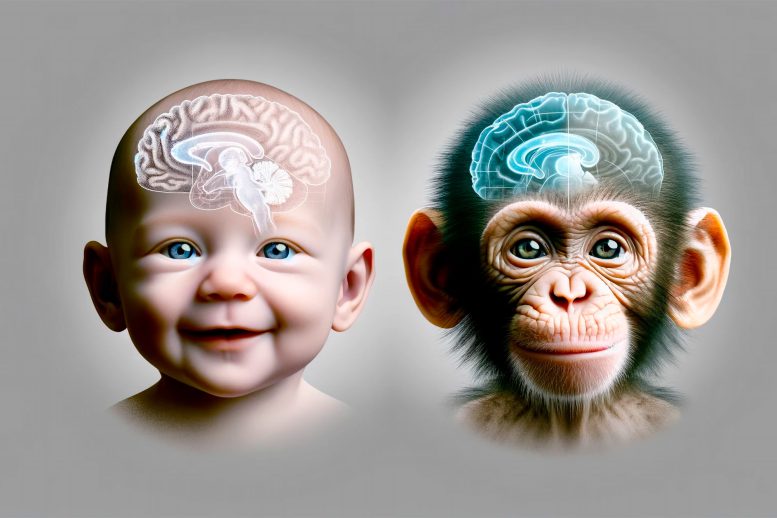
A UCL study reveals human newborns’ brains are similarly developed to other primates at birth, with significant growth occurring post-birth, challenging previous notions about human brain development and evolution.
Contrary to current understanding, the brains of human newborns aren’t significantly less developed compared to other primate species, but appear so because so much brain development happens after birth, finds a new study led by University College London (UCL) researchers.
Understanding Brain Growth in Humans and Primates
The study, published on December 4 in the journal Nature Ecology & Evolution, found that humans are born with brains at a development level that’s typical for similar primate species, but the human brains grow so much larger and more complex than other species after birth, it gives a false impression that human newborns are underdeveloped, or “altricial.”
Lead author Dr. Aida Gomez-Robles (UCL Anthropology) said: “This new work changes the overall understanding around the evolution of human brain development. Humans seem so much more helpless when they’re young compared to other primates not because their brains are comparatively underdeveloped but because they still have much further to go.”
Rethinking Evolutionary Development of the Human Brain
One way that scientists compare the brain development of different species is by measuring the size of their brains as newborns to their brain size as adults. Humans are born with a relatively smaller percentage of their adult brain size, compared to other primates, making it seem they’re born less developed. However, this new research shows that this measure is misleading as other measurements of human brain development show humans are largely in line with other species of primates such as chimpanzees, bonobos, gorillas, and orangutans.
Challenging Prevailing Beliefs in Evolutionary Biology
The research challenges a prevailing understanding of evolutionary human brain development. Up to now, because of their helplessness and poor muscle control, it’s long been believed that humans are born with comparatively less developed brains than other primates. This was thought to be the result of an evolutionary compromise so babies’ heads could fit through their mother’s birth canal, which would require them to further develop outside of the womb.
Based on this understanding, scientists suggested that because humans emerged comparatively underdeveloped, their brains are more malleable in the earliest period of life and more easily affected by environmental stimuli as they grow. It was thought that this underdevelopment at birth encouraged greater brain plasticity, ultimately facilitating human intelligence.
Human Brain Growth: A Different Perspective
Instead, the researchers found that while human brains do take longer than other species to grow to full capacity, it’s not because they come out significantly less developed at birth, but because their brains grow so much more later in life. The researchers added that their findings don’t negate the importance of brain plasticity in human evolution but make it unlikely that this enhanced plasticity resulted from being born less developed than other primates.
Comprehensive Analysis of Mammalian Brain Development
To understand the evolutionary development of human brains, the researchers analyzed the brain development of 140 different mammal species including modern primates, rodents, and carnivores, as well as the fossils of early humans and related ancestral hominins. They compared the length of foetal gestation in modern mammals, the relative size of newborn brains and bodies to their adult size, and the overall brain size of newborns and adults to understand the evolution of human brains.
They found that while there are major variations in brain development at birth between disparate mammal species, primates are relatively consistent with each other. Humans are not born at significantly lower levels of development than modern primates, nor their hominin ancestors. Similarly, the human gestation period is not shorter than it would be expected when compared to other primates.
Reference: “The evolution of human altriciality and brain development in comparative context” by Aida Gómez-Robles, Christos Nicolaou, Jeroen B. Smaers and Chet C. Sherwood, 4 December 2023, Nature Ecology & Evolution.
DOI: 10.1038/s41559-023-02253-z
The research was supported by the National Science Foundation and the National Institutes of Health in the US.
Never miss a breakthrough: Join the SciTechDaily newsletter.
Follow us on Google and Google News.
2 Comments
Why do you folks not attribute any of your images? Just curious.
So human babies are born premature .