
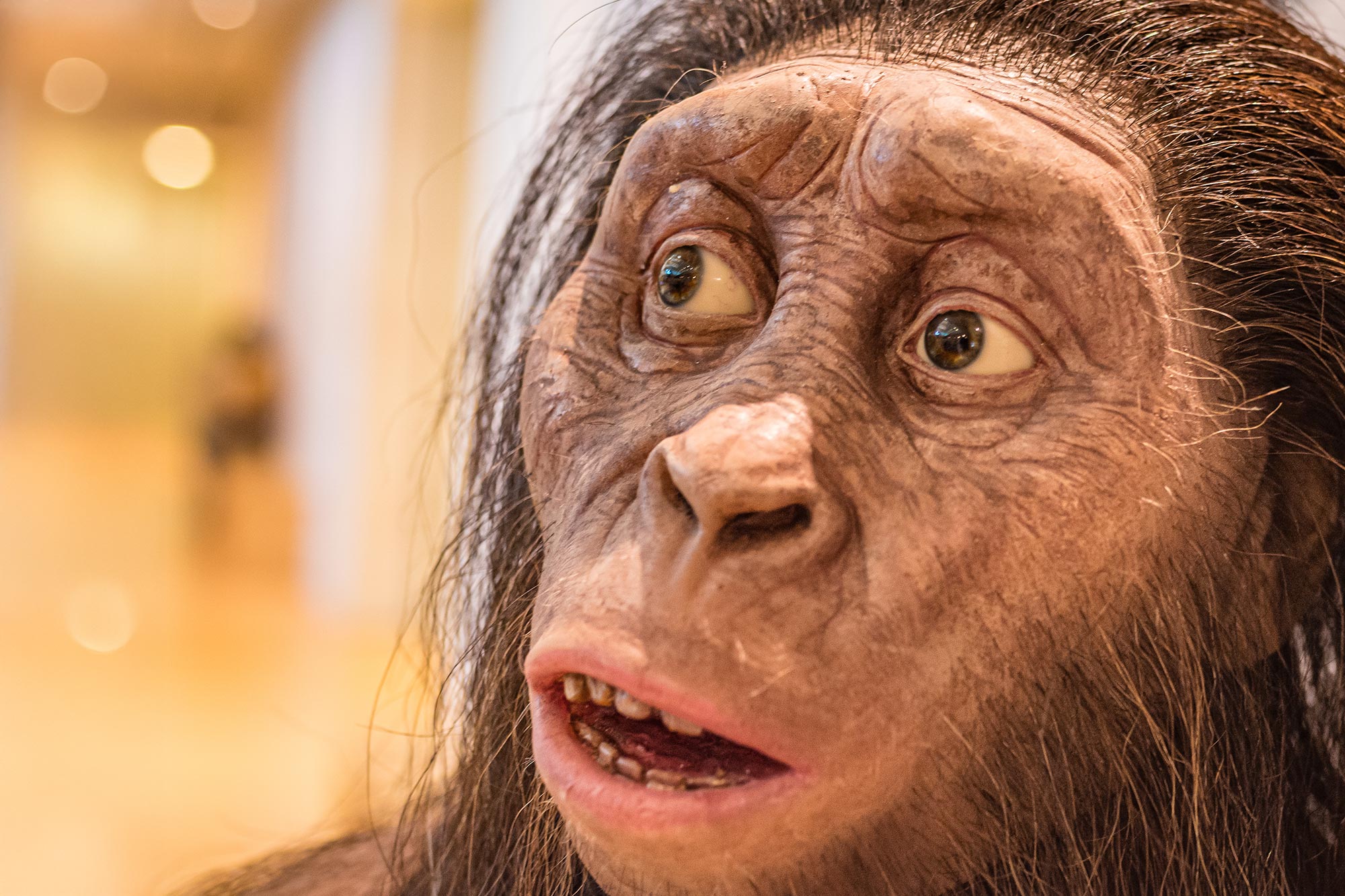
UCL scientists discovered that human skulls evolved far faster than those of other apes.
Using 3D scans, they found that our flatter faces and larger brains developed at roughly twice the expected rate. The results hint that both intelligence and social factors helped drive humanity’s rapid evolutionary leap.
Rapid Evolution of the Human Skull
Humans developed large brains and flatter faces at an exceptionally quick rate compared to other apes, according to new research from UCL scientists. The study suggests that these rapid changes may have offered key evolutionary advantages that shaped the development of our species.
The research, published in Proceedings of the Royal Society B, examined how skull diversity among humans and related apes evolved over millions of years. The analysis revealed that human skulls changed much more rapidly than those of any other closely related ape species, highlighting an unusually fast pace of evolution in our lineage.
Lead author Dr. Aida Gomez-Robles (UCL Anthropology) explained: “Of all the ape species, humans have evolved the fastest. This likely speaks to how crucial skull adaptations associated with having a big brain and small faces are for humans that they evolved at such a fast rate. These adaptations can be related to the cognitive advantages of having a big brain, but there could be social factors influencing our evolution as well.”
3D Virtual Models Reveal Evolutionary Differences
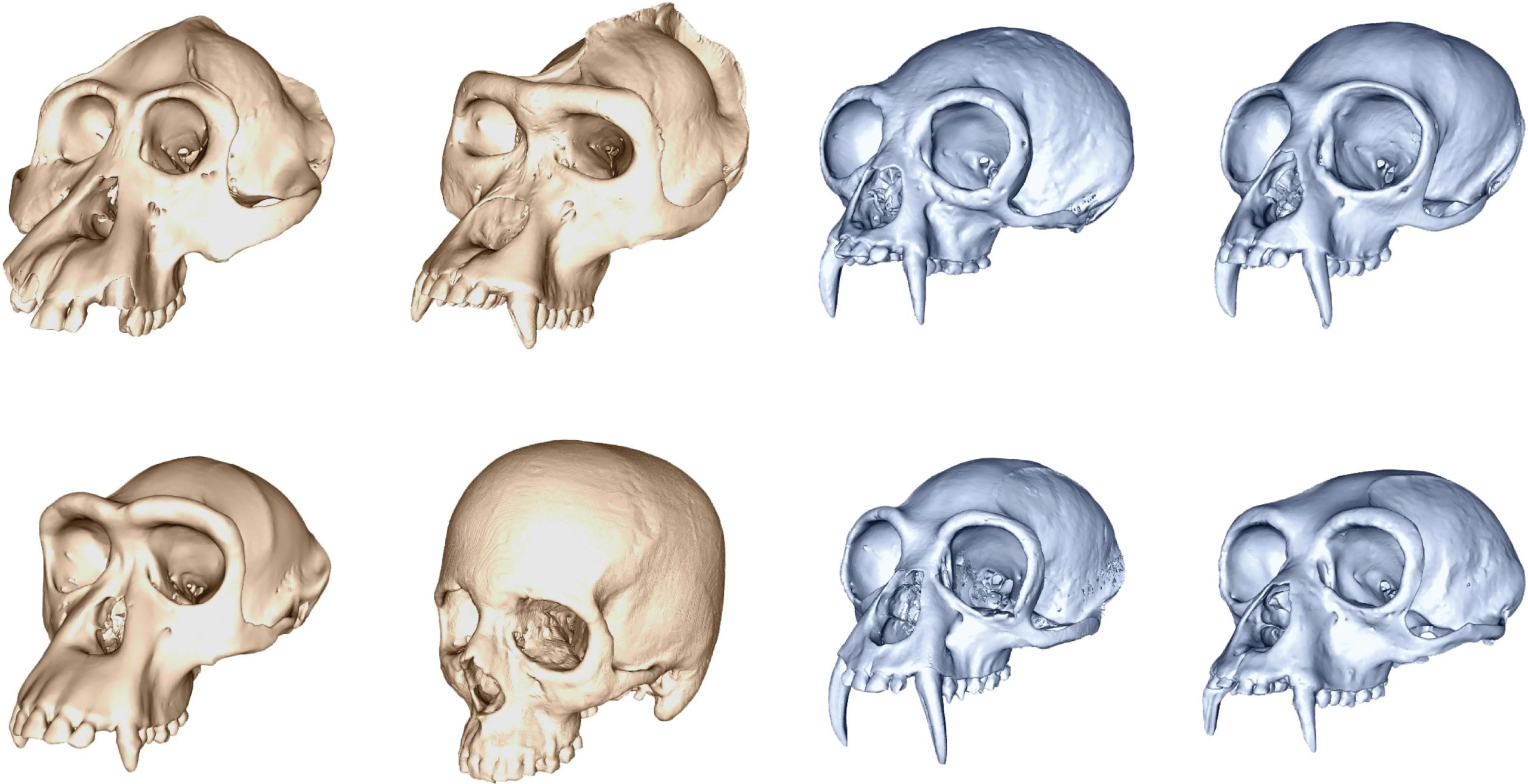
To explore these differences, the researchers created three-dimensional virtual skull models[1] from various modern primates. Their sample included seven hominid species, or “great apes,”[2] such as humans, gorillas and chimpanzees, and nine hylobatid species, or “lesser apes,”[3] such as gibbons.
Hominids and hylobatids diverged from a common ancestor about 20 million years ago. Since then, the two groups have evolved very differently. Hominids have developed a wide range of anatomical diversity, while hylobatids have remained relatively uniform. As a result, gibbon skulls appear strikingly similar across species, whereas the skulls of great apes, particularly humans, are far more distinct. Even within the great apes, humans show the most accelerated evolutionary change.
To quantify this variation, the researchers divided each skull into four major parts: the upper face, lower face, front of the head, and back of the head. Computer analysis of the 3D scans allowed them to calculate how much each region differed among species. This work represents the most detailed comparative study to date of 3D skull structures among closely related apes.
Flat Faces and Big Brains: What Sets Humans Apart
Most great apes have big and forwardly projecting faces with relatively small brains, while humans have flatter faces and large round heads. Gibbons, in some ways similar to humans, likewise have relatively flat faces as well and a round head, but a much smaller brain.
The team used the slow evolution and low diversity of hylobatids as a kind of control to compare the variation in hominid skulls. By comparing the species, the researchers found that humans changed about twice as much as would be expected if there wasn’t some additional factor encouraging additional changes.
Intelligence or Social Influence?
The researchers cautioned that while it can be tempting to conclude that the evolutionary advantages of greater intelligence from bigger and more complex brains were the primary driver for humans’ rapid evolution, social factors could be affecting these changes as well.
Dr. Gomez-Robles added: “After humans, gorillas have the second fastest evolutionary rate of their skulls, but their brains are relatively small compared to other great apes. In their case, it’s likely that the changes were driven by social selection where larger cranial crests on the top of their skulls are associated with higher social status. It’s possible that some similar, uniquely human social selection may have occurred in humans as well.”
Notes
- These are virtual representation of actual skulls, obtained from CT-scans of the skulls.
- Great apes are humans and species of gorilla, orangutan, chimpanzee, and bonobo.
- Lesser apes are gibbons, which consist of around 20 different species.
Reference: “Accelerated evolution increased craniofacial divergence between humans and great apes” by Aida Gómez-Robles, Amy Drennan, Maricci Basa and Alfie Gleeson, 30 September 2025, Proceedings B.
DOI: 10.1098/rspb.2025.1507
Never miss a breakthrough: Join the SciTechDaily newsletter.
Follow us on Google and Google News.
18 Comments
‘Evolution’ is misrepresentations of epigenetic-derived adaptations and effects from mutations’ It is all smoke and mirrors. It is NOT happening. I have studied this subject for 16 years in pro-evolution peer reviewed papers and magazines. I can’t make this any more concise.
I wonder what Intelligent Design has to say about the origin of humans.
That was a daft mistake……….I knew that I shouldn’t have gone to work on Saturday!
Just google ape skull you nitwits. Stop clinging to this lie! Evolution blevolution, Darwin was a racist moron! THERE WAS A GLOBAL FLOOD!
I wonder what ID has to say about the origin of humans.
It is a very interesting and worthwhile study to analyse face and head formation of humans vis-a-vis great apes, as is reported in this article. Such studies can also show where we as humans can benefit from the natural vigor of lower primates.
English, please explain.
Can you elaborate on that? For all us average IQers.
You are on the nose!
In a sexually reproductive pairing of male and female primates, the flat-faced heads of male and female constitute one hemisphere each of a spheroid of brain quadrispheres. Brain halves are called hemispheres, but the human brain is more hemispheroidal than spheroidal. Spheroidal Imbalance occurs when one sex, typically the male, overrules and dominates the other sex, typically the female, resulting in serious psychosocial dissonance, mental unwellness, societal breakdown and environmental catastrophe. The two hemispheroidal halves must cooperate and balance each fairly and equally, as a complementary sex set of quadrispheres, in order for there to be peace, stability, and wholeness in the creation.
What kind of drugs were you on when you wrote that??
Quadraspheres? Sex-linked hemispheres?
Step away from the intoxicants. You’ve taken too many, my friend.
You need help.
Ouch you are treading on dangerous ground my friend 🫣
what are the odds all races of people evolved at the exact same rate in all locations, and if we all started in one place an moved how do we find dino bones shallow but no people before, odd evolution compared to everything else. Just seems less and less valid especially removing any extraterrestrial or outside influence the rate at which we evolved does not add up.
Dinosaurs had two hundred million years to leave behind fossils. That’s a lot of generations. Humans have only had a few million. As for fossils being near ghe surface, that’s just your personal bias. Dinosaur fossils are also found deep in the earth, not just near the surface. But looking deep in the ground requires drilling or mining AND observing what is drilled or mined. That is rarely done, so obviously dino fossils are normally found near the surface. Keep in mind geologic activity can move fossils down and up a lot, to the extent fossils are even found on near the top of Mount Everest. Finally, it’s sad to see someone like you happily denigrate hard-earned knowledge just because you don’t know all the facts and are too unmotivated to learn. You can do much better.
Simple; the good-looking smart chicks preferred to copulate with the good-looking smart guys and vice versa. Once a critical mass of such copulations had been achieved, it was all on.
Or in other words, the fave fashion of the of the day was responsible.
Our brains didn’t evolve. Apes and humans are not even the same. True science would support that human brains and apes are uniquely different. Why is this because they are different species’s. There is no proof of what this article claims.
@Mike – Define what you think true science involves. Does it include testing hypotheses and eliminating competing hypotheses? Does it include examining collections of evidence?