
Close Menu
    Facebook X (Twitter) Instagram
    SciTechDaily
    • Biology
    • Chemistry
    • Earth
    • Health
    • Physics
    • Science
    • Space
    • Technology
    Facebook X (Twitter) Pinterest YouTube RSS
    SciTechDaily
    Home»Space»Researchers Plan to Explore Titan with a Nuclear Powered Drone
    Space

    Researchers Plan to Explore Titan with a Nuclear Powered Drone

    By Brigham Young UniversityJanuary 25, 2012No Comments3 Mins Read
    Facebook Twitter Pinterest Telegram LinkedIn WhatsApp Email Reddit
    Share
    Facebook Twitter LinkedIn Pinterest Telegram Email Reddit
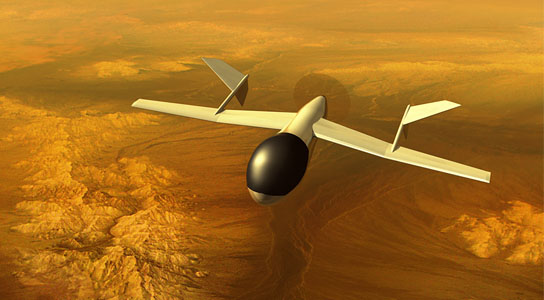
    Putting an airplane on Titan
    Putting an airplane on Titan. Credit: Mike Malaska

    Brigham Young University geologist Jani Radebaugh, alongside researchers from NASA and the Naval Research Laboratory, has put forth a plan that would send a done to Titan. Their plan calls for the drone to operate on a nuclear battery transferring the power between a simple propeller and radio during its one-year research flight.

    In addition to its rivers, oceans, mountains, sand dunes, and winds, Saturn’s moon Titan may someday share another similarity with Earth: airplanes.

    In the journal Experimental Astronomy, BYU professor Jani Radebaugh and other scientists have put forward a plan that would send a nuclear-powered drone to Titan for a year-long flight to observe the most earth-like object in our solar system.

    “Titan is a really interesting place as far as understanding the processes on the early Earth,” said Radebaugh, a geologist at BYU. “It orbits at a good distance, has organic molecules of carbon and hydrogen, there’s energy in the atmosphere and perhaps occasionally water on or near the surface – those are the main things considered necessary for life.”

    Titan is 10 times more distant from the sun than Earth and has a methane atmosphere four times as dense.

    “Walking on Titan would feel a little like walking through a down pillow to us,” Radebaugh said. “The atmosphere is pretty stable with some low-velocity winds. It’s perfect for an airplane.”

    So far what we know of Titan has come from the Cassini spacecraft that orbits Saturn. In recent years Radebaugh led the discovery of Titan’s mountains and sand dunes based on images and data beamed back to Earth by Cassini. That’s why Jason Barnes, a former grad school classmate, invited her to work on the Titan airplane concept alongside researchers from NASA and the Naval Research Laboratory.

    To get a closer look, the proposed drone would operate on a nuclear battery barely strong enough to power a couple of light bulbs. The battery would power a propeller except when it needed to beam data back to radio telescopes on Earth. Prior to these transmissions, the drone would climb high into Titan’s atmosphere. Then power would shift to the radio cone in the drone’s nose as the aircraft glided back down to its usual flight altitude.

    “Nothing is easy in space,” Radebaugh said. “But as far as space exploration goes, this is pretty easy to design and fly.”

    While transporting the drone to Titan would take up to 7 years, the communication relay time once it’s there is a mere 90 minutes.

    Never miss a breakthrough: Join the SciTechDaily newsletter.
    Follow us on Google and Google News.

    Astronomy BYU Drones Exploration Titan
    Share. Facebook Twitter Pinterest LinkedIn Email Reddit

    Related Articles

    Titan’s Hidden Ocean May Not Exist and That Changes Everything

    Titan’s Icy Surface Just Broke a Fundamental Rule of Chemistry

    Titan’s Methane Mysteries: Unraveling Atmospheric Secrets of Saturn’s Largest Moon

    Unveiling the Mysteries of Titan’s Icy Faults: A Journey Through Space Geology

    Webb and Keck Telescopes Team for Unprecedented Look at Saturn’s Moon Titan – “Simply Extraordinary!”

    ESA’s Euclid Mission Receives Final Approval

    Cassini Detects Methane Lakes on Titan

    A Closer Look at Titan’s Chemical Production

    NASA’s NuSTAR is One Step Closer to Launching

    Leave A Reply Cancel Reply

    • Facebook
    • Twitter
    • Pinterest
    • YouTube

    Don't Miss a Discovery

    Subscribe for the Latest in Science & Tech!

    Trending News

    Don’t Miss: A Brilliant Venus and Glowing Harvest Moon Light Up the Sky

    New Twist on the Einstein Problem Reveals Unexpected Physics

    JWST Captures Stunning Evidence of How Supermassive Black Holes Feed

    Early Exercise May Permanently Change How Much Energy the Body Uses To Move

    New Molecule Wipes Out Aggressive Lymphoma Tumors in Mice in Just 11 Days

    The Human Family Tree May Need a Major Rewrite

    Scientists Find a Surprising Cancer-Fighting Effect in Dark Sweet Cherries

    New AI Detects Hidden Warning Signs of Solar Eruptions Hours Before They Emerge

    Follow SciTechDaily
    • Facebook
    • Twitter
    • YouTube
    • Pinterest
    • Newsletter
    • RSS
    SciTech News
    • Biology News
    • Chemistry News
    • Earth News
    • Health News
    • Physics News
    • Science News
    • Space News
    • Technology News
    Recent Posts
    • Could Alien Life Be Conscious in Ways We Can’t Imagine?
    • Scientists Develop a Fruit Wash That Removes Pesticide Residues and Keeps Produce Fresh Longer
    • Scientists May Have Finally Explained Why Astronauts Get Constipated in Space
    • Pomegranates Could Unlock a New Treatment for Heart Failure
    • Africa’s Giant Herbivores Were Disappearing Millions of Years Before Humans Could Hunt Them
    Copyright © 1998 - 2026 SciTechDaily. All Rights Reserved.
    • Science News
    • About
    • Contact
    • Editorial Board
    • Privacy Policy
    • Terms of Use

    Type above and press Enter to search. Press Esc to cancel.