
Using NASA’s Hubble Telescope, a team of researchers has detected a stratosphere on the planet WASP-33b. A stratosphere occurs when molecules in the atmosphere absorb ultraviolet and visible light from the star. This absorption warms the stratosphere and acts as a kind of sunscreen layer for the planet below.
NASA’s Hubble Space Telescope has detected a stratosphere, one of the primary layers of Earth’s atmosphere, on a massive and blazing-hot exoplanet known as WASP-33b.
The presence of a stratosphere can provide clues about the composition of a planet and how it formed. This atmospheric layer includes molecules that absorb ultraviolet and visible light, acting as a kind of “sunscreen” for the planet it surrounds. Until now, scientists were uncertain whether these molecules would be found in the atmospheres of large, extremely hot planets in other star systems.
These findings will appear in the June 12, 2015 issue of the Astrophysical Journal.
“Some of these planets are so hot in their upper atmospheres, they’re essentially boiling off into space,” said Avi Mandell, a planetary scientist at NASA’s Goddard Space Flight Center in Greenbelt, Maryland, and a co-author of the study. “At these temperatures, we don’t necessarily expect to find an atmosphere that has molecules that can lead to these multilayered structures.”
In Earth’s atmosphere, the stratosphere sits above the troposphere – the turbulent, active-weather region that reaches from the ground to the altitude where nearly all clouds top out. In the troposphere, the temperature is warmer at the bottom – ground level – and cools down at higher altitudes.
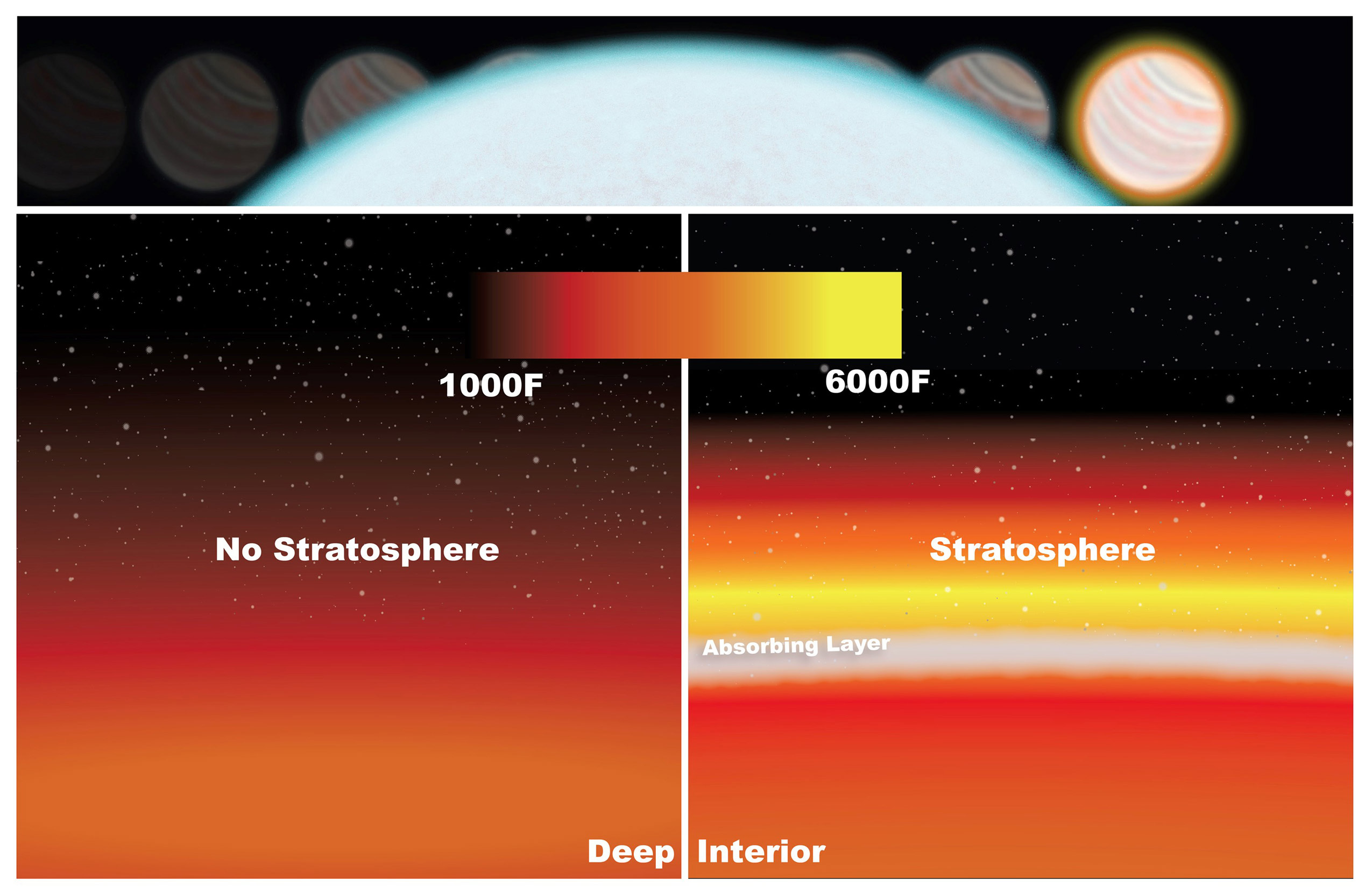
The stratosphere is just the opposite. In this layer, the temperature increases with altitude, a phenomenon called temperature inversion. On Earth, temperature inversion occurs because ozone in the stratosphere absorbs much of the sun’s ultraviolet radiation, preventing it from reaching the surface, protecting the biosphere, and therefore warming the stratosphere instead.
Similar temperature inversions occur in the stratospheres of other planets in our solar system, such as Jupiter and Saturn. In these cases, the culprit is a different group of molecules called hydrocarbons. Neither ozone nor hydrocarbons, however, could survive at the high temperatures of most known exoplanets, which are planets outside our solar system. This leads to a debate as to whether stratospheres would exist on them at all.
Using Hubble, the researchers have settled this debate by identifying a temperature inversion in the atmosphere of WASP-33b, which has about four-and-a-half times the mass of Jupiter. Team members also think they know which molecule in WASP-33b’s atmosphere caused the inversion – titanium oxide.
“These two lines of evidence together make a very convincing case that we have detected a stratosphere on an exoplanet,” said Korey Haynes, lead author of the study. Haynes was a graduate student at George Mason University in Fairfax, Virginia, and was working at Goddard with Mandell when the research was conducted.
The researchers analyzed observations made with Hubble’s Wide Field Camera 3 by co-author Drake Deming at the University of Maryland in College Park. Wide Field Camera 3 can capture a spectrum of the near-infrared region where the signature for water appears. Scientists can use the spectrum to identify water and other gases in a distant planet’s atmosphere and determine its temperature.
Haynes and her colleagues used the Hubble observations, and data from previous studies, to measure emission from water and compare it to emission from gas deeper in the atmosphere. The team determined that emission from water was produced in the stratosphere at about 6,000 degrees Fahrenheit. The rest of the emission came from gas lower in the atmosphere that was at a temperature about 3,000 degrees Fahrenheit (1,650 degrees Celsius).
The team also presented the first observational evidence that WASP-33b’s atmosphere contains titanium oxide, one of only a few compounds that is a strong absorber of visible and ultraviolet radiation and capable of remaining in gaseous form in an atmosphere as hot as this one.
“Understanding the links between stratospheres and chemical compositions is critical to studying atmospheric processes in exoplanets,” said co-author Nikku Madhusudhan of the University of Cambridge, United Kingdom. “Our finding marks a key breakthrough in this direction.”
Reference: “Spectroscopic Evidence for a Temperature Inversion in the Dayside Atmosphere of the Hot Jupiter WASP-33b” by Korey Haynes, Avi M. Mandell, Nikku Madhusudhan, Drake Deming and Heather Knutson, 12 June 2015, The Astrophysical Journal.
DOI: 10.1088/0004-637X/806/2/146
Never miss a breakthrough: Join the SciTechDaily newsletter.
Follow us on Google and Google News.