
Close Menu
    Facebook X (Twitter) Instagram
    SciTechDaily
    • Biology
    • Chemistry
    • Earth
    • Health
    • Physics
    • Science
    • Space
    • Technology
    Facebook X (Twitter) Pinterest YouTube RSS
    SciTechDaily
    Home»Earth»Starry Nights and Snowy Lights: Space Station’s Stunning View of Eastern Canada
    Earth

    Starry Nights and Snowy Lights: Space Station’s Stunning View of Eastern Canada

    By NASA Earth ObservatoryMarch 26, 2024No Comments2 Mins Read
    Facebook Twitter Pinterest Telegram LinkedIn WhatsApp Email Reddit
    Share
    Facebook Twitter LinkedIn Pinterest Telegram Email Reddit
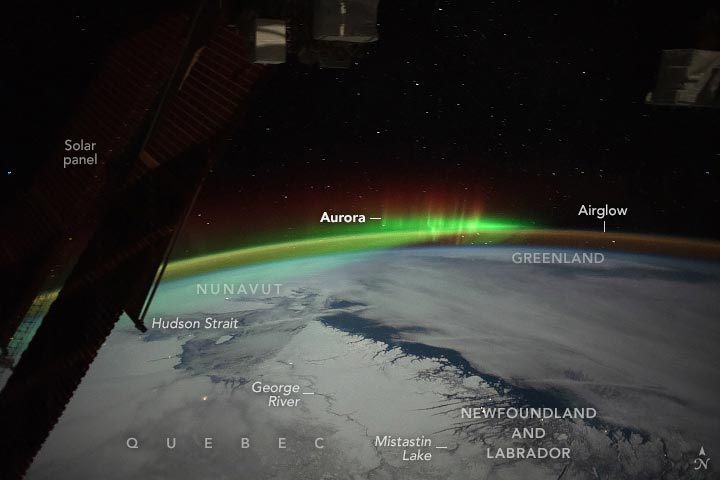
    Eastern Canada Airglow and Aurora Annotated
    Photo of eastern Canada captured on January 1, 2024, by an astronaut aboard the International Space Station.

    Lights, snow, and clouds brighten this wintery scene of Earth’s northern latitudes.

    An astronaut aboard the International Space Station took this photo of eastern Canada. The image was taken near the northernmost limit of the station’s inclined equatorial orbit, which tops out about 52 degrees north of the equator. The perspective includes a view of space station’s solar panels in the foreground, Earth’s horizon about 1,500 kilometers (930 miles) away, and celestial objects far in the distance. Lights, snow, and clouds brighten the winter scene on Earth.

    Two of Canada’s provinces—Quebec, and Newfoundland and Labrador—are pictured along with the territory of Nunavut on the other side of the Hudson Strait. Toward Earth’s limb, the coast of Greenland is faintly visible beneath the clouds. Higher in the atmosphere, airglow hugs the curvature of Earth and the light of the aurora cuts across the scene.

    Thin cloud layers cover the Atlantic Ocean, while clearer skies prevail over the land exposing snow cover, the lights of small settlements, and rivers flowing toward Canada’s coast. Tucked into the frozen scene is Mistastin Lake, which partially fills the depression of an impact crater. The crater serves as a site where astronauts are trained in geology and work on techniques for planetary exploration.

    Astronaut photograph ISS070-E-51709 was acquired on January 1, 2024, with a Nikon D5 digital camera using a focal length of 24 millimeters. It is provided by the ISS Crew Earth Observations Facility and the Earth Science and Remote Sensing Unit, Johnson Space Center. The image was taken by a member of the Expedition 70 crew. The image has been cropped and enhanced to improve contrast, and lens artifacts have been removed. The International Space Station Program supports the laboratory as part of the ISS National Lab to help astronauts take pictures of Earth that will be of the greatest value to scientists and the public, and to make those images freely available on the Internet. Caption by Andrea Wenzel/Jacobs-JETS II Contract at NASA-JSC.

    Never miss a breakthrough: Join the SciTechDaily newsletter.
    Follow us on Google and Google News.

    Astronaut Geography NASA NASA Earth Observatory
    Share. Facebook Twitter Pinterest LinkedIn Email Reddit

    Related Articles

    Paleozoic Plymouths: Plymouth, Massachusetts, and Plymouth, England, Share a Historical Connection Even Older Than the First Thanksgiving

    Cumbre Vieja Lights Up the Night – Astronaut Photo Captures Volcanic Eruption From Space

    Stunning Astronaut Photo From the Space Station Captures Tokyo’s Lights at Night

    NASA Picturing Earth: Behind the Scenes [Video]

    Fisheye Over Sinai: Capturing the Intersection of Two Continents From Space

    Socked in Stratovolcano: Astronaut on ISS Captures Incredible View of Uninhabited Atlasov Island

    Ecologically Important El Bibane Lagoon Photographed by Astronaut Aboard the Space Station

    NASA Picturing Earth: Astronaut Photography In Focus [Video]

    Coloring the Great Salt Lake – Astronaut Takes Beautiful Photograph From Space Station

    Leave A Reply Cancel Reply

    • Facebook
    • Twitter
    • Pinterest
    • YouTube

    Don't Miss a Discovery

    Subscribe for the Latest in Science & Tech!

    Trending News

    Stanford Scientists Reverse Age-Related Memory Loss by Targeting the Gut

    James Webb Uncovers the Atmosphere of a Hellish Lava World 41 Light-Years Away

    Could We Have Been Wrong About Fish Oil and Brain Health? New Study Raises Major Questions

    Scientists Say Intermittent Fasting Could Make Weight Loss Easier

    Scientists Just Found a Smiling “Happy-Face” Spider in the Himalayas

    A Colossal Moon Impact May Have Left Ancient Secrets Near Future Artemis Landing Sites

    Earthquake Researchers Discover Dangerous Stress Levels Building Beneath Southern California

    NASA Satellites Spot Rare Underwater Volcano Eruption That Could Create Earth’s Newest Island

    Follow SciTechDaily
    • Facebook
    • Twitter
    • YouTube
    • Pinterest
    • Newsletter
    • RSS
    SciTech News
    • Biology News
    • Chemistry News
    • Earth News
    • Health News
    • Physics News
    • Science News
    • Space News
    • Technology News
    Recent Posts
    • Could Creatine Boost More Than Muscles? It May Also Help Depression
    • New Calculator Reveals Your Real Risk of Statin Side Effects
    • Scientists Discover a Natural Molecule That Could Help Prevent Vision Loss
    • Scientists Create Plastic That Blocks Heat Without Losing Strength
    • A New Way To See Life’s Hidden Chemistry: $10 Spectrometer Could Turn Wearables Into Personal Health Labs
    Copyright © 1998 - 2026 SciTechDaily. All Rights Reserved.
    • Science News
    • About
    • Contact
    • Editorial Board
    • Privacy Policy
    • Terms of Use

    Type above and press Enter to search. Press Esc to cancel.