
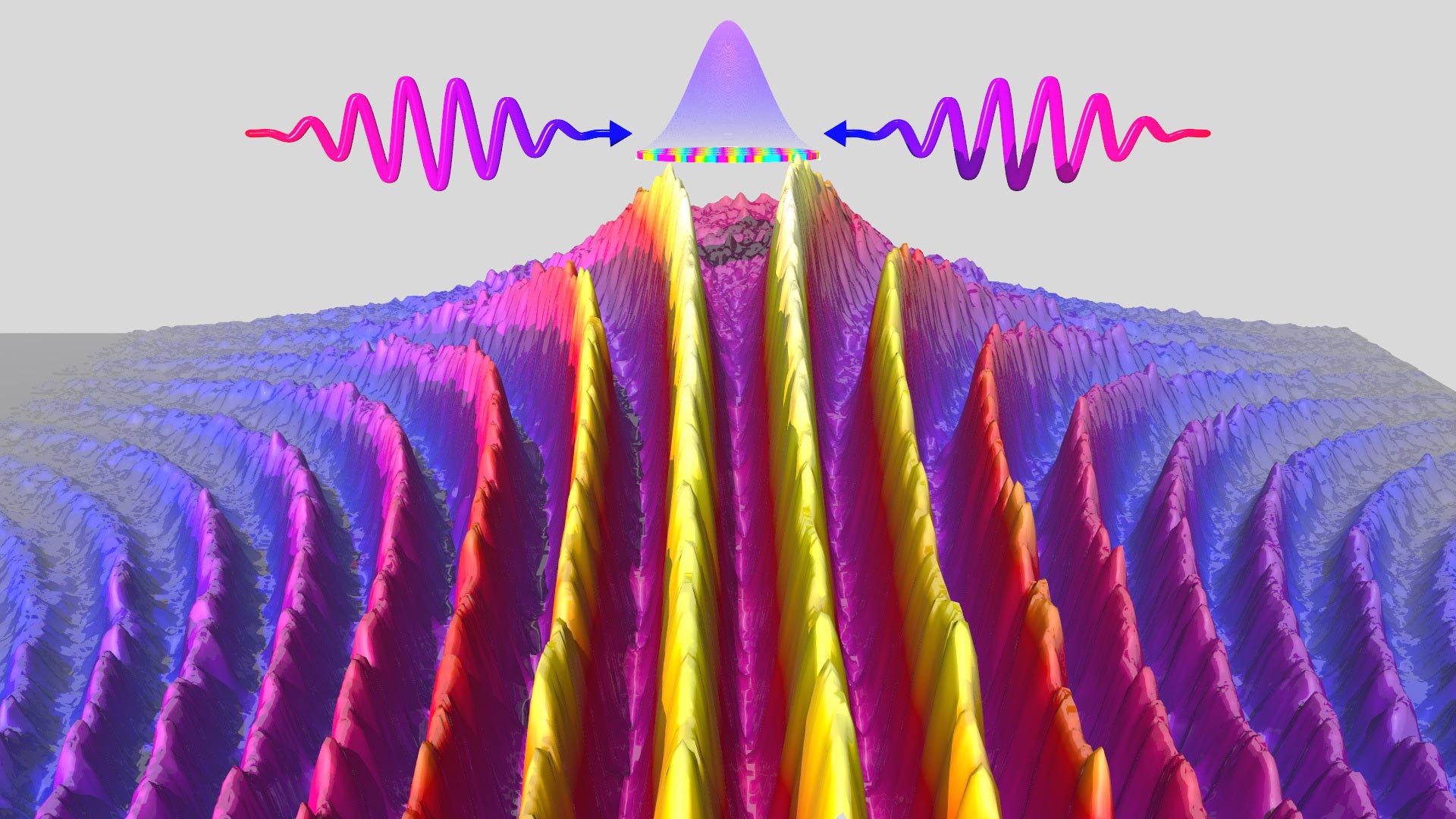
Kapitza-Dirac effect used to show temporal evolution of electron waves.
It was one of the biggest surprises in the history of science: In the early days of quantum physics around 100 years ago, scholars discovered that the particles that make up our matter always behave like waves. Just as light can scatter at a double slit and produce scattering patterns, electrons can also display interference effects. In 1933, the two theorists Piotr Kapitza and Paul Dirac proved that an electron beam is even diffracted from a standing light wave (due to the particles’ properties) and that interference effects as a result of the wave properties are to be expected.
Kapitza-Dirac Effect Visualized
A German-Chinese team led by Professor Reinhard Dörner from Goethe University Frankfurt has succeeded in using this Kapitza-Dirac effect to visualize even the temporal evolution of the electron waves, known as the electrons’ quantum mechanical phase. The researchers have now presented their results in the journal Science.
“It was a former doctoral researcher at our institute, Alexander Hartung, who originally constructed the experimental apparatus,” says Dörner. “After he left, Kang Lin, an Alexander von Humboldt fellow who worked in the Frankfurt team for 4 years, was able to use it to measure the time-dependent Kapitza-Dirac effect.” To do so, it was necessary to further develop the theoretical description, too, as Kapitza and Dirac did not take the temporal evolution of the electron phase specifically into consideration at that time.
Advanced Experimental Techniques
In their experiment, the scientists in Frankfurt first of all fired two ultrashort laser pulses from opposite directions at a xenon gas. At the crossover point, these femtosecond pulses – a femtosecond is a quadrillionth (one millionth of one billionth) of a second – produced an ultrastrong light field for fractions of a second. This tore electrons out of the xenon atoms, i.e. it ionized them. Very shortly afterwards, the physicists fired a second pair of short laser pulses at the electrons released in this way, which also formed a standing wave at the center. These pulses were slightly weaker and did not cause any further ionization. They were, however, now able to interact with the free electrons, which could be observed with the help of a COLTRIMS reaction microscope developed in Frankfurt.
“At the point of interaction, three things can happen,” says Dörner. “Either the electron does not interact with the light – or it is scattered to the left or to the right.” According to the laws of quantum physics, these three possibilities together add up to a certain probability that is reflected in the wave function of the electrons: The cloud-like space in which the electron – with a certain probability – is likely to be, collapses, so to speak, into three-dimensional slices. Here, the temporal evolution of the wave function and its phase is dependent on how much time elapses between ionization and the moment of impact of the second pair of laser pulses.
“This opens up many exciting applications in quantum physics. Hopefully, it will help us to track how electrons transform from quantum particles into completely normal particles within the shortest space of time. We are already planning to use it to find out more about the entanglement between different particles that Einstein called ‘spooky’,” says Dörner. As so often in science, putting long-established theories to the test again and again has been worthwhile here, too.
Reference: “Ultrafast Kapitza-Dirac effect” by Kang Lin, Sebastian Eckart, Hao Liang, Alexander Hartung, Sina Jacob, Qinying Ji, Lothar Ph. H. Schmidt, Markus S. Schöffler, Till Jahnke, Maksim Kunitski and Reinhard Dörner, 28 March 2024, Science.
DOI: 10.1126/science.adn1555
Never miss a breakthrough: Join the SciTechDaily newsletter.
Follow us on Google and Google News.
1 Comment
Perspective, MAN owe man the closest I’ve seen to the alchemy of Elements , could use a little more collaboration with the other physics of mechanics, dynamics and field energy.