
Close Menu
    Facebook X (Twitter) Instagram
    SciTechDaily
    • Biology
    • Chemistry
    • Earth
    • Health
    • Physics
    • Science
    • Space
    • Technology
    Facebook X (Twitter) Pinterest YouTube RSS
    SciTechDaily
    Home»Earth»Ecological Islands: Exploring the Alien Worlds of Venezuela’s Sky-High Tepuis
    Earth

    Ecological Islands: Exploring the Alien Worlds of Venezuela’s Sky-High Tepuis

    By NASA Earth ObservatoryApril 26, 2024No Comments3 Mins Read
    Facebook Twitter Pinterest Telegram LinkedIn WhatsApp Email Reddit
    Share
    Facebook Twitter LinkedIn Pinterest Telegram Email Reddit
    Southeastern Venezuela January 2024 Annotated
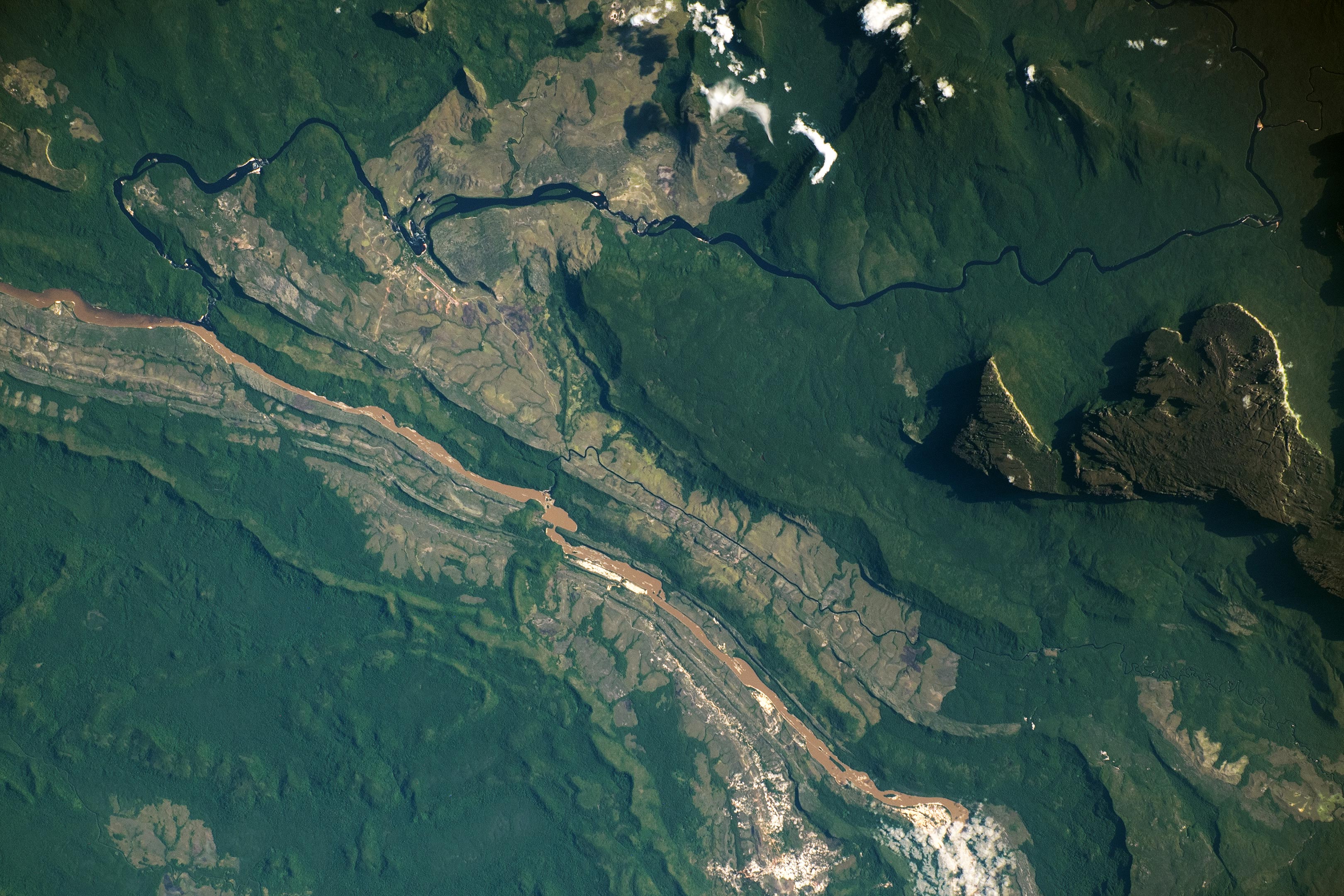
    Photo of the lush, dynamic landscape of southeastern Venezuela captured on January 4, 2024, by an astronaut aboard the International Space Station.

    In the country’s southeast, towering table-top mountains known as tepuis host unique species of flora and fauna.

    This photograph, taken by an astronaut aboard the International Space Station (ISS), captures the lush, dynamic landscape of southeastern Venezuela. The Auyán-tepuí, also called Auyán Massif, towers thousands of feet above the surrounding area, casting shadows along its northern and western edges. The Caroní and Carrao rivers flow west of the massif, converging near Canaima and ultimately joining the Orinoco River.

    Located within the Guiana Highlands, the table-top mountains—known as tepuis—have steep vertical cliffsides that rise up to 3,000 meters (10,000 feet). Auyán-tepuí, one of the larger tepuis, reaches a height of almost 1,524 meters (5,000 feet).

    Due to their height, the summit zones of the tepuis have cooler climates. They are unique ecological islands, hosting species of flora and fauna only found on the flat tops of the range. The tepuis contain some of the oldest geologic formations on Earth, with ages estimated at more than 1.7 billion years old, making them older than the Himalayan and Appalachian mountains combined.

    The small town of Canaima appears as a small, light-toned patch at the top left of the image. Tourists visiting the tepuis access the remote area via this town. To the east of the Caroní River, Canaima National Park preserves waterfalls, rivers, rainforests, and wildlife such as giant otters, jaguars, and exotic birds. Along the Carrao River, waterfalls, such as the Salto el Sapo, are visible near Canaima. The area is a UNESCO world heritage site, known for its geologic history, significant number of endemic species, biodiversity, and natural beauty.

    Astronaut photograph ISS070-E-53609 was acquired on January 4, 2024, with a Nikon D5 digital camera using a focal length of 240 millimeters. It is provided by the ISS Crew Earth Observations Facility and the Earth Science and Remote Sensing Unit, Johnson Space Center. The image was taken by a member of the Expedition 70 crew. The image has been cropped and enhanced to improve contrast, and lens artifacts have been removed. The International Space Station Program supports the laboratory as part of the ISS National Lab to help astronauts take pictures of Earth that will be of the greatest value to scientists and the public, and to make those images freely available on the Internet. Caption by Sara Schmidt, GeoControl Systems, JETS II Contract at NASA-JSC.

    Never miss a breakthrough: Join the SciTechDaily newsletter.
    Follow us on Google and Google News.

    Biodiversity Geography NASA NASA Earth Observatory
    Share. Facebook Twitter Pinterest LinkedIn Email Reddit

    Related Articles

    Wild Islands Hiding Just off California’s Coast – And Why Scientists Call Them ‘Galápagos’

    See the Alarming Before-and-After of Ghana’s Disappearing Forests

    Can Culebra’s Coral Survive the Climate Crisis?

    Sea Ice in Denmark Strait – Drifted More Than 1,000 Km (600 Miles) From the Arctic Ocean

    NASA Advanced Rapid Imaging Satellite Maps Blast Damage: Beirut Explosion Aftermath

    NASA/NOAA Satellites Observe Surprisingly Rapid Increase in Scale and Intensity of Fires in Siberia

    Mars Terraforming: Cultivating Ideas for Mars on Earth

    Meandering Mississippi River: Photo Taken by Astronaut on Space Station Shows Divergence From State Boundaries

    Incredible Rare Peek at Patagonia in Winter

    Leave A Reply Cancel Reply

    • Facebook
    • Twitter
    • Pinterest
    • YouTube

    Don't Miss a Discovery

    Subscribe for the Latest in Science & Tech!

    Trending News

    1.4-Million-Year-Old Footprints Reveal a Giant Human Relative

    Astronomers May Have Found the First Moon Beyond Our Solar System

    Underwater Cameras Expose the Secret Lives of Whale Sharks

    Why Dreaming Leaves the Brain Running Low on Energy

    CERN Experiments Detect Signs of the Universe’s Primordial Matter

    Study Finds a Surprising Link Between Gut Microbes and Aging

    Frequent Cannabis Users Wake Up With More “Stress Hormone”

    Scientists Reveal Hidden DNA Traces in the Shroud of Turin

    Follow SciTechDaily
    • Facebook
    • Twitter
    • YouTube
    • Pinterest
    • Newsletter
    • RSS
    SciTech News
    • Biology News
    • Chemistry News
    • Earth News
    • Health News
    • Physics News
    • Science News
    • Space News
    • Technology News
    Recent Posts
    • Scientists Expose Hidden Quantum Identity of a Superconductor
    • Black Holes May Not Be the Bottomless Pits We Imagined
    • Perseverance Finds Organic Carbon Preserved Just Beneath the Martian Surface
    • Beetroot Juice May Ease Pregnancy’s Strain on the Kidneys
    • Tick Found in Austin Apartment Linked to Rare Relapsing Fever
    Copyright © 1998 - 2026 SciTechDaily. All Rights Reserved.
    • Science News
    • About
    • Contact
    • Editorial Board
    • Privacy Policy
    • Terms of Use

    Type above and press Enter to search. Press Esc to cancel.