
Close Menu
    Facebook X (Twitter) Instagram
    SciTechDaily
    • Biology
    • Chemistry
    • Earth
    • Health
    • Physics
    • Science
    • Space
    • Technology
    Facebook X (Twitter) Pinterest YouTube RSS
    SciTechDaily
    Home»Earth»Wild Islands Hiding Just off California’s Coast – And Why Scientists Call Them ‘Galápagos’
    Earth

    Wild Islands Hiding Just off California’s Coast – And Why Scientists Call Them ‘Galápagos’

    By Kathryn Hansen, NASA Earth ObservatoryApril 23, 2025No Comments5 Mins Read
    Facebook Twitter Pinterest Telegram LinkedIn WhatsApp Email Reddit
    Share
    Facebook Twitter LinkedIn Pinterest Telegram Email Reddit
    Channel Islands 2025 Annotated
    The Channel Islands off the coast of southern California support diverse ecosystems, with some plants and animals found nowhere else on the planet.

    California’s Channel Islands, often called North America’s Galapagos, are home to a stunning array of unique wildlife and landscapes.

    From San Miguel’s windswept pinniped rookeries to Santa Cruz’s colossal sea cave and diverse endemic species, these five protected islands each hold their own secrets. Satellite imagery reveals just how varied and ecologically rich they are, and visitors willing to venture across the Santa Barbara Channel are rewarded with a rare experience of nature’s untouched beauty and ongoing restoration efforts.

    A Biodiversity Hotspot in California’s Backyard

    Just off the coast of Southern California lies the Channel Islands, often called “the Galápagos of North America.” Like the famous islands off Ecuador, this small archipelago supports an impressive variety of plant and animal life in a compact area. Many of these species, such as the island fox, are found nowhere else on Earth.

    Of the eight Channel Islands, five belong to Channel Islands National Park. Four of these islands — San Miguel, Santa Rosa, Santa Cruz, and Anacapa — stretch across about 60 miles (100 kilometers) in the Santa Barbara Channel. The fifth, Santa Barbara Island, is the smallest and sits farther southeast.

    On March 18, 2025, the NOAA-20 satellite’s VIIRS (Visible Infrared Imaging Radiometer Suite) captured a clear view of the park’s five islands from space, as seen above.

    Close Yet Unique: Diverse Island Features

    Although the northern islands are relatively close to each other, each has its own distinct landscape and ecology. These differences are highlighted in additional satellite images taken the same day by the Landsat 8 satellite using its OLI (Operational Land Imager).
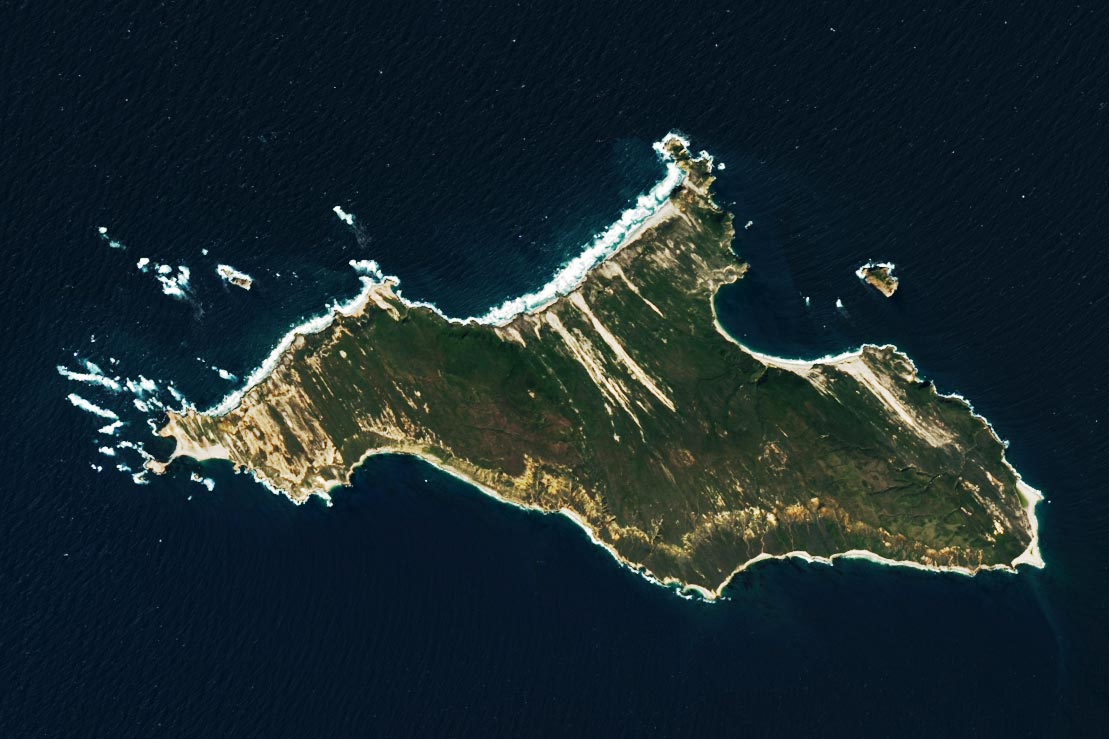
    San Miguel Island 2025 Annotated
    San Miguel is the westernmost of the Channel Islands and one of the most remote. Known for its rugged, windswept landscape, the island is home to one of the largest concentrations of seals and sea lions on the Pacific Coast.

    Windswept Wilderness of San Miguel

    San Miguel Island is the farthest from Ventura, a popular launching spot for trips to the islands and the location of one of the park’s visitor centers. (There is another visitor center on the mainland in Santa Barbara.) The 70-mile (113-kilometer) trip, however, might be worth the effort for some intrepid visitors. Point Bennett on the island’s westernmost side displays a windswept landscape of sand and vegetation. Its beaches are the site of one of the largest rookeries for pinnipeds — mammals such as seals, sea lions, and walruses — on the western coast of North America.
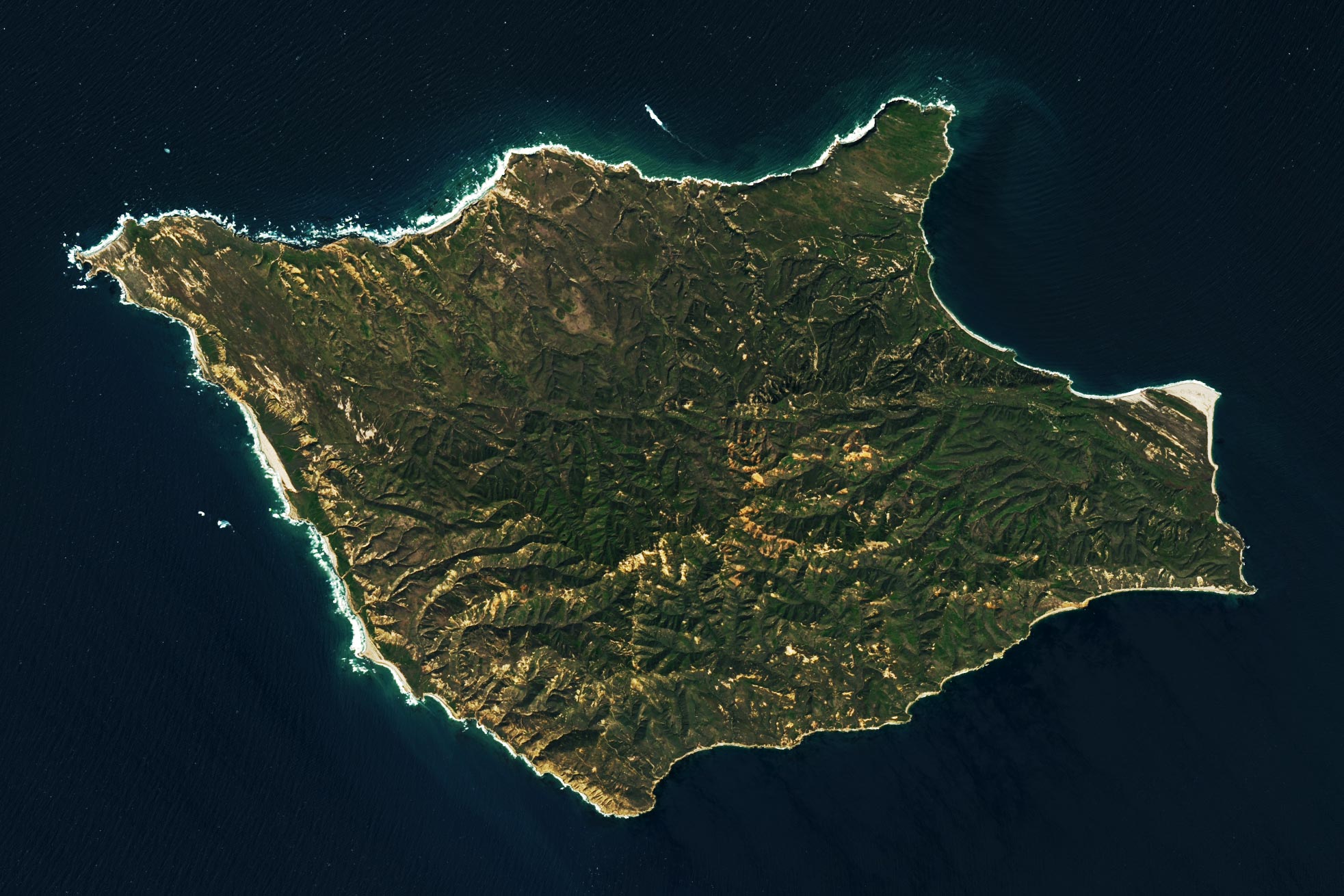
    Santa Rosa Island 2025 Annotated
    Santa Rosa, the second largest island in the park, once had expansive cloud forests fed by dense fog. Though much was lost to overgrazing, restoration efforts are helping native oaks and pines slowly return.

    Santa Rosa’s Vanishing Cloud Forests

    The next island to the east, Santa Rosa, lies 40 miles from Ventura. Cloud forests — groves of tall oaks and pines that harvest water from the area’s heavy fog — were once common on the island. Though fragments remain, such as on the slopes of Black Mountain, most of these forests were decimated by grazing in the 19th and 20th centuries. The national park, U.S. Geological Survey, and partners have been making efforts to restore native vegetation and help the forests begin to recover.

    Santa Cruz Island 2025 Annotated
    The largest of the Channel Islands, Santa Cruz is a hotspot of biodiversity with over 60 species found nowhere else. It’s also home to Diablo Peak and Painted Cave, one of the world’s largest sea caves.

    Santa Cruz: Giant of Biodiversity and Caves

    East of Santa Rosa lies Santa Cruz Island, just 20 miles from Ventura. This island is the park’s largest, spanning 96 square miles, and includes Diablo Peak, the park’s tallest mountain (2,450 feet/750 meters). With all this land area—three times the size of Manhattan—there’s ample space for unique plants and animals. More than 60 species are only found here, the largest number of endemic species of any of the Channel Islands. A major draw to this island, however, lies along its perimeter. At the western end of the island’s north side, visitors will find the entrance to Painted Cave, one of the planet’s largest-known sea caves.

    Anacapa: Smallest Distance, Big Adventure

    Anacapa Island is the closest to the California mainland and just 14 miles (23 kilometers) from Ventura. Still, as with travel to any of the islands, getting there takes some extra planning; visitors can only access the islands via boat. Park concessionaire boats offer transportation to several of the islands year-round and others on a seasonal basis. Once there, visitors usually tour the islands on foot or by kayak.

    NASA Earth Observatory images by Lauren Dauphin, using MODIS data from NASA EOSDIS LANCE and GIBS/Worldview and Landsat data from the U.S. Geological Survey.

    Never miss a breakthrough: Join the SciTechDaily newsletter.
    Follow us on Google and Google News.

    Biodiversity Evolution Geography NASA NASA Earth Observatory
    Share. Facebook Twitter Pinterest LinkedIn Email Reddit

    Related Articles

    See the Alarming Before-and-After of Ghana’s Disappearing Forests

    Can Culebra’s Coral Survive the Climate Crisis?

    Ecological Islands: Exploring the Alien Worlds of Venezuela’s Sky-High Tepuis

    Aldabra Atoll: A Living Archive of Evolution

    Sea Ice in Denmark Strait – Drifted More Than 1,000 Km (600 Miles) From the Arctic Ocean

    NASA/NOAA Satellites Observe Surprisingly Rapid Increase in Scale and Intensity of Fires in Siberia

    Mars Terraforming: Cultivating Ideas for Mars on Earth

    Meandering Mississippi River: Photo Taken by Astronaut on Space Station Shows Divergence From State Boundaries

    Incredible Rare Peek at Patagonia in Winter

    Leave A Reply Cancel Reply

    • Facebook
    • Twitter
    • Pinterest
    • YouTube

    Don't Miss a Discovery

    Subscribe for the Latest in Science & Tech!

    Trending News

    One of the Universe’s Largest Stars May Be Getting Ready To Explode

    Scientists Discover Enzyme That Could Supercharge Ozempic-Like Weight Loss Drugs

    Popular Sweetener Linked to DNA Damage – “It’s Something You Should Not Be Eating”

    Ancient “Rock” Microbes May Reveal How Complex Life Began

    Researchers Capture Quantum Interference in One of Nature’s Rarest Atoms

    “A Plague Is Upon Us”: The Mass Death That Changed an Ancient City Forever

    Scientists Discover Game-Changing New Way To Treat High Cholesterol

    This Small Change to Your Exercise Routine Could Be the Secret to Living Longer

    Follow SciTechDaily
    • Facebook
    • Twitter
    • YouTube
    • Pinterest
    • Newsletter
    • RSS
    SciTech News
    • Biology News
    • Chemistry News
    • Earth News
    • Health News
    • Physics News
    • Science News
    • Space News
    • Technology News
    Recent Posts
    • Scientists Prove There Are Just Six Degrees of Separation in a Social Network
    • Bee Bacteria Could Fix a Major Flaw in Plant-Based Milk
    • Scientists Discover a Surprising Way To Make Bread Healthier and More Nutritious
    • Natural Compounds Boost Bone Implant Success While Killing Bacteria and Cancer Cells
    • After 60 Years, Scientists Uncover Unexpected Brain Effects of Popular Diabetes Drug Metformin
    Copyright © 1998 - 2026 SciTechDaily. All Rights Reserved.
    • Science News
    • About
    • Contact
    • Editorial Board
    • Privacy Policy
    • Terms of Use

    Type above and press Enter to search. Press Esc to cancel.